Filling a large hole in GRP

Gixer

Well-Known Member
Joined
29 Nov 2015
Messages
1,125
Visit site
Hello,

I'm changing the instruments on my British Hunter yacht and on removing the old instruments I've found a large hole cut into the cockpit measuring 95mm x 255mm.
I want to fill this void to give a solid backing for the new instruments and was thinking of using a wooden plug covered with fiberglass matting.

Is there any other material I could use instead of wood to fill the void?

Thanks

Dave
 
Will the new instrument be held in place by this plug? How is access from the backside?
Whatever material you close the hole with, it is important that it is properly locked to the GRP around. Otherwise it will crack and even fall out. If it is easy to work from the backside, I would grind og sand the area around the hole, press a plastic plate against the outside and cover the hole with GRP from the backside. I will not be perfect, but you will avoid destroying gelcoat around the hole on the outside.
If the edges does not look bad, or you trim them to something acceptable, you can glue and/or screw a plate of GRP or quality plywood behind the hole and glue a GRP or any suitable white plastic plate in the hole. The insert is easiest made before you install the backing plate by holding it (if possible) up to the hole from the inside and tracing the shape of the hole. The insert should be cut 4-5mm smaller than the hole to create an opening for caulking.
An average boat yard is likely to have some cutout laying around from installing hatches etc
 
Thank you for the swift reply eilerts.
the new instruments will be partially held in place by the plug, it will be hidden so doesn't need to be really neat. Access to the rear is no problem and hidden by a wooden trim. I didn't even know the hole was there until I removed the wooden panel.
I like the idea of a plate of GRP and didn't think of looking for an offcut from a boat yard. Your instructions are year clear.
Thanks again!
 
The "right" way to do it would be to layup some glass on a flat bed (table top with some plastic sheet over) to make a grp plug, but I'm sure a bit of ply will work just as well, and will be a lot quicker to do.
 
I was just thinking the same thing Bobc....
I do have resin, matting and the rough dimensions as well as a pot of the correct gel coat at home.
Oh, and some time on my hands....

Don't think I've got an excuse......
 
Rogershaw, good thinking. Would I need something to release if from the glass or will in not 'stick'?
 
I guess it will do if you have bottle of ordinary boat wax. It is not so that you are to pry a 40-footer out of the mould. If the only glass available is the glass coffee table, I recommend that you factcheck my advice, say, where flowerpot use to stay.
It is not advisable to use PE film, it will swell and wrinkle.
 
Wax will work as a release agent. Just give the glass a good polish with pledge.

Not a good idea to use any wax polish that is Silicon based ... that was advice from Strand Glass many years ago to me when I was making various items .....

I ended up using natural wax products based on beeswax ..... as the commercial agents based on PVA needed a lot of work ...

If the overall face finish is not an issue ... then you could use packing tape on the glass laid so you have ends to use to remove. Or painters tape.
 
Will do, although actually fitting the home made plug to the boat could be a little while away....

Hang on, when I come to fit to the boat you could help Fantasie 19 as i'm only in Shoreham :)
 
If you want to avoid fiberglassing and messy stuff, Cut youself a piece of suitable material such as coloured perspex or poly sheet that over laps the hole by say 10mm allround , Cut two backing pieces of Rectangular box section (For Rigidity) in stainless or Aluminimium. These box sections again overlap the hole at the back. Use two bolts through the Frontplate and backing backing pieces to squeese up and clamp on the original cockpit material. No messy stuff required except if you wany to run a bead of Sikaflex all round to ensure its water tight. You nedd the 10 mm or so of free space for the overlap overlap inorder for this to work, but it is much easier to und up with a professional looking job,

Kinsale 373
 
Packing tape it is then.

Thanks guys!
Packing tape can work very well, with care you can get a gelcoat finish where you just need to polish out the join marks.
For less critcal stuff, I just use ordinary polythene.
I find it helps to use a mould with a frame around it, so you can ensure the glass goes right to the edges and the thickness doesn't taper away.
Otherwise make the layup well oversize and trim.
 
I'm a great believer in a nice piece of wood ..... I know often you look at such and think - yes - covers a hole ... but done well - it can add character and look nice.

One boat I know - he removed a boarding ladder array from the transom of a Pageant .... leaving unsightly holes that previous guy had made to fit it. Those holes were awful and gelcoat splintered etc. So my pal decided to cover up after roughly filling with a very nice engraved nameboard. He used the holes for fastening the board in place.
 
Hello,

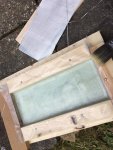
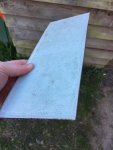
I was asked to post a couple of photo's so I have :)

I used plastic in the end and that seemed to work ok. After sanding its come up pretty smooth but I'm going to try it again and see if I can come up with a better result. What surprised me was how many layers of mat you need to build up the thickness...

Anyway, thanks for the advice and giving me the confidence to give it a go.

IMG_1074.JPGIMG_1076.JPG
 
Top