
Filler

Ubergeekian

Well-Known Member
Joined
23 Jun 2004
Messages
9,904
Location
Me: Castle Douglas, SW Scotland. Boats: Kirkcudbri
www.drmegaphone.com
Following on from my question about GRP sources ...

I want to flatten off the exposed bits of lead on the bottom of my keel before I lay up some glass and kevlar on top of it. Is there any good reason not to use bog standard car body filler - perhaps the stuff with glass fibre in it - to do this? Because it's on a flat surface pointing down I need something very slump-proof in there, and since it will all be encapsulated I can't see the actual material mattering much. Or am I wrong ... ?
 
Car fillergoes soft and falls off under constant wet conditions.
There is a Marine Filler by Isopon. Bit dear.
There is also a fibre glass paste with chop glass strands which comes in tubs which I have used extensively on damaged dinghies Halfords sell it

Also bigger tins at Lincs Paints
Picture-007.gif
 
Last edited:
Following on from my question about GRP sources ...

I want to flatten off the exposed bits of lead on the bottom of my keel before I lay up some glass and kevlar on top of it. Is there any good reason not to use bog standard car body filler - perhaps the stuff with glass fibre in it - to do this? Because it's on a flat surface pointing down I need something very slump-proof in there, and since it will all be encapsulated I can't see the actual material mattering much. Or am I wrong ... ?

I think you are wrong, if you intend to use epoxy for the repair you will have it anyway, it is very easy to make a filler putty to any consistency you need and it should adhere fine, and if you use the right stuff (not microbubbles which are for final fairing and best not used underwater) it will have far better long term adhesion and abrasion resistance. I would mix some epoxy resin and coat the area first, then as it goes off I would lay on the filler. If you are having trouble sourcing small quantities of filler powder I can send you some. Laying epoxy/kevlar over polyester car body filler will be like putting gold leaf on a baked bean tin.
 
Thanks, Quandary. Which filler would you recommend for this - powder of some sort, chopped glass or something else?

I've just had confirmation from the boat yard at Port Bannatyne that they can do the work over the next couple of weeks for what I reckon is only £150 more than the materials would cost me. Since it would also save me two trips (2 hours plus ferry, taking the car across at least once) plus the fun of lying on my back while covered with epoxy, I'm very tempted ...
 
West System Web Page and Help Line

Ubergeekian,
If you go to West System's web page they have lots of information on this type of work, including mixing consistencies for upside down work for their products. I believe they also have information on applying their products to different metals as well.

I cant link to the West page from work so you have to look yourself. They also offer a technical advice help line for their products. I am not sure, but I believe I have read about keel repairs within their literature.

Its tempting at that price to let the yard do the work but if you have the information and tools, confident in your abilities, you should do it. At least you save money and know that its done properly, not that I am insinuating that the yard executes shoddy work.

Hope this helps,

BlowingOldBoots
 
As the boat is made of polyester resin I can't see the problem with using a polyester ready-made filler with chopped strand glass in it.
It is after all, just a filler before the encapsulation.

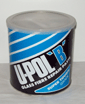
The Upol stuff (£20 for 2 kg) ticks the boxes and is more likely to set properly at this time of year, outdoors, than epoxy.
Upol b 1.85ltr glass fibre repair paste

Description
2k strong polyester bridging compound. Ideal for bridging holes comes complete with hardener and is water resistant when cured .
 
The best one for general purpose bonding, filleting etc. is colloidal silica sold by West as 406 (less than £10 for about 2l. tub) but also available loose in fibreglass suppliers. I think the stuff sold as 'glue powder' is the same. It is a bit more work to smooth for fairing off than microbubbles or 'lightweight filler powder' but for a small job probably not worth buying two kinds. It makes a really sticky paste which should not slump. If you use the really lightweight fillers they need to be mixed away from wind because if you even breath on them they go everywhere.
I think the boatyard offer is fair, you can not be sure you will get the job all done in one visit and you are going to have to pick your weather, easier for some one on site to do that, different for me I am looking for projects to keep me amused.

I think Lakeys suggestion of a quick fix with exothermic polyester is fine and should last ok, easier to do on a coolish day and cheap. But if you are serious about a sophisticated job with kevlar laminates etc. (which might be overkill) its worth using epoxy for the bonding properties.
 
Last edited:
As far as I'm aware, absolutely nothing will stick to lead for any length of time, so you may as well use the cheapest, nastiest "porridge" available. As Lakey says, the rest of the boat is polyester. I assume that as you're only using it for fairing, it's not going to be keeping the water out, so it doesn't matter. If you use the "hairy" stuff, it will stick better upside-down. I'd definitely use epoxy for the outer layers. It seems to stick better to old polyester than new polyester does and, of course, it's more waterproof. I think it's very important not to have any glass (or kevlar) fibres near the surface of the laminate so that water can't "wick" up them in the long term.
 
Assuming you are just fairing the bottom of your lead keel I can see little point in using kevlar as part of the laminate.

Just use West System epoxy with 406 Colloidal Silica as a filler and thickening agent. Mix the epoxy first then add the 406 Colloidal Silica until you get something like thick peanut butter.

If you are working on a hot day you will need 209 super slow hardner IMHO.

To make life easier although the above will stick to overhead surfaces I would get some non creased HD polythene sheet and prepare a piece to cover the work area and tape to the keel. Apply the filler then the polythene sheet and smooth the stuff in esp. around the edges. Saves a lot of sanding.

BTW UNDER NO CIRCUMSTANCES USE CAR BODY FILLER UNDERWATER. IT ABSORBS WATER LIKE A SPONGE. OSMOSIS WILL FOLLOW.
 
Assuming you are just fairing the bottom of your lead keel I can see little point in using kevlar as part of the laminate.

It's an encapsulated long keel, and the GRP has worn through in several places as a result of the boat spending many years on drying moorings on the East Coast and Milford Haven. The plan is to smooth the bottom with filler then rebuild the laminate on top. I fancy having some Kevlar there as a substitute for a shoe, to provide better protection for impacts (:eek:) and drying out in the future.

BTW UNDER NO CIRCUMSTANCES USE CAR BODY FILLER UNDERWATER. IT ABSORBS WATER LIKE A SPONGE. OSMOSIS WILL FOLLOW.

Is that a problem when it's completely encapsulated? After all, plenty of boats use balsa wood below the waterline ...
 
Is that a problem when it's completely encapsulated? After all, plenty of boats use balsa wood below the waterline ...

Yes it is a problem. It will cause osmotic blistering. Using polyester based car body filler instead of epoxy / silica is spoiling the ship for a few pennies!

Re the use of kevlar to protect the base of the keel from repeated groundings. I now see why you might want to use kevlar based on its use in flak jackets. Using it would be better than just a layer of epoxy but I am not sure if it would be any better than regular glass cloth in this application. I am not sure that kevlar is good in resisting abrasion, I think not.

Perhaps some will chime in with a better solution to protecting your keel base.
 
Yes it is a problem. It will cause osmotic blistering. Using polyester based car body filler instead of epoxy / silica is spoiling the ship for a few pennies!

But how is the water going to get there? It will/would be completely surround by lead and GRP. I really can't see why it would be worse than balsa wood.

Re the use of kevlar to protect the base of the keel from repeated groundings. I now see why you might want to use kevlar based on its use in flak jackets. Using it would be better than just a layer of epoxy but I am not sure if it would be any better than regular glass cloth in this application. I am not sure that kevlar is good in resisting abrasion, I think not.

It's not so much abrasion resistance as puncture resistance - when three tons of boat starts coming down on two or three wee hard stones. I might yet stick a stainless shoe along the bottom, but since it's going to be resined (is that a word?) anyway then I don't think a layer or two of Kevlar will harm.

I've decided to pass this one on, by the way, so have asked the boatyard to do it. Much as I like lying on my back doing composite repairs, there'e enough other stuff to be going on with and it seems like a good way to spend a bit of a tax refund I had last week!
 
GRP is quite permeable to water.

How do balsa cored hulls cope, then?

I'll be chatting to the boatyard today about the repair - with a bit of luck they may have time to grind back the old GRP so I'll have a chance to see exactly what's needed - and I'll certainly talk to them about the filler they'll be using.
 
How do balsa cored hulls cope, then?

.

They don't. They get soggy and rot. Which is why balsa cored laminates are found above the waterline. I am not saying that no boats were built with balsa cored hulls below the waterline but it causes problems.

I believe that PVC foam used to be the material used for cored hulls below the waterline where longevity was the goal.

Where racing hulls are concerned the ideal might be found in a hull that would last for the racing 'season' and self destruct on the next.

Colin Chapman of Lotus fame said some similar

" Any car which holds together for a whole race is too heavy. "
 
Colin Chapman of Lotus fame said some similar

" Any car which holds together for a whole race is too heavy. "

"Simplify and add lightness."

Thanks for the advice. Had a look at the keel today with the Boatyard Chappie. The damage is much less than I thought - only three or four feet will need done. He's going to cut the old stuff away on Monday and assess the situation - it may take some combination of bagging, heat and time to dry her out, but he's hopeful that it shouldn't take long.
 
Top