
Filler/GRP repair on stem - beginner without a clue

Reptile Smile

Well-Known Member
Joined
8 Feb 2012
Messages
539
Location
Bristol
Visit site
Hi all,

As part of my bringing my boat back on the canal system, I've managed a really heavy collision which has resulted in a big ding in my bow/stem. I'll post a picture of this below so that you can see what I mean. It's crunched through everything so that I can fibres, wood - everything. Felt a bit sick when I did it, but actually, it's probably not the end of the world. It's surrounded by a bunch of small dings, and I presume what I need to do is filler it. I also presume that this will mean sanding back the house paint around it too?

What I'm not sure about is whether this then needs a layer of GRP mat/resin over the top of it, which I presume would cause a bit of a 'lip' where it finishes over the regular top sides? Or should I just apply filler, and then sand and paint? Any thoughts great fully received. If, also, you feel the urge to make any pithy "look where you're going" type comments, I more than fully deserve them...
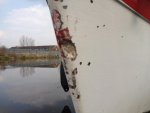
 
I would remove any loose material, wash the area down with acetone, then make up some thickened epoxy and bung it in. Use wide parcel tape or similar as a dam to retain it until cured. Not a big job.
 
Doesn't look very serious to me. Like Kelpie says, wash it, sand it smooth and fair the edges then fill the dent with some thickened epoxy. Finish with a few layers of mat over the top and a sanding coat. A power sander makes things easier and plenty of solvent makes it nicer. Googling glassfibre repairs will give you all the info you need.
 
Don't wash with acetone if then using epoxy. There's a real risk of solvent-entrapment which will mess up the bond.
Looking at the photo I doubt there's a significant loss of structural strength.
Epoxy with microfibres is the preferred filler for the deeper parts of the repair, finishing with epoxy and microballons which are much easier to sand. Or finish with a proprietory epoxy filler. Grind away all damaged material, fill, fair and paint. If you feather the edges when grinding, you should be able to avoid any lip.

Another suggestion (particularly if you plan on banging into anything else, but stems often get clattered on the best-run boats): consider a merely structural rather than full cosmetic repair, then capping with a protective stem cover in stainless steel. Plenty of boats have them: look around and you'll get the idea.
 
The link below takes you to West Epoxy 'How To Manuals'. They are free to download. The repair methods they discuss are universally applicable to other manufacturers epoxy glue, fibreglass products.

Http://www.westsystem.com/ss/use-guides/ Scroll down and download their 002-550 Fiberglass Boat Repair & Maintenance. Section 2.0 should help.

All the best,

BlowingOldBoots
 
How long ago did it happen? Fibreglass has an irritating habit of forming stress cracks radiating out from the original point of impact for a few months after the event. The paint might be hiding the true extent of the damage. If it was me, I'd start by sanding back the surrounding paint, maybe up to 6" back from the visible damage and look for fine hairline cracks. If there are, they'll need grinding out and filling.

That aside, I'd grind the damaged area and wash with acetone, then mix up some resin and catalyse it. Paint on to the surface you've just ground and then mix up some more resin with some loose chopped strands in it like these :

http://www.ebay.co.uk/itm/Chopped-S...cd79cd&pid=100204&rk=2&rkt=28&sd=230967943735

into a thick hairy paste and fill to just below the visible surface, trying hard to get as much air out as possible, and applying while the first coat of resin is still tacky. Leave to cure, and then take any high spots off so that it's all just fractionally below the surface that you want to end up with. Fill any low spots with polyester body filler and paint white flowcoat over it until you're just proud of the desired surface and flat back with progresively finer grades of paper, then touch up the paint.
 
How long ago did it happen? Fibreglass has an irritating habit of forming stress cracks radiating out from the original point of impact for a few months after the event. The paint might be hiding the true extent of the damage. If it was me, I'd start by sanding back the surrounding paint, maybe up to 6" back from the visible damage and look for fine hairline cracks. If there are, they'll need grinding out and filling.

That aside, I'd grind the damaged area and wash with acetone, then mix up some resin and catalyse it. Paint on to the surface you've just ground and then mix up some more resin with some loose chopped strands in it like these :

http://www.ebay.co.uk/itm/Chopped-S...cd79cd&pid=100204&rk=2&rkt=28&sd=230967943735

into a thick hairy paste and fill to just below the visible surface, trying hard to get as much air out as possible, and applying while the first coat of resin is still tacky. Leave to cure, and then take any high spots off so that it's all just fractionally below the surface that you want to end up with. Fill any low spots with polyester body filler and paint white flowcoat over it until you're just proud of the desired surface and flat back with progresively finer grades of paper, then touch up the paint.

I second that.Use a mix of shredded chopped strand mat and polyester resin.Grind around a bit.For filler there's no need to buy body filler,just mix some talcum powder with resin until you get the righ consistency.
 
If you have no experience in working with fiberglass, and at the risk of upsetting the professional amateurs who give excellent advice on these pages, I would (in this instance) repair the damage the Motor Trade (Bodyshop) way.
From a Car Accessory Shop buy some of the Fibreglass Filler which has chopped strands of fibreglass in it.
Drill some holes in the centre of the dent and screw in some large self tapping screws. You can also drill smaller holes (at an angle)
Apply the Chopped strand filler, this will go behind the screw heads making sure that it wont fall out (or move)
After sanding down apply some of the white Gel Coat filler which Chandlers sell in small tubes.
 
Don't worry, it's minimal. Even if you've got through the hull, a purist would grind back inside and out to feather the edges, then lay new mat from both sides, then fill and fair. If you lay new mat with polyester resin don't use epoxy filler, make your filler paste with polyester lay up resin and micro balloons. Otherwise just fill and fair with epoxy, if you grind back any soft material and paint I think you will find the shape will hold it just fine. As above , car bridging filler is effective, and you will paint over so no colour match problems. The advice I had is that epoxy will not bond to new polyester, less than two weeks old.
 

Other threads that may be of interest

Top