
You are using an out of date browser. It may not display this or other websites correctly.
You should upgrade or use an alternative browser.
You should upgrade or use an alternative browser.
feather or fold
- Thread starter PabloPicasso
- Start date

PabloPicasso
Well-Known Member
I'm sorry I asked

snooks
Well-Known Member
So how do you moor to French pontoons if there's nothing to moor to ?
Boo2
There is usually something to tie to in France

Go in at a sensible speed, as slow as I can, but instead of a loop I use a single slack line around the midships cleat out over the toerail and back to the primary, crew steps off with the end and puts the slack line through the ring or D hoop at the end and holds it tight, if enough time takes a turn. I take the slack in on the winch and reduce the revs. Once in, the line is made off with a RTATHH, I ease the line until we're lined up in the berth.
Crew then takes the bow line, makes it fast, walks back and takes the stern line. Springs added engine in neutral, kettle on, tidy boat up have a cuppa, or a beer
This is usually how I berth anywhere I can, as a turn can easily be taken around a cleat and held.
Last edited:
Ridax
Well-Known Member
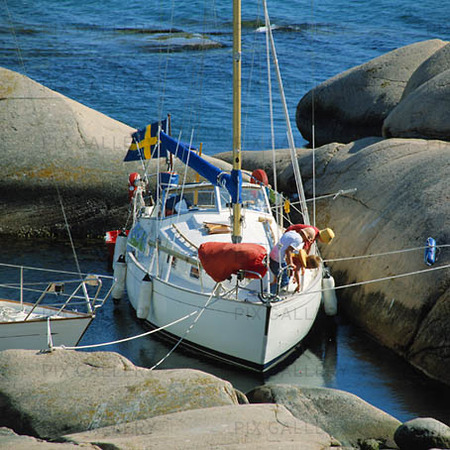
What will you do here? Make a warp to the neighbour boat and use it to stop your heavy displacement boat instead of engaging reverse? You won't be very popular in that harbour after that. And what do you do if no suitable neighbour there to take advantage of? Alongside is not an option as there are lines going straight out in the water, anchoring is forbidden, and the lines that are going straight out from the pontoon is too deep to catch 10m from the pontoon.
You seem to be so afraid of using reverse (which could be understandable if you have a folder ) that I think your gesrbox will rust and refuse to engage reverse just because of that.
You seem to be so afraid of using reverse (which could be understandable if you have a folder
) that I think your gesrbox will rust and refuse to engage reverse just because of that.
Tranona
Well-Known Member
This is just a pointless argument. The majority of berths in the UK (and Northern France) are either finger berths or alongside pontoons, and a warping method is usually suitable. This is not the case in other parts of the world as the last post shows, so different methods are called for. Even in the Med where mooring is mostly end on to a quay you can berth using minimal engine power for stopping by controlling speed with the anchor.
So, if you are in a situation where you cannot easily use warps to fixed points, rely on the engine (and possibly bow thruster). If warps work for you, use them.
What could be a simpler decision rule?
So, if you are in a situation where you cannot easily use warps to fixed points, rely on the engine (and possibly bow thruster). If warps work for you, use them.
What could be a simpler decision rule?
snooks
Well-Known Member
What will you do here? Make a warp to the neighbour boat and use it to stop your heavy displacement boat instead of engaging reverse? You won't be very popular in that harbour after that. And what do you do if no suitable neighbour there to take advantage of? Alongside is not an option as there are lines going straight out in the water, anchoring is forbidden, and the lines that are going straight out from the pontoon is too deep to catch 10m from the pontoon.
You seem to be so afraid of using reverse (which could be understandable if you have a folder
Read my posts and quote where I have said I never ever use reverse.
You seem to be a little confused thinking I'm saying something I'm not.
If anyone has found a will to live lying around, it's mine, I lost it a while ago!
Last edited:

Sans Bateau
Well-Known Member
What will you do here? Make a warp to the neighbour boat and use it to stop your heavy displacement boat instead of engaging reverse?
I know you make post that in jest, but we did exactly that, OK, we are not a heavy displacement I grant you. We arrived at the waiting pontoon in St Peter Port with an intermittent engine problem. We thought it was sorted so when it was our turn to enter Victoria marina we did happy we were going to be able to berth without trouble. Just as we crossed the sill the engine died, again, we had some way on and called out in desperation to the berthing master. He just directed us to a boat on our Stbd side that was on the hammer head, he wanted us to berth alongside, but offered no assistance. Calling out to the crew of our new host they made ready to take our warps, which they did without any drama. I'm glad they did as the next stop was Mark & Spenser's!
we sorted the engine, properly next day and the cruise continued without further drama.
Ridax
Well-Known Member
I said there are situations when good stopping performance could be good. You said (my bolds):Read my posts and quote where I have said I never ever use reverse.
To which I answered warps around what and pointed out that there are a lot of situations there you don't have anything to warp anything around, in which you replied with a picture of a warp around a cleat.Then you use warps to slow you down, don't rely on the engine.
I did once, and the walkway pontoon still has antifoul from the forefoot (but it's now hidden under one of those pontoon fenders
It's a mistake you only make once.
You just look back to the message quoted above and you will see... I also pointed out that HERE cleats at suitable positions aren't that common. But you had travelled far and wide hinting that your way works most places.
Last edited:
Ridax
Well-Known Member
If you are having an engine problem of course that would be a proper way to handle it, but if you make it as your standard way of approaching a quay just because you don't want to engage reverse on your engine, it is quite impolite. It is just what I have said earlier. Using the engine to stop is my first choice and using ropes and such is my backup plan, because here there are usually nothing except other boats to attach the ropes to. Sometimes there is a buoy you can attach a rope to, but I am not relying on getting a rope through it when approaching.I know you make post that in jest, but we did exactly that, OK, we are not a heavy displacement I grant you.
Last edited:
Sans Bateau
Well-Known Member
Yes I do agree, I would not like to make a habit of that procedure. It does make you appreciate the value of a reliable engine and prop.