feather or fold

which is quite useful if the previous owner got his calculatins wrong, where as if it is a folder it is yet more expense.

Surely this is about buying a new prop, and if you give the correct details to the prop manufacturer, they will supply the correct prop....So it would be if you got the calculations wrong :D

Flexofold are good, they give you all the measurements of the props so it's possible to make a template to see what size the biggest prop I could fit was.

16clearance.jpg


Knowing I could get a 16" in there if I had to, I changed the gearbox on my new engine to get the biggest prop I could for it, which happened in the end to be a 15" in the end
 
I've had a quick skim over this thread so apologies if I missed anyone else saying this but ... a well designed folder should be more efficient than a feathering prop. A blade should be twisted, tip to root, so that the apparent angle of attack is constant, taking into account the difference in tangential velocities for each radial section. Feathering blades have to be flat, folders don't, so they're always a compromise in this respect.

This matters. Any sacrifice of efficiency simply goes into unseen churning of water, burning of pound notes and loss of range between fuelling stops.

Not that I'm saying that all folding props are efficient. My Radice is adequate, excellent for sailing and racing, but with its fairly ugly profile is obviously going to be inefficient motoring. The fixed three blade it replaced consumed about 70% as much fuel, maybe even less. Having said that, it will drive the boat at near hull speed - I've a big engine and power to spare/waste. Stopping is absolutely not a problem. And it backs up in a straight line straight away, something the three blade would never do.

However, the comparitive tests in YM(?) a couple of years ago produced hugely impressive results for the flexofold which really does look the part. I've recently re-engined and, having an extra 20% of torque to play with, I intend to use this an excuse to get a new flexofold and go up a couple of inches in pitch. Given the apparent performance and efficiency of the flexofold, I see no point in having either fixed or feathering props on a sailing boat.

The YM test was a bit limited and contained a number of errors. If you do a bit of searching you should find a forumite offering a few days ago a copy of a French Voile test which was much more comprehensive. You may already have made the best choice for you, but it is always worthwhile to have a look at all available useful data.

Nothing (other than Allah, but let's not go there) is perfect, and I think the main underlying concern about folders is "what happens if it doesn't unfold - for whatever reason."
 
You just don't approach places that don't have a cleat at a suitable position for you?

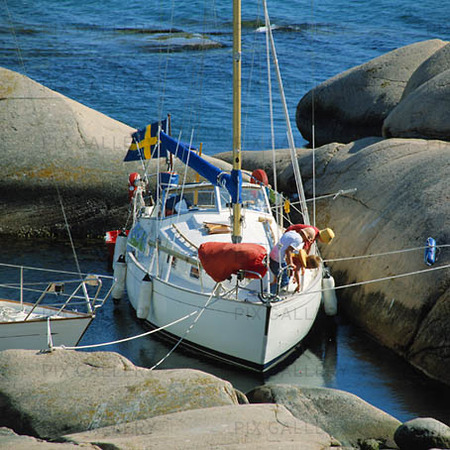
PIX-RS5HSC.jpg

No, I go there, I just don't charge in somewhere at 6 knots and cross my fingers and hope my engine will stop me in time :)

If the wind is strong I could motor in against a stern anchor, or reverse against the bow anchor.

Neither require a lot of astern engine power or speed
 
No, I go there, I just don't charge in somewhere at 6 knots and cross my fingers and hope my engine will stop me in time :)

If the wind is strong I could motor in against a stern anchor, or reverse against the bow anchor.
Who says 6 knots? It could be just 2 knots, even 1 knot, but you will still need stopping power. It is just plain stupid to try to argument that there are never situations there you need stopping power and try to claim that you can always find a cleat to use and in the rare cases you don't find it you just throw in an anchor this side or that side. It doesn't work like that, you throw the anchor there it is suitable for anchoring purposes and you can't throw the anchor when doing a narrow passage, who would pick it up, or would you do it on the way back?
 
The point is the two most important functions of a prop are, how does it perform in ahead and how tidily does it tuck itself away to avoid nasty things floating in the sea (ropes etc). Any prop will drive the boat in reverse it should not be the most important feature, because it is used so little. even if the prop is a little slow in reversing/slowing the boat (measured against what?) you get to know, to learn its potential and its limitations.
 
I think the most important features are up to each user snd not up to you to decide. I have a long keeler there the prop is pretty well protected and anyways we don't have that much much debris floating around here.

Almost any prop will drive the boat forward so that is not much of a deciding factor either.

I am reversing into a finger berth at my home marina and for me the reversing characteristics of the prop is important. High reversing power and a predictable/consistent slow reversing are important factors for me.

But you seem to claim you know better what is important for me?
 
I too have an opinion if you dont mind.:p
Yes, but you are not expressing an opinion. You are claiming it as a fact, at least that is how you express it.

The point is the two most important functions of a prop are, how does it perform in ahead and how tidily does it tuck itself away to avoid nasty things floating in the sea (ropes etc). Any prop will drive the boat in reverse it should not be the most important feature, because it is used so little.

To express your opinion you should have said "To me, the two most important functions of a prop are....". But this is not how you express it. You say "THE POINT IS the two most important functions of a prop are"...

That is not expressing your opinion, but rather to try to upgrade your opinion as a fact and impose it onto others.
 
I find the Flex-o-fold 2 blade very efficcient ahead and good enough astern.


For me the main considerations are

Enough bite for close quarters manouvering with a heavy boat.
Efficient when motoring.
Sailing efficiency. Folder has to be the best here.
Sailing without picking up lobster pots. The folder is very good for this.
 
It is just plain stupid to try to argument that there are never situations there you need stopping power and try to claim that you can always find a cleat to use and in the rare cases you don't find it you just throw in an anchor this side or that side.

It's plain stupid to argue that the surface of the earth is hotter that the surface of the sun, but nobody is arguing that.:D

Likewise nobody is arguing that there are never situations you need stopping power and no one was trying to claim that you can always find a cleat to use, and in the rare cases you don't find it you can just throw in an anchor over the side.

You said "good forward speed" I don't consider 2 knots or even 1 knot to be "good forward speed" that's only moving forward, of course if you would like to be pedant, 1-2 knots is great forward speed for a limpet, but for a yacht, it would be somewhat disappointing:)

So, if you were to go into the anchorage pictured, on a breezy day using "good forward speed" and your engine failed to go into reverse (stuck in gear, prop comes off, stalls, gear cable brakes, fouled feathering propeller etc etc) how would you stop?:)
 
Likewise nobody is arguing that there are never situations you need stopping power and no one was trying to claim that you can always find a cleat to use, and in the rare cases you don't find it you can just throw in an anchor over the side.
So then we agree that good stopping/reversing performance can be a benefit? And then we agree that there are situations there you rely on the engine doing a stopping action? So why are you (or anyone else) argueing that you should NEVER rely on the engine for stopping? I see no reason at all for not relying on the engine being able to stop the boat (at least not if I don't have a folding prop :D ) and the only precausion I have to take is to make sure that any failure to stop does not cause any disaster. But I don't have a Bav, so bumping into the quay with some speed left wouldn't leave me with a hole.

You said "good forward speed" I don't consider 2 knots or even 1 knot to be "good forward speed" that's only moving forward, of course if you would like to be pedant, 1-2 knots is great forward speed for a limpet, but for a yacht, it would be somewhat disappointing:)
Everything is relative and I see 2 knots in a tight natural harbour manouver as in the picture where I mentioned 2 knots as a good speed, while you exaggerated and mentioned 6 knots. If you forgot, let me refresh your memory with the picture in question where you said 6 knots and I said 2 knots.

PIX-RS5HSC.jpg


So, if you were to go into the anchorage pictured, on a breezy day using "good forward speed" and your engine failed to go into reverse (stuck in gear, prop comes off, stalls, gear cable brakes, fouled feathering propeller etc etc) how would you stop?:)
If any of those things happen (which happens so rarely, at least for me, actually never happened with the current setup), then a bump against the cliffs is something I am prepared to take. My boat can handle it and as long as nothing serious happens that's OK for such an extraordinary situation such as a prop that comes off just as you are going to engage the reverse.

You can't have a backup for everything. You can always come up with a scenario that will leave you in a difficult situation. It is all about a calculation of how probable the situation is and how serious the consequences are.

What will you do yourself if you are out sailing and a big wave and heave wind makes your mast come down and the batteries give up so you can't start the engine?
 
But I don't have a Bav, so bumping into the quay with some speed left wouldn't leave me with a hole.

Unlikely to get a "hole" in a Bav. The front end is Kevlar reinforced and the back end absorbs bumps very well as you can see on a daily basis on any stone quayside in the Eastern Med.
 
Unlikely to get a "hole" in a Bav. The front end is Kevlar reinforced and the back end absorbs bumps very well as you can see on a daily basis on any stone quayside in the Eastern Med.
So good... So then even those with Bavs can rely on the reverse and not be so over worried about bumping into the quay in those rare cases where the reverse refuse to engage. I thought Snooks had a Bav and that was why he was so concerned about bumping into the quay, but maybe he has something less robust than Bavs.
 
Last edited:
You really should have read my previous posts in this thread :rolleyes:
Which post more exactly? The one that said it is not your boat? Did it say you don't have a Bav or are you referring to the post where you mentioned when you bumped into the pontoon? As everything went well when you bumped into the pontoon, I assumed that you have changed boat since that time, as you now are so worried about bumping into anything. Otherwise, your story about bumping into the pontoon would just prove that you don't have to be so over anxious about what would happen in the rare case that the prop fell off just as I am trying to reverse. No one died when you misjudged your reversing capabilities and the only consequence, according to your story, was some paint on the pontoon, which is now even invisible. :D
 
Snooks does not have a Bavaria - you only have to look at his profile to see that, or better still read his latest article in PBO (which he is probably too modest to mention).

On the other hand I do have a Bavaria, with a Flexofold and it does all the motory bits very well. I also like Snooks take advantage of using warps where possible, particularly into my home berth where they are all set up ready to use when I am single handed. And it survived 7 years chartering in the Med without getting holes in it, no doubt helped by good stopping power using the engine.
 
I am totally confused about the argument of using a warp to slow down and stop instead of going in reverse with the engine. My feeling is that Snooks ended up in a John Cleese Fawlty Tower situation where he is continuing to dig a deeper hole defending his original comment.

Sure you can configure your own mooring and know your own marina so that you come in to your mooring at virtually no speed and throw a warp over a cleat you know is there, but what about all other new situations, new marinas, another boat just leaving as you are coming in, natural harbours, sudden and unforeseen gust of wind etc., etc.

There is absolutely no way I would rely on throwing a warp to make the boat stop each time I moor up. Your speed can be affected by currents, wind, unforeseen situations, and as with med-mooring keeping sufficient speed when backing up to have steerage. Yes I too try to use currents, wind and prop walk to my advantage but it is not always possible.

Furthermore throwing a warp would often require precision aim, or someone on land to help, and if your speed is more than a knot or so (due to wind, current or whatever) you will also end up with a jerky stop putting extra strain on your own cleats.

To say that the reverse performance of a given propeller is of no importance because you should not rely on the prop to break or slow down the boat and instead always use warps to stop your boat is in my opinion absurd. Sorry but I just don't see any argument here.

Cheers,
Per
 
There are many situations where you can use the warp from boat midship cleat to end cleat on a pontoon, and if you can it is a very effective way of stopping the boat and holding it in before stepping off to secure the main warps. Regularly illustrated in the "How to moor" features in the mags.

Problems arise when the finger is short relative to the boat and particularly if the cleat is not a cleat but a ring as you have to then use some sort of device such as a Moorfast to attach the warp. Also not always suitable in some tide and wind conditions, or if you do not have time to prepare in advance.

However, if successful it does reduce stress on everybody and removes the need for noisy reverse. You just have to use your judgement to decide which method is safest and most appropriate for the situation.
 
All I, as skipper, have to do is get close enough to the end of the pontoon (where you'll usually find a cleat -unless you're in a French marina with either nothing or a ring at the end)
So how do you moor to French pontoons if there's nothing to moor to ?

Boo2
 
Top