FAME Diesel and small fuel lines?

Ian_Edwards

Well-Known Member
Joined
9 Feb 2002
Messages
2,222
Location
Aberdeen Scotland
Visit site
The story so far:
Eberspacher Hydronic 10, installed in 2007, work flawlessly until last year.
Last year it would fire up first time, but stop after 20 to 25 mins with an error code 53 or 54, did not reach the required temperature in one of the power modes.
I replaced all three sensors, new glow plug, stripped and cleaned the combustion chamber and the fuel pump filter.
None of these changes made any difference, it still stopped after 20 to 25 mins.
In desperation I bought a new Hydronic 10 mk2 and installed it last week.
It started first time, but stopped after 25 minutes with the same code.
So it has to be an installation problem. It's a completely new system apart from the fuel line and the exhaust.
I can't see anything wrong with the exhaust, when it's running there's a strong flow of exhaust gases through the skin fitting.
The Hydronic 10 is mounted below the the level of the diesel in the tank, which is almost full.

I'm wondering if the fuel line is partially clogged with wax from the FAME diesel I'm using.
Because of Covid-19 restrictions, the boat was only used for about 3months in both 2020 and 2021, so diesel has been sitting in a narrow fuel line, and when the heater is running it is only using about 1L per hour, or round about 0.3cc per second.

Stripping out the fuel line to replace it would be a significant task, the line is hidden behind panels and furniture.

Is waxing up a fuel line a real possibility?
And
Is there anything I could flush the fuel line with the dissolve the wax?
I know the methanol is injected into pipelines to prevent wax and hydrate formation in the Oil and Gas industry, and I was wonder if petrol or Isopropanol, would work?
 
I very much doubt waxing is a problem. I had a similar problem with a webasto which turned out to be water contamination. It was easy to spot with red diesel but may not be so obvious with undyed FAME.
Is it possible that due to lack of use you have had a build up of water in tank. Mine was over a short period with a badly sealed deck filler.
I ended up removing fuel pipe at heater and pumping out a litre of water before clean diesel came through.
I also removed fuel feed to engine and found nearly another litre of water that luckily didn't get circulated into injectors.
 
The reason for the small diameter and maximum permitted length of fuel line is so that the heater can be above the fuel tank and still prime in a given number of pulses. If your heater is below the diesel fuel level, then priming of the line is not an issue and you could use larger bore piping.

You might simply have some debris or diesel bug in the line. You could back flush it with petrol (a syringe?). Obviously, take care in a confined space, but make sure you're happy putting back even small quantities of petrol to your diesel tank. And make sure you get all of the petrol out of the fuel line before you start the heater!

I know you say you can't get access easily, but it's worth checking the fuel line route is direct and doesn't offer the possibility of an air lock.

Good luck.
 
Thanks for the reply, I'll think this through before I go back the boat on the 20th Feb (it's 160miles away).
I don't think that an airlock is likely, the heater ran successfully from 2007 to 2020, and the tank has been empty and cleaned several times. If an airlock was likely it would probably have happened before now.
I have a small Aldi/Lidle oil pump, I'm wondering if that could be used to back-flush petrol into the tank. It's a 400L tank, so a small amount of petrol isn't going to make much difference. In days of old, petrol was often added to diesel to stop it freezing in the winter.
There could be debris in the pipe, I had a problem with small particles of sealant getting into the fuel line for the main engine and getting trapped in the fire safety valve, causing fuel starvation. Which makes back-flushing a possible solution.
 
Don't use an electric pump to back flush petrol. It's not safe.

The volume of a proper Eber fuel line is only a few cc's. A small manual syringe would do the job and keep you safe. ?
 
maybe I missed it, but have you replaced the wiring back to the battery?
Yes, it's a completely new system.
If the diesel level in the tank is higher than the pump, simply slackening off the connection at the pump will tell you if there's a free flow to the pump.
Although the diesel in the the tank is higher than the heater, the fuel pump isn't. At at the moment the pump is about 100mm above the tank level. Diesel is getting through, the heater runs at low heat setting, it only fails at the two highest heat setting, when it obviously needs more fuel.

I get the warning about not back flushing with a pump and petrol. Perhaps a bulb hand pump, as used on a petrol outboard would be better.

A quick calculation indicates that the is around 8cc in the line from the tank to the Eberspacher fuel pump, and about the same from the fuel pump to the heater, so a 100ml syringe might work. I'd be concerned that I couldn't get enough flow to shift what is causing a partially block pipe.
 
If the pump is above the heater and above the diesel level in the tank, then it seems to be at the high point of a siphon. How does any entrained air get out?

Does the installation manual specify a location for the pump?
 
The heater is angled so that the output is above the input, and the manual say the angle should be at least 15deg .
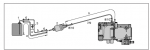
Screenshot (5).png
The image is taken from the manual, once the air is through the pump it gets pulled along by the fuel.
The system does self prime, if the fuel line is empty, it takes a few attempts to start.
The system isn't quite like the above, there's no dip between the tank and the pump.
The installation has worked for something like 14 years, and although I installed a new pump, the heater fired up on the 1st attempt.
 
It's a brand new out of the box fuel pump.
When I checked the old fuel pump, after 14 years, it had a little dark stuff around the edges, but a,long way from being blocked.
 
You could backflush the fuel pipes with a bicycle pump. If there is any crud, it may blow it out. The pickup tube in the tank may be blocked. You said you are happy that the filter at the pump is ok, so all I can think of after blockage is an air leak. If the pump suction line is above the diesel level, then any leaky joint will let air in.
 
To conclude, for now, at least.
I returned the Hydronic 10 to the supplier for them to test
They did a soak test on it, using a cold water mains supply, so that the heater was forced to working flat-out, it ran for 3hours or more.
They reported no problem, no errors.
Which confirmed my guess that it was a fuel supply problem.
I got back to the boat, armed with syringes, paraffin, carb cleaner an old SU fuel pump off, an old car I'd owned sometime in the 1970's, and a range of solvents, ready to clear any obstruction in the pipe.
I connected the Hydronic 10, and decided to try the system as I'd left it, just in case it worked. Figuring that if it did work, it would save a lot of time and possible "maintenance induced faults", ie me doing something silly.
To may amazement it worked! It ran for 2hours, no errors, I've subsequently run it for two, 3hr periods, without error. I didn't want to run it for too long, the boat is inside a big shed, with other boats, and although far from draft proof, I didn't think it fair to run it for too long.
I've no idea why it ran after refitting it, I didn't change anything in the fuel supply.
So, I'm hoping that it will continue to work when the boat goes back into the water at the beginning of April.
If it does fail again, I have all the stuff to try and clean the fuel pipe on board.
 
Yes Vyv, I think fuel degradation was or is the root of the problem I had (or have because I'm entirely sure I've solved it), the fuel had been contained in a narrow copper tube, 6mm ID, for 18months in the past 24months. Because of the pandemic, and because we didn't get sailing until June 2021, when I don't use the heating very much, the fuel was static in the copper pipe. As noted in other threads, copper is a catalyst for the formation of some sort of gum or jelly. In contrast with the fuel in the heater fuel lines, the main engine and generator did get used, and the fuel refreshed.
I guess that the multiple attempts to get the heater going, it would run for about 25mins has flushed the line. And, I think I'll make the point of running the Eberspacher every week or so, just to keep the fuel line clear.
 
The sarga continues.
I'm living on the boat for the next week or so.
The Eberspacher still isn't working correctly.
It'll run ok for long periods on parraffin, but as soon as I switch to diesel, it will fire-up and run for anything from 30min to 1hr and then stop.
Both the diesel and the parraffin are using the same fuel line, I'm swapping the hose at the tank. I take vyv point about degraded fuel, but both the generator and the main engine will run OK on it.
I'd like to change the fuel, but it's a 400L tank, and it's almost full.
Any other ideas as to why it should run reliably on parraffin and not diesel?
I guess I could just run the generstor (5kVA) unit O've run the stock down and use electric heater.
And it's +2 C outside to night.
 
Have I got this right ... It's a 400l tank and the diesel in that tank is "white" diesel with FAME which has been in the tank since before lockdown?

If that's the case, there's your problem (almost certainly at any rate)

No doubt the keyboard warriors will jump up and down but commercially the maximum recommended storage time for diesel containing FAME is 6 months and that's in ideal conditions
 
That's all most correct, we have had 2 short season, with around 200L added in 2020 and 2021.
But why do both my main engine and generator run happily on it?
And why will the new Eber fire up on it, but only run for a relatively short period of time?
I'm going to try connecting a 5L can of fresh diesel in place of the parraffin today, and test that theory.
 
Top