Failing to Adjust a Compass.

DJE

Well-Known Member
Joined
21 Jun 2004
Messages
7,742
Location
Fareham
www.casl.uk.com
Our newly-installed Plastimo Olympic 135 compass has serious deviation problems - as did it's predecessor. Fortunately we have an electronic fluxgate compass which is considerably better. So we set about trying to adjust the Plastimo unit on Monday morning in Thorney Channel, Chichester Harbour. Comparing the main compass with the handbearing compass they were within one or two degrees when heading North or South. But when heading east the the main compass reads about 17 degrees higher than the handbearing compass. And when heading west the main compass reads about 15 degrees less than the handbearing compass. (By this method I had produced deviation cards for both compasses about 18 months ago and the fluxgate compass still gives the same results when compared with the handbearing compass.)

So I carefully started turning the E/W adjuster one turn at a time writing down what I was doing and checking all the bearings after each change. But nothing seemed to change. Eventually I got to about 10 turns on the adjuster from the original position with no difference in the measured deviations. At that point I gave up. (The north and south readings stayed spot on.)

How sensitive are the adjusters? Should 10 turns have produced a measurable change? Or is there something in the boat that causes a deviation much bigger than the adjusters can cope with? The obvious suspects are a big engine, gearbox and saildrive a couple of metres ahead of the compass and an autopilot ram a metre or so to one side and an Ardic Heater the same distance on the other side. None of which can easily be moved.

Will I have to get a man in?
 
How sensitive are the adjusters? Should 10 turns have produced a measurable change?

I think it should take much less than that before you start seeing the needle move.

Perhaps the thing has been unwound so far that the business end is out of range, and needs to be moved back to the middle before starting.

Otherwise, I might suspect that the magnet has fallen off the end.

Pete
 
In adjusting a compass, you have to compensate for five different coefficients. Coefficient A is a fixed error caused by not mounting the compass in line. The other coefficients B-E vary with (and I can't exactly remember the order): the Sine of the bearing: the Cosine of the bearing: the Sine of half the bearing: and the Cosine of half the bearing. The first two are the more important, but in effect it means that if the compass is correct for 0 degrees and 90 degrees, the rest should fall into place.

You are trying to alter the field around the compass to compensate for the stray field, so the compensating magnets need to be pointing in the same direction. A simple approach might be to start with the boat facing north. Insert magnets in the NS axis to get zero deviation, then do the same EW with the other axis.

There is also heeling error, but there is not much you can do about that with a yacht compass except remove the engine.
 
Could it possibly be a compass sold for the Southern hemisphere or a region with a different magnetic anomaly ?
 
If both compasses have massive deviation stop looking at the compass at start looking for whatever it is that's causing the deviation I reckon. The manual may tell how much the adjusters will move the card per turn but they're really meant for 5° or so, 10° at the most. If the hand-bearing compass shows a massive deviation when you put it near the Plastimo then it's definitely not the compass that's at fault but compasses are like engines that start making a funny noise - you could lose your sanity before you find the cause. You may find using the hand bearing compass as a kind of MAD (magnetic anomaly detector) helps to find the culprit if it does show a deviation near the main compass (and do things like check the back of the compass if it's bulkhead mounted - the exponential law does strange things to field strength and fields can be funny shaped too).

When you get back to swinging your compass (after removing the loudspeaker or whatever from it's location a few inches from the compass) make sure you centre the adjusters and start over. You may find the RAF Form 712A helpful to keep track of what's going on when you swing the compass. https://www.gov.uk/government/uploads/system/uploads/attachment_data/file/567707/712A.pdf. I'd strongly recommend finding somewhere with a nice simple and low variation and a decent transit and using that to swing the boat against if you can.

Having been so glib about it, good luck - it can be a real pig finding out what's causing the deviation but it's worth doing I think.
 
Some compass adjusting screws control a pair of magnets that at a 'neutral position' of the screw have two small magnets lying opposed to each other and therefore cancelling out any 'correction'. Fractional turns of the screw allows N or S (or E or W) influence to bear and provide 'correction'.

I suggest the OP try's turning the screw a fraction of a turn and seeing what happens.

I haven't ever seen compass correctors that use whole turns of a screw to add or subtract 'correction'.

The only other screws I've seen are the caps on small bronze tubes where a Compass Adjuster inserts tiny wire long thin magnets to apply the correct compensation.

It's quite possible that there are other forms of adjustment, but those are the ones I've seen and used.
 
Will all those long belts of 303 ammunition that have been dumped on the bottom of Thorney channel have an effect? We are talking yards and yards of the stuff thanks to the RAF.
 
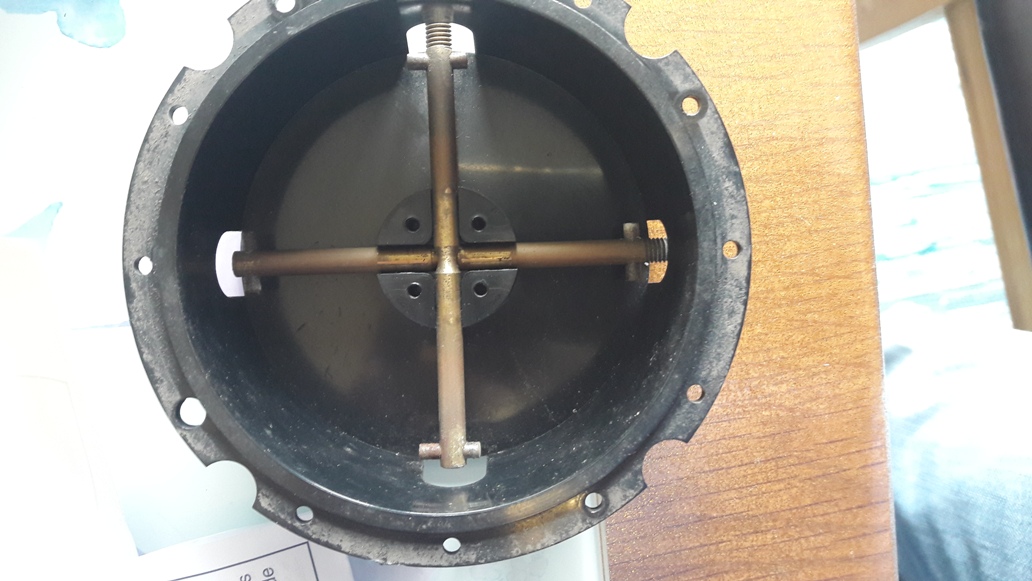
Thanks for all the suggestions. I had a brainwave and dismantled the compensator on the old compass. Turns out I have completely misunderstood the way it works. One full turn puts the adjuster back where it was and 45 degrees movement of the adjuster has more effect than 90 degrees of movement. Inside it looks like this:-

Compass%20Compensator%201.jpg


The little bars through the ends of the brass rods are presumably magnets which rotate with the rods. I thought the adjuster was a lead screw moving a magnet horizontally below the compass - Wrong!

So I'm off back to try again this time turning the adjusters 30 degrees at a time.
 
Some compass adjusting screws control a pair of magnets that at a 'neutral position' of the screw have two small magnets lying opposed to each other and therefore cancelling out any 'correction'. Fractional turns of the screw allows N or S (or E or W) influence to bear and provide 'correction'.

I suggest the OP try's turning the screw a fraction of a turn and seeing what happens.

I haven't ever seen compass correctors that use whole turns of a screw to add or subtract 'correction'.

The only other screws I've seen are the caps on small bronze tubes where a Compass Adjuster inserts tiny wire long thin magnets to apply the correct compensation.

It's quite possible that there are other forms of adjustment, but those are the ones I've seen and used.

Spot on - thanks!
 
In the hunt for 'residual deviating influences' there are sometimes surprising culprits. These can include the HBC stowed on the other side of the bulkhead together with its handle-mounted battery cells, the Sony Walkman on the adjacent shelf, and certain fixings.

The P2 'get-you-home' compasses windshield-mounted on the RAF's French-built Puma helicopters were a sod to correct. Eventually it was discovered - proved - that the official 'compass correction procedure' didn't work on them. Investigation finally showed - after a decade of RAF service and 10 years of compass swings - that the compasses had been mounted to the canopy frame using magnetic machine screws. A decade of compass swingers had been 'frigging the figures' on the Form 712A so as to come back in and write the thing up as serviceable, without which the aircraft wasn't serviceable. Couldn't fly.....

The squadron boss wasn't fazed. He was old school. "We're helo drivers. If we can't see where we're going, we don't go there."
 
I believe the correct way to adjust such a compass is to place ships heading on N-S heading and using that adjuster to adjust the NS heading to 360. Then place boat on E-W heading and using EW adjuster halve the error between E and needle. Then go S-N heading and halve error between needle and S. Then put boat on W-E heading and adjust to halve the error between Boats heading and W. Finally place boat on N-S heading again and adjust to half the distance between boats heading and North and then draw up a deviation table. This needs to be done in no tidal stream. I found the easiest way to do the adjustment was in a locked tidal basin, using pontoon berths at right angles to each other which were fortunately just about NS and EW.
 
I believe the correct way to adjust such a compass is to place ships heading on N-S heading and using that adjuster to adjust the NS heading to 360. Then place boat on E-W heading and using EW adjuster halve the error between E and needle. Then go S-N heading and halve error between needle and S. Then put boat on W-E heading and adjust to halve the error between Boats heading and W. Finally place boat on N-S heading again and adjust to half the distance between boats heading and North and then draw up a deviation table. This needs to be done in no tidal stream. I found the easiest way to do the adjustment was in a locked tidal basin, using pontoon berths at right angles to each other which were fortunately just about NS and EW.

There are several 'correct ways'.

One uses a pelorus.

Another uses known transits.

Another uses a hand bearing compass on marks that are several miles away, having swung the hand bearing compass to be reassured that it does'\t suffer from any measurable deviation in the place you are using it.

There are others.
 
If I can get the deviation down from nearly 20 degrees to less than 5 then I will be more than happy.

The fluxgate compass has deviation that is always negative and varies from about -2 degrees to -7 degrees which suggests to me that it is perhaps not quite aligned with the boat centreline.
 
Our newly-installed Plastimo Olympic 135 compass has serious deviation problems - as did it's predecessor. Fortunately we have an electronic fluxgate compass which is considerably better. So we set about trying to adjust the Plastimo unit on Monday morning in Thorney Channel, Chichester Harbour. Comparing the main compass with the handbearing compass they were within one or two degrees when heading North or South. But when heading east the the main compass reads about 17 degrees higher than the handbearing compass. And when heading west the main compass reads about 15 degrees less than the handbearing compass. (By this method I had produced deviation cards for both compasses about 18 months ago and the fluxgate compass still gives the same results when compared with the handbearing compass.)

So I carefully started turning the E/W adjuster one turn at a time writing down what I was doing and checking all the bearings after each change. But nothing seemed to change. Eventually I got to about 10 turns on the adjuster from the original position with no difference in the measured deviations. At that point I gave up. (The north and south readings stayed spot on.)

How sensitive are the adjusters? Should 10 turns have produced a measurable change? Or is there something in the boat that causes a deviation much bigger than the adjusters can cope with? The obvious suspects are a big engine, gearbox and saildrive a couple of metres ahead of the compass and an autopilot ram a metre or so to one side and an Ardic Heater the same distance on the other side. None of which can easily be moved.

Will I have to get a man in?

When I had a pro adjust done on a boat with a big deviation to get it right he taped little magnets next to the adjuster screw.
 
Only once ever used a 'pro'adjuster, as a package deal with several clubmates. What started as a compass with no obvious deviation detected became one with very definite error thsat he grudgingly had to return to correct blaming me for moving something when I had not. After the second visit we made a cross Channel trip and 'missed'by a mile or two west of intended landfall which, trust me, was rare to non existent before. Did a quick swing by handbearing compass and driving down a charted leading line in Cherbourg and yes there WAS an error again still. After that I bought me a pelorus, made a sun shadow pin and used that to make my own deviation chart on multiple headings round the clock when in a suitable stable place like a marina berth and with sun available. It took several weeks to collect all the headings and create the chart but after that all was well. Quite probably had I removed the magnets said 'pro had added I could have left it alone, but my card was with everything as left by 'pro' . It served me very well and proved very accurate. When we bought a bigger boat I made a 'temporary' card by comparing COG to compas on different headings at slack water neaps in a sheltered bay and again in a current free location in the Vilaine above Arzal Dam I also used the pelorus as before over many weeks and confirmed in fact my 'temporary' card created by comparing dGPS v compass V COG display was indeed pretty darn good.

Note 1 My exercise was to create a deviation card, not to adjust out deviation on all headings to zero.

Note 2 My pelorus was a Davies plastic one, bought in the USA for not a lot, later sold on YBW to another forumite, for less than a lot.
 
Top