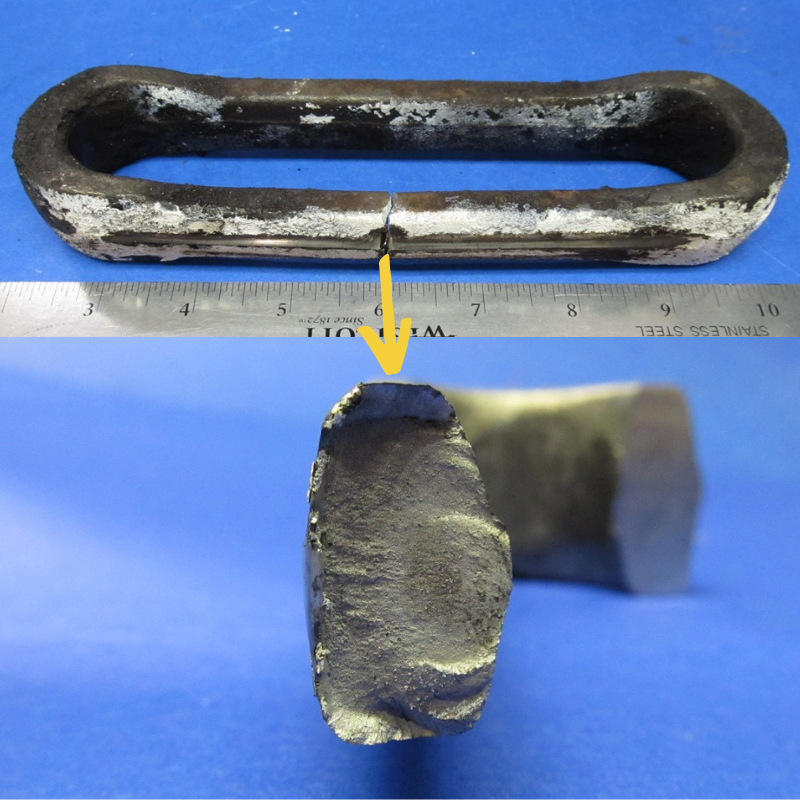
Failing anchor chain

I'm not sure how many chandler's car parks have decent vices. 😀

You could simply take your B&D Workmate or copy.

You surely have a vice on your boat, similarly you could carry the same or maybe a bigger version in the boot of your car.

A new rode is not cheap and secures one of your most expensive assets - it does not seem unreasonable, if you have doubts, to minimise the risks - and carrying a decent vice once in 10 years is hardly difficult. What you also need is a decent piece of heavy duty plywood, drilled to take the securement bolts for the vice and large enough for you to kneel on when you cut the link (battery angle grinder, on my wish list, or hacksaw). Then secure link in vice and twist -

It takes maybe all of 15 minutes, its free and it offers opportunity to minimise risk.

What's not to like?

Jonathan
 
You could simply take your B&D Workmate or copy.

You surely have a vice on your boat, similarly you could carry the same or maybe a bigger version in the boot of your car.

A new rode is not cheap and secures one of your most expensive assets - it does not seem unreasonable, if you have doubts, to minimise the risks - and carrying a decent vice once in 10 years is hardly difficult. What you also need is a decent piece of heavy duty plywood, drilled to take the securement bolts for the vice and large enough for you to kneel on when you cut the link (battery angle grinder, on my wish list, or hacksaw). Then secure link in vice and twist -

It takes maybe all of 15 minutes, its free and it offers opportunity to minimise risk.

What's not to like?

Jonathan
To be absolutely sure, you would have to do the twist test on every link, meaning that you'd be left with a pile of individual cut links. That would tell you how good your chain would have been if you'd left it alone. Maybe not the most useful exercise.
 
The problem with testing and individual link or a few more, in a batch of chain, is the assumption that it is representative of the batch. It could be, but it equally could not be. I think consumer testing of their own chain is folly.
 
The problem with testing and individual link or a few more, in a batch of chain, is the assumption that it is representative of the batch. It could be, but it equally could not be. I think consumer testing of their own chain is folly.
I initially tested single links of chain whose welds looked suspicious to me. As shown on my website my suspicions were justified by easily separating the link. It can do no harm to test a single link assuming its appearance is characteristic of all the others by visual inspection. Without proof testing the whole length there can be no other method.
 
... It can do no harm to test a single link assuming its appearance is characteristic of all the others by visual inspection. ...

It can do a lot of harm. As proposed by Neaves, I buy chain and test individual links in the car park of the chandler's (-; likely from the end of the chain as I really don't want to cut into the middle. The test identifies that welds don't fail, yet within my chain there is a poor quality link. I am none the wiser.

Your testing regime on your website serves a different purpose.

The other method is based on assured manufacturing and testing through a qualified process from type approved design, ladle analysis, quality assurance and testing, all within management system that has been designed and verified as delivering quality. As a consumer, that is what I want. I think in general quality chain exists and confidence is warranted without consumers resorting to their own testing.
 
It can do a lot of harm. As proposed by Neaves, I buy chain and test individual links in the car park of the chandler's (-; likely from the end of the chain as I really don't want to cut into the middle. The test identifies that welds don't fail, yet within my chain there is a poor quality link. I am none the wiser.

Your testing regime on your website serves a different purpose.

The other method is based on assured manufacturing and testing through a qualified process from type approved design, ladle analysis, quality assurance and testing, all within management system that has been designed and verified as delivering quality. As a consumer, that is what I want. I think in general quality chain exists and confidence is warranted without consumers resorting to their own testing.
Assuming there to be a poor quality link in the length of chain it can do no harm at all to test one end link. (Personally I would not carry out my test in the car park as my experience is that most chanders will provide a few links for assessment.) In this hypothetical case a certificate stating the chain to satisfy every requirement would be equally misleading.
 
I replaced my old and rusty anchor chain this week with what was described as G40 Lofrans chain, I would normally have bought G30 Noname chain but this was cheaper. It is stamped with 'LFR' every few links. Reading between the lines it is Chinese manufactured but calibrated against Lofrans gypsies. Whether it also undergoes extra tensile testing or not I'm not sure.
 
I replaced my old and rusty anchor chain this week with what was described as G40 Lofrans chain, I would normally have bought G30 Noname chain but this was cheaper. It is stamped with 'LFR' every few links. Reading between the lines it is Chinese manufactured but calibrated against Lofrans gypsies. Whether it also undergoes extra tensile testing or not I'm not sure.
If you test a link at the end of a length of chain from a drum you can be assured the chance that it is the beginning or end of the length of the batch is near zero. Take a link from the end of the length in the drum - it will be somewhere from the middle. If the test you conduct is satisfactory and you buy a rode then and there then the link you test is representative of the whole, that you buy.

Chain is meant to be proof tested, that's tension to 2 x WLL. On modern chain. making kit this is done continuously - the complete batch is tested. So every link is tested to 2 times WLL. If you read the link to the NACM I provided earlier you will find that chain makers (who are the NACM), are happy with tensile testing, to failure, of short lengths of chain, a few links, from a batch. Peerless, the largest chain maker in the US is a member of NACM, along with Campbell and a couple of others. If the NACM have found that taking a random length (and we could do the same by testing a random link) is sufficient to test a batch - I find it difficult to argue. Much testing, of anything, is conducted on random samples.

There might be doubts that the chain in question was Proof Tested at all. But similarly you might question why a recall has not been issued, it may have been - but its not mentioned - for all the chain from that batch imported by the wholesaler - not, only, Gael Force but all the other chandlers who have the same batch sitting in their retail outlets. It seems very unlikely that Gael Force have imported direct from the Chinese manufacturer and are simply one of a number of customers.

I'm fine with the criticism that Vyv's test is not full proof - but if the OP had made the test it is more than likely the test would have turned up the issue and he would then would have no tale too tell. I suggest the test in the car park - because if you then buy the rode you know you have tested near your length of rode.

But without the test - and a bit stronger wind - the OP could have lost his yacht. The lost yacht could have drifted off into the sunset (with a novice wife and young children on board), - and he would never have known the cause - and very unlikely to blame a faulty chain - the obvious fault would be a finger pointing at a dragging anchor.

Some years ago a member here, I forget who, had exactly the same issue with a French made chain, the same company who make those fancy Alan headed shackle pinned shackles (Chainerie L....?). The owner saved his yacht, he was on the beach as it drifted off and he found the broken end of his rode. The picture he posted on YBW was identical to the one posted on this thread. The chain was replaced - in exactly the same way as Gael Force replaced the current example. The chain maker has since been taken over by a major European maker of lifting chain, Rud?, and I am sure new controls will have been introduced.

It must be mentioned..... my recollection, previous paragraph, and this thread are almost unique. Chain failure is now virtually unheard of. Search this forum, search other sailing forum and chain failure is notable by its absence. Anchor chain is reliable - poor quality chain does not slip through the net, the test protocols defined by the NACM seem to work and adding Vyv's test is simple an added layer of safety. Go back 20 years and I recall mention of chain failure, usually old chain of unknown original - but nothing recently.

Jonathan
 
Last edited:
All credit to Gael Force?

Not knocking it entirely but

I assume the chain came with some sort of certification of conformity. It should have specified batch reference, chain type G30, G40 etc, size, 8mm, 12mm and test details namely Proof Testing, that 2 x WLL, a tensile test and who made it. All the certification would normally come from the manufacturer (who would normally conduct the testing). The buyer would determine what data they require and the technical information would be part of the shipping documents.

The chain did not obviously meet any known specification - and it slipped through the net. Apparently the importer (who might be Gael Force, or another party) did nothing to confirm the technical data provided with the shipment from China, (assuming its Chinese). Or if they did conduct testing it was insufficient.

Arguably the OP was lucky - he could have lost his yacht, or worse.

Are members happy with this arrangement? What are the alternatives - knowing that the cost of the alternatives will be paid by the consumer? I have noted that there are some who would not be bothered with Vyv's link test - so they must have another way of anchoring 'in comfort'.

Its quite possible to conduct a Proof Test on, any chain. Its non destructive. The test equipment is common place, or it is around Sydney/Newcastle - but we have a large 'local' mining industry (and in the UK you will have a large local construction industry as well as mining/quarrying - whose chains will need to pass muster.)

The reason we are all buying Chinese chain is simple economics. Local chain makers have found they cannot compete with Chinese prices, nor Chinese quality. There is still money in lifting chain and there are a number of highly reputable companies making and supplying the market - but not bog standard G30 anchor chain. Chinese anchor chain quality has been good, no complaints about failure and galvanising seems good (no-one complains about chain life).

Chinese lifting chain is increasingly used in the transport and lifting industry, G80 and G100 quality (though the importers/retailers I know all check what they buy). It is not, yet, possible to buy G120 from China - but all the components, Chinese, are commonplace (chain joiners, hooks etc).

Jonathan
 
Completely logic fail Neaves, post 29. A company that tests individual links has a statistically meaningful sample from a continuous process. Buying a length of chain and doing a simple bending test at home is meaningless as representative of the chain just purchased.
 
Perhaps the question should be...
How strong was this chain?
We know it started to fail, but we don't know what load was applied to it.

Does 'perfectly good' chain ever look like that if you overload it?
 
Perhaps the question should be...
How strong was this chain?
We know it started to fail, but we don't know what load was applied to it.

Does 'perfectly good' chain ever look like that if you overload it?
Good chain never fails at the weld. The weld should be stronger than the chain.

Good chain stretches slightly before it fails, the links distort. Based on the NACM rules, link given earlier, (and the rules are accepted by most western chain manufacturers) all chain should be continuously Proof Tested to 2 times WLL. It should not distort at this tension. Break strength would be a minimum of 4 x WLL, most chain is manufactured to a 4:1 safety factor. Break test on a batch would be a few links tested to destruction, a batch could be 1,000m - or more. There is no restriction on where the test length is taken, could be at the beginning or end of the 1,000m (and would be significantly less representative than Vyv's single link test).

It is fairly obvious that some members have not bothered to read the NACM test protocols and are basing their comments on a figment of their imagination.

I don't recall seeing the size of the OPs chain but WLL for G30 x 8mm chain is 750 kg and a 750 kg tension is not likely to have ever been imposed on the chain by the OP - I'd be surprised if the tension has ever been above 350kg - assuming that the chain was 8mm and of a size recommended for the relevant size of yacht, say 35' -45' yacht.

Basically it looks as if the chain was not Proof Tested by anyone, not the manufacturer, not the importer, not Gael Force - as multiple welds failed, at probably, as low as a 350kg tension (as the OPs yacht would be unlikely to impose beyond a 350kg tension). Noting that if the manufacturer followed protocols every weld of every link should have been tested to 1500kg tension during the continuous Proof Test. Of course the chain is only as strong as the weaker link - and every link should be stronger than 1,500kg (assuming 8mm G30) and for a good chain every link should be stronger than 3,000kg tension and, again, failure should never be at the weld.

Of course Gael Force acted as they did - they had no choice. They will know the test protocols. I have to assume they have contacted all of their relevant customers.

As Vyv pointed out - make his test and the link would have failed at the weld (and should have been rejected on that basis).


Where is the recall on the rest of the rodes that Gael Force sold, where is the recall on other rodes from the same batch sold to other chandlers by the importer (assuming Gael Force were not the importer).

When a similar failure occurred on a batch of anchors the Forum showed their concern. Those days have been forgotten and/or such failures are now accepted.

Funny old world.

Jonathan
 
I'm not sure how many chandler's car parks have decent vices. 😀
Good point. Thread drift.

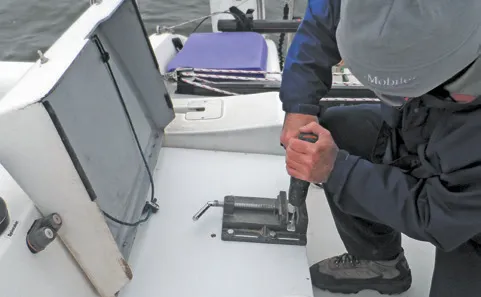
One I have used on several boats is a drill press vice mounted to a sheet of plywood, which is then placed in a locker opening in a cockpit locker. The result is:
  • A largish work surface.
  • A vice mount that can take a lot of twist and some banging. Because it is on a plywood sheet the tress is safely distributed.
  • Pretty cheap and light. Much less than a similar size machinist vice.
Workbenches-ft-image.png.webp

----

I have quite a few vices (not meaning faults and character flaws!). At home I have a 50 kilo 1890 blacksmiths vice that is perfect when something really needs a beating. They are designed to transfer the force of a sledge hammer blow to the floor. I'd had it for years in the corner, but I mounted it and started using it after I cracked my machinist vice and had to weld the jaw plate.
20190817_121507.jpg.5f316430b3b757672f376d081e5604b2.jpg
 
Good point. Thread drift.

One I have used on several boats is a drill press vice mounted to a sheet of plywood, which is then placed in a locker opening in a cockpit locker. The result is:
  • A largish work surface.
  • A vice mount that can take a lot of twist and some banging. Because it is on a plywood sheet the tress is safely distributed.
  • Pretty cheap and light. Much less than a similar size machinist vice.
Workbenches-ft-image.png.webp

----

I have quite a few vices (not meaning faults and character flaws!). At home I have a 50 kilo 1890 blacksmiths vice that is perfect when something really needs a beating. They are designed to transfer the force of a sledge hammer blow to the floor. I'd had it for years in the corner, but I mounted it and started using it after I cracked my machinist vice and had to weld the jaw plate.
20190817_121507.jpg.5f316430b3b757672f376d081e5604b2.jpg
Your vice is bigger than my vice. :)

My larger vice, coincidental picture below, is bolted to a reinforced concrete bench - though I'm not inclined to hit it or anything in its jaws with a sledge hammer.

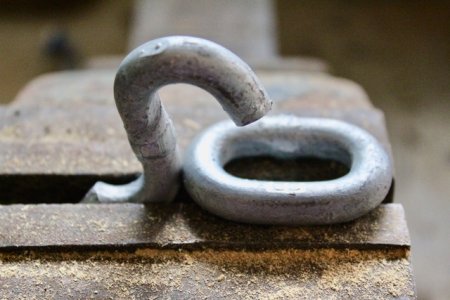
This first picture (immediately below), in one of my 2 big bench vices is a chain link bent to Vyv's standard instructions.

The 'S' shape shows that the weld remains secure despite twisting through 180 degrees. Also shown is that the galvanising remains secure -it is well bonded to the underlying steel.

IMG_0190 2.jpeg

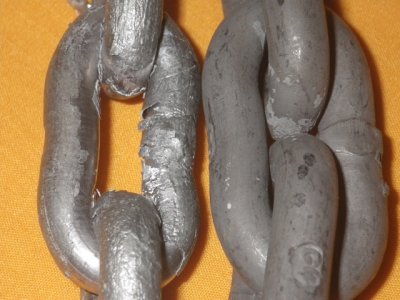
Below focus on the left hand chain links

This is a conventional HDG tensile tested to break. The links have stretched and the spacing of the links has narrowed and locked adjacent links. The chain did not fail at the welds.

Note that in stretching the gal has peeled off, not as good adhesion as the example above.

IMGP4602 2.jpeg

Vyv did not make mention but his twist test assesses the integrity of the weld and the integrity of the galvanising - its important as gal life determines chain life.

The right hand chain is an Armorgalv coated chain, also tested to break (different steel) - the gal coating has remained intact and all adhered.

Jonathan
 
… When a similar failure occurred on a batch of anchors the Forum showed their concern. …

About 2 people if I remember correctly bent shanks deliberately, which demonstrated very little beyond a bent shank and one of them was a Fortress. Pretty sure consumers didn’t start bending shanks en mass. Similarly when keels fell off, I don’t remember everyone taking cores, or dropping keels. When rigging fails they don’t all sacrifice a stay to see if their wire is substandard.

In this case, consumer has identified a failed product and vendor has addressed it. That is an entirely satisfactory and proportional response.
 
Perhaps the question should be...
How strong was this chain?
We know it started to fail, but we don't know what load was applied to it.

Does 'perfectly good' chain ever look like that if you overload it?
In the previous few posts I have tried to answer the question and this is, maybe, the last part of the jigsaw.

I've been testing chain primarily from the US, Peerless and Campbell, from Europe, Maggi A4 and A7 and from Australia, PWB, Serafini, Titan (from CMP) and various Chinese - from chandlers. The Chinese are random, I don't know where in China, I don't know if chandlers chop and change based on costs or what the buyer had for breakfast. I've looked at G30, G40, G43, G70 and G80 chain and I tried to stick to 5/16th" Imperial or 8mm metric. I've tested about 50 samples, some are repeats of the same chain from different sources.

I've taken 1m lengths at random and simply tested them at a NATA certificated testing facility. I obtain a stress strain graph of each test, which also gives a Proof Load result as well as Ultimate Tensile Strength.

I've kept every broken sample - in case one of the suppliers wanted to question the results

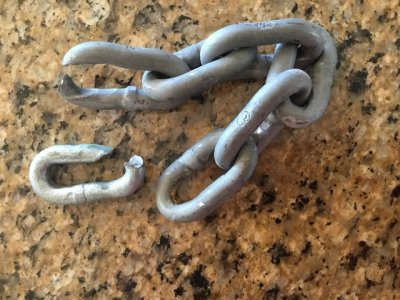
Most chain when it fails breaks like these 2 broken links. The link fails at or near the crown, the failure almost exclusively was comfortably higher than specification. In exceptional cases, I was given some cheap and beautiful stainless chain to test (it failed at the weld, below specification for G30 - another instant profit maker burnt and crashed).

IMG_0782.jpeg

I hope Posts 33, 35 and this post helps answer the question raised by B27.

The failure of the OPs chain is an exceptional failure, outside normal (and intentional) breaks. If you follow Vyv's test the weld will hold, though the gal may flake off. In virtually all cases the weld is stronger than the steel wire from which the chain is made. Chinese chain quality, during the time when I tested, has been good.

But my tests and those of Vyv represent a, short, moment in time.


Jonathan
 
Good chain never fails at the weld. The weld should be stronger than the chain.
.......

I don't recall seeing the size of the OPs chain but WLL for G30 x 8mm chain is 750 kg and a 750 kg tension is not likely to have ever been imposed on the chain by the OP - I'd be surprised if the tension has ever been above 350kg - assuming that the chain was 8mm and of a size recommended for the relevant size of yacht, say 35' -45' yacht.
......

Funny old world.

Jonathan

750kg would be 0.1g acceleration for a 7.6 tonne yacht

It would be easy to see some big numbers instantaneously, perhaps retrieving the anchor in bumpy conditions.

As an amateur in the metals field, it's interesting that the links opened just a crack and no further?
I'd have guessed that the weakest link would have peeled right open and let go completely.
 
About 2 people if I remember correctly bent shanks deliberately, which demonstrated very little beyond a bent shank and one of them was a Fortress. Pretty sure consumers didn’t start bending shanks en mass. Similarly when keels fell off, I don’t remember everyone taking cores, or dropping keels. When rigging fails they don’t all sacrifice a stay to see if their wire is substandard.

In this case, consumer has identified a failed product and vendor has addressed it. That is an entirely satisfactory and proportional response.
A nice slick answer but not entirely correct.

One manufacturer changed the steel for his anchor shank to a high tensile strength steel. Contemporaneously another manufacturer reinforced their hollow shank. A man lost his life about a month ago when the keel fell off a yacht and the yacht capsized - they still need to do some work. We don't sacrifice a stay - we have to dump the whole lot, at 7 years, because we will not get insurance otherwise. We change sail drive gaskets under a similar regime.

Jonathan
 
Last edited:
... As an amateur in the metals field, it's interesting that the links opened just a crack and no further?
I'd have guessed that the weakest link would have peeled right open and let go completely.

This is a very interesting point. Once the crack opens, the link looses about 70-80% of it's strength. This means it broke very near the SWL. I will entertain theories that this is not correct, but I've bent links enough to be pretty sure, just as Neeves is sure an ultimate strength failure should look different. If the stress had been greater the link would have ripped open and if had been less the crack would be closed. This tells us that the failure was in a relatively narrow stress range. I'd like to present a different failure theory, for discussion. It is probably wrong, but I'm not sure of that.

This chain broke from fatigue. My other guess is that the OP does not use a long rope chain snubber and he has anchored some places with good exposure to small/moderate waves or wakes from passing boats. The water was not overly deep and the wind strong enough to straighten the catenary. The boat surged against the chain. I have measured forces well over the SWL on anchor chains in light winds when the right combination of wakes was present. The funny thing is, these surges really didn't feel like much because the weather was moderate and it was mostly just the momentum of the boat being arrested by the chain. Just a slight jerk. As B27 pointed out, it would only take 0.1 G, depending on the mass of the boat. One of the surges I experienced broke a load cell and shackles.

The links would only have opened if the load was near the SWL. Otherwise, they would be like the image below. Ideally, the crack should not be through the weld. That does indicate a substandard well and perhaps a chemistry problem as well. But the load was near the SWL or the chain would not be bent.

This should take many thousands or tens of thousands of cycles to cause this, but combined with some minor defect, it would be less, perhaps no more than 1000 cycles. Unless the OP is sure this is loading history is incorrect, perhaps it is also an object lesson on the value of elastic snubbers.

fatigue testing mooring chains

(fatigue crack in chain)
Figure-1-FF.png


images
 
Top