Experiences with in-mast furling

..On the subject of weight distribution, surely there is only a significant difference between in-mast furling and traditional furling when the sail is furled? With the sail unfurled, the weight is pretty much distributed the same for both.


Plus the additional weight of the reefing gear within the mast. Incidentally this not only affects stability but the capacity to carry sail. What the Americans call, I believe, a double wammy.
There are many airy references to boats being designed with attention to the weight of additional mast gear but I have never seen evidence of this, it probably falls into the category of "everyone knows this to be true"
If anyone has figures, or references, it would be great to see them.

On the other hand Peter Bruce tells us this:

"An alarming illustration of the dangers of approximate assessments is given by a comparison of the stability curves for two examples of the same class of 28.5ft production cruising yacht. The yacht with a range of 128deg has a conventional rig as designed. The other with a range of only 96deg has a mast furling mainsail and furling headsail fitted."
Heavy Weather Sailing 5th Edition.

It would be very unwise to assume adding weight aloft has little effect on performance or that clever people have taken it all into consideration.

Mind you, I have nowt against mast furling, though I am not keen for smaller inshore boats. Even there I can see the rationale as long as racing or fast sailing is not on the agenda.
There little positive to be said about many things but comfort and convenience are powerful incentives. Sprayhoods are hopeless efforts in many, many respects but we mostly all use them.


Dockhead's post 3 is a grand piece of work
- a keen owner himself who does not hector or sound like a salesman, putting each side of the case. Most of his points look good to me.
 
There are many airy references to boats being designed with attention to the weight of additional mast gear but I have never seen evidence of this, it probably falls into the category of "everyone knows this to be true"
If anyone has figures, or references, it would be great to see them.

Exactly the same as the "everybody knows" i referred to earlier in respect of there must be extra weight aloft that is bad.

In both cases there is no hard evidence that this is the case, only people saying "it must be".

If it really was an issue we would have confirmed tales of people coming to grief because their boat was unstable, or at the very least people "believing" that the effect is negative. I have never seen either and I guess neither have you.

So, until you, or I or indeed anyone else comes up with some hard facts we have to rely on the well respected designers who know far more than you or I about designing safe boats and rigs. They seem to make no issue of designing boats with either rig on the same hull and publish stability data that does not differentiate. This is unlike shoal draft keels for example where they either show different stability data or more commonly modify the design usually by adding ballast to maintain stability.
 
Agree with most of the above with perhaps the exception of extra weight aloft which I think for boats designed for in mast is way over exaggerated. The stability figures are exactly the same for both versions of my boat. Designers are well aware of the potential issues having been designing boats with in mast for getting on for 30 years.

Five years ago some pals ordered a new jeanneau 37 ft with lift keel and in mast. That combination got the boat downgraded from cat A to Cat B when it was delivered and it was nothing to do with the keel. They complained and (luckily I think as it was a silly combination to order) they got a performance mast with slab instead at no extra and the boat rated cat A. Presumably the broker selling it didn’t know either but Jeanneau did.

So there are certainly some cruisers, or variants thereof, where weight aloft has an important part to play.

No lift keel Bavarias out there though.
 
Five years ago some pals ordered a new jeanneau 37 ft with lift keel and in mast. That combination got the boat downgraded from cat A to Cat B when it was delivered and it was nothing to do with the keel. They complained and (luckily I think as it was a silly combination to order) they got a performance mast with slab instead at no extra and the boat rated cat A. Presumably the broker selling it didn’t know either but Jeanneau did.

So there are certainly some cruisers, or variants thereof, where weight aloft has an important part to play.

No lift keel Bavarias out there though.

That is interesting. I would guess the AVS (and STIX) is pretty marginal with the keel up anyway, but I am surprised it was not quoted in the literature that the combination resulted in a lower category and was only discovered after delivery - presumably on sight of the Declaration of Conformity. Slapped wrists for Jeanneau and the dealer.

As you say no lift keels on Bavarias and the 33/34 is available with a deep and shallow keel. They are different designs - not just one a shorter version of the other and the shallow keel has 200kgs greater weight. The published data shows the same AVS and STIX (both comfortably above the minimum for CatA) for both versions and does not differentiate for rig options.
 
That is interesting. I would guess the AVS (and STIX) is pretty marginal with the keel up anyway, but I am surprised it was not quoted in the literature that the combination resulted in a lower category and was only discovered after delivery - presumably on sight of the Declaration of Conformity. Slapped wrists for Jeanneau and the dealer.

As you say no lift keels on Bavarias and the 33/34 is available with a deep and shallow keel. They are different designs - not just one a shorter version of the other and the shallow keel has 200kgs greater weight. The published data shows the same AVS and STIX (both comfortably above the minimum for CatA) for both versions and does not differentiate for rig options.

Much the same for my Hanse 301. I have the shoal draft lead wing and it is much heavier than the iron fin option. Don’t know the AVS or STIX for the two off the top of my head but expect it is similar. In mast was never offered on these boats though, they are not a bit old for good in mast technology and fundamentally too much fast cruiser orientated for that to have appealed to their buyers.

As I say I thought it was asking for trouble at the time they did it but i’m not a yacht designer.

The OP does not say what marque or keel he is looking at though so it may be a useful lesson.

Suspect the lack of hard evidence of the effect on older boats with retro fits, especially bilge keel boats, is more to do with lack of rigorous publication of stability data before the RCD than to do with their fundamental stability in the sort of extreme conditions in which old, retrofitted boats are not usually going to be at sea. This might back up Peter Bruce’s point which also caused me to pause when I read it some time ago. As I said the OP should tread carefully and consider what sort of sailing he wants to do.
 
Last edited:
....So, until you, or I or indeed anyone else comes up with some hard facts .......


"An alarming illustration of the dangers of approximate assessments is given by a comparison of the stability curves (Fig 3.2) for two examples of the same class of 28.5ft production cruising yacht. The yacht with a range of 128deg has a conventional rig as designed. The other with a range of only 96deg has a mast furling mainsail and furling headsail fitted."

Peter Bruce Heavy Weather Sailing. 5th Edition.

Cartoon-Ostrich-With-Head-In-Sand.png
 
On the other hand Peter Bruce tells us this:

"An alarming illustration of the dangers of approximate assessments is given by a comparison of the stability curves for two examples of the same class of 28.5ft production cruising yacht. The yacht with a range of 128deg has a conventional rig as designed. The other with a range of only 96deg has a mast furling mainsail and furling headsail fitted."
Heavy Weather Sailing 5th Edition

The relevance of that depends on how long ago that was written, and the vintage of the boat mentioned. In-mast furling is now a mature technology, but it wasn't always. I've not heard or read of a yacht being capsized by its furling gear.
 
Thanks everyone, all very insightful

On the subject of weight, the Selden C245 (non furling section) weighs in at 7.15kg per mtr and the furling equivalent is 7.44m so a 4kg difference over a 15mtr mast. That said, I think those weights are just the section and wouldn't include the furling gear, but beyond the top and bottom fittings I cant believe the furling extrusion would weigh much.
 
Thanks everyone, all very insightful

On the subject of weight, the Selden C245 (non furling section) weighs in at 7.15kg per mtr and the furling equivalent is 7.44m so a 4kg difference over a 15mtr mast. That said, I think those weights are just the section and wouldn't include the furling gear, but beyond the top and bottom fittings I cant believe the furling extrusion would weigh much.

I don't know the weight of my mainsail but I would guess about 10-15Kg, compared to my radar which is 7Kg though mounted at the stern. The point at issue would not be the weight when sailing normally but when deeply reefed. Clearly, modern boats with furling mains are perfectly sound. What we don't know is whether a boat without a furling main may not have a noticeable advantage. If anyone has twin boats with different set-ups, perhaps they would be kind enough to take them out in a F8 and let us know how they got on.
 
"An alarming illustration of the dangers of approximate assessments is given by a comparison of the stability curves (Fig 3.2) for two examples of the same class of 28.5ft production cruising yacht. The yacht with a range of 128deg has a conventional rig as designed. The other with a range of only 96deg has a mast furling mainsail and furling headsail fitted."

Peter Bruce Heavy Weather Sailing. 5th Edition.

View attachment 73086

How is that in the least bit relevant to today's boats which are designed from the start with furling headsails and mainsails, particularly when your quote gives no real information about the boat in question?

Therefore largely useless piece of information. It is on single line quotes that myths build.
 
You tell us a lot about the ways boats are designed and certified, I ask again, how do you know?

Tell us.

Because I am an educated person and I read. Suggest you do the same rather than relying on implausible observations made a long time ago that have no relevance to today's designs. A lot has happened since the 1970s even if it seems to have passed you by.

As a start read the requirements for the RCD in respect of design, construction and certification and all the standards that are contained within it, particularly ISO 12215. That will keep you busy and hopefully show why what you post is so far away from reality.
 
The relevance of that depends on how long ago that was written, and the vintage of the boat mentioned. In-mast furling is now a mature technology, but it wasn't always. I've not heard or read of a yacht being capsized by its furling gear.


Very true, it comes from the fifth edition, 1999 it may well be reprised in the present edition printed 2008. Certainly that printing contains a very similar article.

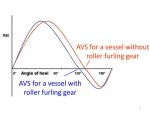
However the laws of Physics do not change. The RYA updated it's syllabi in 2008 to increase awareness of stability issues. This is from their course material:

slide4-n.jpg

It is very similar to the figure 3.2 mentioned earlier, only imagine the blue line pitched much nearer to 90 deg.

In reefing weather a sail stowed up the mast is leaving weight in exactly the wrong place for sailing performance.
 
What a coincidence. I was in Scoresbysund as well. We noticed a Red Ensign sailing yacht and we were wondering why they had in-mast furling on an expedition like this. Have some pictures. We also talked to a group with sea canoes and a SUP board in Harefjord if I am correct.

That group was us! Did we not meet you? Not the Norwegian flag wooden ketch? I would love to see your photos!
 
Thanks everyone, all very insightful

On the subject of weight, the Selden C245 (non furling section) weighs in at 7.15kg per mtr and the furling equivalent is 7.44m so a 4kg difference over a 15mtr mast. That said, I think those weights are just the section and wouldn't include the furling gear, but beyond the top and bottom fittings I cant believe the furling extrusion would weigh much.

Yes, exactly. So the difference in weight aloft with in-mast furling is really significant. You have the sail and furling gear, as was mentioned, but also the mast itself, which is larger and more complex, is heavier. It adds up to a big difference.

This makes no difference to stability for a boat designed for in-mast furling -- because the designers simply add ballast until they get the stability curve they want.

But it makes a difference in the polar moment of inertia around the longitudinal axis.

Also no one mentioned windage -- the thicker mast section has more windage -- another downside.

And one more thing no one mentioned -- boats designed for in-mast furling have TALLER MASTS, to try to make up for the lack of roach of the mainsail. This compounds the other flaws.

So in-mast furling altogether does hurt performance -- you can't argue it doesn't.


That being said -- the performance hit of in-mast furling may not matter in windy conditions, and may be compensated by other advantages, such as the excellent shape in-mast furling mains have when they are furled in, and the ability to finely adjust sail area to always have just the right amount up.

Our boat with in-mast furling has excellent sailing performance. We turned in a 209 mile day a few weeks ago on the way back from Greenland, and we regularly break 200 miles/day in decent conditions. We walk all over hot cruiser/racers in the 40 to 45 foot range, including upwind, except in very light conditions. Our longer waterline has a lot to do with that, but the in-mast furling rig works very well indeed, in our particular case.

Would the performance be even better with a slender, normal, lighter, bendable, slightly shorter mast, and a roachy slab reefing mainsail? Definitely! Does it matter? For our purposes, not at all! YMMV!
 
I've sailed quite a few boats with in-mast furling, one quite extensively - thousands of miles. For easy cruising in a larger boat it's excellent. You do lose a bit in performance. One boat had in-mast PLUS a second track to hoist a fully battened main for racing.

On anything bigger than 38-40 ft now I'd choose in-mast if I couldn't afford in-boom reefing.

Re weight aloft: when calculating stability designers and coding surveyors do take account of the extra weight aloft - they also calculate in radar scanner weights. Weight aloft reduces stability but steadies roll motion a bit.
 
Very true, it comes from the fifth edition, 1999 it may well be reprised in the present edition printed 2008. Certainly that printing contains a very similar article.

However the laws of Physics do not change. The RYA updated it's syllabi in 2008 to increase awareness of stability issues. This is from their course material:

View attachment 73093

It is very similar to the figure 3.2 mentioned earlier, only imagine the blue line pitched much nearer to 90 deg.

In reefing weather a sail stowed up the mast is leaving weight in exactly the wrong place for sailing performance.

I accept that on the basis of that out-of-context image, which may relate to only one design or to a retro-fitted system, I haven't the inclination to research it more deeply, in-mast furling may have an effect on stability. But If I were contemplating buying a boat, I wouldn't be put off if it was the one with the blue curve, if I considered in-mast furling desirable.
 
Very true, it comes from the fifth edition, 1999 it may well be reprised in the present edition printed 2008. Certainly that printing contains a very similar article.

However the laws of Physics do not change. The RYA updated it's syllabi in 2008 to increase awareness of stability issues. This is from their course material:

View attachment 73093

It is very similar to the figure 3.2 mentioned earlier, only imagine the blue line pitched much nearer to 90 deg.

In reefing weather a sail stowed up the mast is leaving weight in exactly the wrong place for sailing performance.

This all assumes that the extra gear is added to a boat that was not designed for it - as in your original example. That was written when adding furling gear including add on in mast furling to boats that were never designed for it. It is obvious that stability would be reduced as was shown when some of these boats were assessed for coding purposes.

However as I keep pointing out this is irrelevant to today so cannot understand why you keep on using it as an example. Those of us who have kept abreast of this because it affects our decisions on buying boats are well aware of what went on 30 years ago.

Equally one should be well aware of the RYA concerns about knowledge on stability as again it is nothing new having first started well over 20 years ago at the time the RCD was being prepared and the time when there were concerns about the stability of some existing boats, particularly those modified by additions to the rigs.

This is all water under the bridge and while interesting from a historical point of view, and of course for owners of boats from that pre 1990s era, it really does have little relevance today. Designers understand the laws of physics and use design principles that produce boats with stability as required by the RCD. Does not necessarily mean the RCD is perfect, but there are many well known designs from earlier periods that would simply not meet the basic requirements of the directive, including stability. Indeed at the time I had some peripheral involvement in the work required to make a very well known design Cat A compliant - part of which was to increase the ballast ratio.

Suggest you read Dockhead's post (if you have not already done so) which summarises the issues far better than I can.
 
I accept that on the basis of that out-of-context image, which may relate to only one design or to a retro-fitted system, I haven't the inclination to research it more deeply, in-mast furling may have an effect on stability. .

But If I were contemplating buying a boat, I wouldn't be put off if it was the one with the blue curve, if I considered in-mast furling desirable.


Quite right, because you grasp the issues. It's a educational resource to show people that adding weight aloft is fine, within limits. Depending on the boat and the weights involved.

Most people understand mass produced designs are cut from the roll.
You buy a boat; choose one set of options it will be less stable, choose others it will be more so. The designer has done his sums to stay out of courtroom, in either case. The only stability information you will be given is lightship, standard trim - if you are lucky.
Only the chronic optimist will take this as evidence that both options are the same.
 
Top