Expansion Bottle position & type

superheat6k

Well-Known Member
Joined
10 Jan 2012
Messages
6,798
Location
South Coast
Visit site
Having fixed the last leak on the engine, itself I then discovered a new leak had occurred on the expansion bottle, which is bolted to the side of the engine. Removal showed the stub fixing for the hose to the engine header tank had split.

The setup is the header has a seal cap only, with the pressure cap on the expansion bottle.

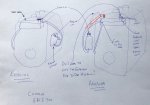
But I cannot find a replacement expansion bottle of the same style, so can I change the set up so I move the pressure cap to the engine header (same fitting), then affix a standard expansion bottle with a seal cap (not a pressure cap) somewhere convenient, with a hose tapping into an existing 1/8" NPT plug on the side of the header tank. Does the hose need to rise to the top level of the header tank ? The existing connection is in the zone between where a seal cap sits and pressure cap sits on the header connection, so at the system high point.

Thanks.
 
A picture of the complete system would help so we know exactly what you mean my "header tank" and "expansion bottle". There are also variants that are referred to as "overflow containers" and "de-gas tanks". It also depends on whether your expansion bottle is arranged so the coolant gets sucked back into the system as the engine cools down.

www.solocoastalsailing.co.uk
 
If by engine header tank you mean the heat exchanger then no, the pressure cap shouldn't be on there except as a get you home fix. It needs a cap (not a pressure cap) on there as water sent to the expansion tank has to be able to return to the engine as it cools or to top it up. The expansion tank can be mounted anywhere in the engine bay, around the same height as original mount so, as long as the pressure cap is the same spec. you can get one from from a breaker's yard.
 
Having fixed the last leak on the engine, itself I then discovered a new leak had occurred on the expansion bottle, which is bolted to the side of the engine. Removal showed the stub fixing for the hose to the engine header tank had split.

The setup is the header has a seal cap only, with the pressure cap on the expansion bottle.

But I cannot find a replacement expansion bottle of the same style, so can I change the set up so I move the pressure cap to the engine header (same fitting), then affix a standard expansion bottle with a seal cap (not a pressure cap) somewhere convenient, with a hose tapping into an existing 1/8" NPT plug on the side of the header tank. Does the hose need to rise to the top level of the header tank ? The existing connection is in the zone between where a seal cap sits and pressure cap sits on the header connection, so at the system high point.

Thanks.
As I understand you, what you propose is the standard arrangement. A pressure cap on the top / filler side of the circulation system with a drain pipe leading off beyond the pressure cap to the bottom entry spiggott of an overflow bottle / container. Fill the system to show 1-2cms in the overflow tank, not more, when cold. The tank base to stand about 20 cms above the pressure cap.

PWG
 
The set up is very simple. The coolant expands into the expansion bottle as the engine warms and gets sucked back as the engine cools. The header tank is completely separate to the heat exchanger.

The 1/8NPT fitting sits ~ 50mm below the existing high point vent to the expansion tank, and connects to the engine at the coolant return from the cooler back into the engine.

There is also a vent valve on top of the header tank so another indeed better option would be to connect the expansion vessel to that.

In fact thinking about its as a fluid system, I can't see that it matters where the pressure cap sits if the expansion line comes off from a highpoint somewhere. In which case the obvious answer to my original question is it will be fine to connect the new expansion bottle to the high point vent, whilst re-locating the pressure cap to the top of the header tank.

IMG_4099.jpeg
 
In your revised version, I'm not sure where the pressure will be relieved. It will build up in the revised remote header tank as coolant transfers over but cannot relieve because that has a sealed cap so will relieve through the pressure cap and out of the vent.

There needs to be a pressure relief of some kind on the remote header tank.

I posted this yesterday but one of these should apply to the new installation:

There are essentially four types of system but if you change between them you obviously need to preserve the same operating pressure in the new system that applied in the old. If it's a pressure cap which ejects and then sucks back the coolant, you cannot allow it to eject coolant when over-pressurised into a simple catch-can:

1) The tank on top of the heat exchanger which has a one way pressure cap. When the pressure is exceeded, the valve opens and pressure is vented to atmosphere or into a simple catch can. The tank normally has an air space and is not completely filled as the some coolant would be ejected.

2) The tank has a two way pressure cap which allows coolant to flow out into an expansion tank. There is no air space at the top of the H/E tank and coolant is expelled into the expansion tank when the engine is hot and sucked back when it is cold.

3) The tank has no pressure cap but a fixed hose which leads to a remote header tank. The H/E tank and hose are full of coolant and the remote header tank has the air space at the top and a one way pressure cap which vents to atmosphere/catch can.

4) The H/E tank has a fixed hose which leads to the remote header tank but the remote header tank in this case is filled to the top and has a two way pressure cap which is connected by another hose into an expansion tank as in 2).

Hope this helps.

Richard
 
Last edited:
Reminds me of my dear departed Peugeot 406, but at least you can park one of those on a hill to bleed the cooling system.
I think your system will be prone to expelling coolant as it heats up and drawing in air as it cools down.
You will end up running with a lot of air in the top of the system and the expansion bottle not doing anything much.
It would work better if the expansion vessel had two hoses, so that the level in it was the same as in the engine, it would need to be raised though.

Better to have the pressure cap on the expansion vessel. Or use a catch tank, unpressurised.
 
When I was building my current boat my engine was set up as you propose. I converted it to how you have it now using a mini metal expansion tank. and a collection bottle on the expansion vent.

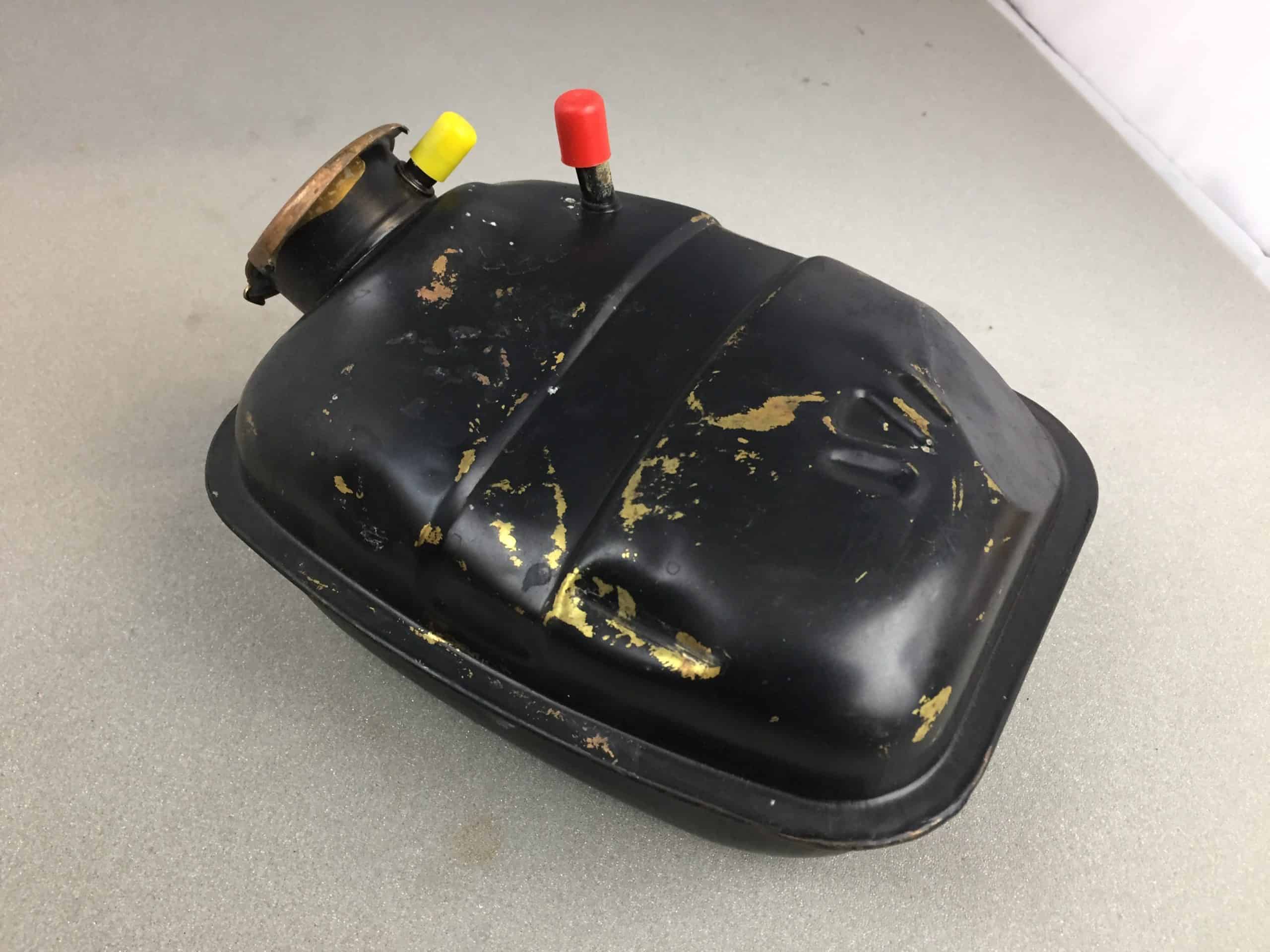
Like this but should be easy to fabricate one. The neck fitteing is available from any radiator service agent as I had to replace the one on my heat exchanger due to the leak as can be seem

C29050-tank1-scaled.jpg


35953344461_5d37cd9167_b.jpg


Expansion tank to right collection bottle just below

35246467244_2c78acfca7_b.jpg
 
When I was building my current boat my engine was set up as you propose. I converted it to how you have it now using a mini metal expansion tank. and a collection bottle on the expansion vent.

Like this but should be easy to fabricate one. The neck fitteing is available from any radiator service agent as I had to replace the one on my heat exchanger due to the leak as can be seem

C29050-tank1-scaled.jpg


35953344461_5d37cd9167_b.jpg


Expansion tank to right collection bottle just below

35246467244_2c78acfca7_b.jpg
The tank you show is more or less identical to my broken one except mine is plastic (HDPE) with the connection close to the base. However, I am going to make a brass fitting so I might be able to recover this one.
 
The tank you show is more or less identical to my broken one except mine is plastic (HDPE) with the connection close to the base. However, I am going to make a brass fitting so I might be able to recover this one.


If it HDPE have look at welding it with a hot air gun. I repaired several jetty floats made from HDPE by welding with a hot air gun.
 
If an HDPE tank has failed, it's probably because it's old and gone brittle.
Or it's some crap plastic that hasn't enjoyed heat and antifreeze.
Don't mess about, buy a new one!
 
If an HDPE tank has failed, it's probably because it's old and gone brittle.
Or it's some crap plastic that hasn't enjoyed heat and antifreeze.
Don't mess about, buy a new one!
The small spout cracked because I tried to fit a decent quality layered hose, rather than the prior clear braided stuff which isn't really suitable for high temperature coolant, but which with its increased wall thickness required a larger jubilee clip, but when I nipped it up the increased band pressure buckled the spigot, creasing it and forming a crack.

To buy a replacement option is not so straight forward as this part if not original Cummins, and whereas I can find similar I can't find the identical item.

So I am going to turn up a fitting reducing to an 8mm minor diameter barb. Once assembled it wil be simple to use air pressure to test for leaks . The cap lifts at 13 psi so I reckon it need to hold to ~ 18 psi, or 1.2 bar.
 
Top