wonkywinch
Well-Known Member
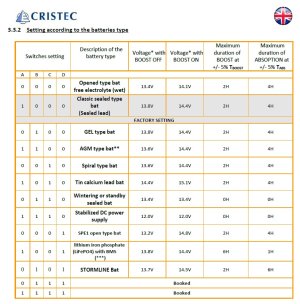
It took me almost a year and half a dozen emails to extract the info from Exide regarding the correct charging and float of their ER350 battery which was prompted by my domestic set gassing off when left on charge on the pontoon hooked up to the boat's Cristec charger. I found the charger had been left on it's factory default "sealed lead acid 13.8v float" setting rather than open lead acid with 13.4v float, so I flicked a DIP switch to correct that and the gassing stopped. The ER350 spec says float at 13.7v though.
Here's the info Exide send me which will apply to other batteries in this range.
Lead Acid Battery Types - Flooded/Wet Deep Cycle, Leisure & Marine
Bulk Charging (Constant Current)12 volt Battery - Charge at a constant current rate of no more than 10 times I20 to a voltage of 14.8V (example; For C20=100Ahr, the max charge current is 10x5A or 50A)
Absorption Charging (Constant Voltage)12 volt Battery - Charge with 14.7V - 14.9V limit for 12 to 24 hrs or when current drops below 1% of the C20 rating (example; C20=100Ahr, the low current shut off is 1%x 100 or 1A)
Float Charging (Constant Voltage) 12 volt Battery - 13.7V
Trickle Charging (charge maintenance during extended storage) - Charge voltage on point - 12.50v Charge voltage off point - 13.5v Limit current to 0.4 times I20
Temperature Compensation - Charging Temperature Compensation: All the listed charging voltages are appropriate for a temperature range of 15-25ºC (60-77ºF). For average operating temperatures below this range (colder than) the maximum voltage set point should be compensated with an increase at a rate of 0.063 Volts Per Cell (0.38 Volts for a 12 v battery) for every 10ºC (18º F.) For average operating temperatures above this range (warmer than) the maximum voltage set point should be compensated with a decrease at a rate of 0.063 Volts Per Cell (0.38 Volts for a 12v battery) for every 10ºC (18º F.)Example: at 35°C (95ºF) and 14.8volt set point Corrected Voltage = 14.8 + ((25-35) x 0.038) = 14.42 volts
Open Circuit Voltage (OCV) @ 20% State of Charge (SOC) - 11.9V
Open Circuit Voltage (OCV) @ 50% State of Charge (SOC) - 12.2V
Open Circuit Voltage (OCV) @ 60% State of Charge (SOC) - 12.3V
Open Circuit Voltage (OCV) @ 70% State of Charge (SOC) - 12.4V
Open Circuit Voltage (OCV) @ 90% State of Charge (SOC) - 12.75V
Special notes -
Battery Temperature: Batteries should be brought to a temperature of at least 60ºF (15ºC) for most efficient charging and below 85ºF (30ºC) to limit over heating effects.
AC Ripple Charge Limitations: Some DC chargers will have what is referred to as an AC ripple wave-form to the charging input. Excessive ripple can cause battery heating and gassing resulting in reduced life. Ripple current excursions during the float charging phase should not exceed 5 Amps for every 100 AH of nominal capacity (Example: 4 amps for 80 AH battery)
Ripple voltage excursions during float should not exceed +/- 5% of the float voltage. (Example: +/- 0.70 volts at 13.8 volts)
Operating Temperature: The recommend operating temperature range is 10ºC - 30º (50ºF -86ºF) for optimal operation. Lower temperatures will limit capacity output. Higher temperatures may reduce life. Maximum operating temperature is 50ºC (122ºF).
Other Guidelines -
Storage: For open circuit storage it is recommended that the battery be stored indoors in a clean, dry location. Never store (or operate) in an airtight enclosure. Keep away from direct heat sources.
Storage temperature should be between 50ºF - 77ºF (10ºC - 25ºC). Batteries should be disconnected from all potential load sources during storage. Batteries should be fully charged prior to storage.
Batteries should be boost charged every 6 months or when the battery voltage reaches 12.52 volts. Storage at elevated temperatures will result in accelerated rates of self discharge.
A general rule of thumb is that for every 18ºF (10º) above 77ºF (25ºC) the time before boost charging will be halved.
Storage without proper charge can result in excessive sulfation and can be detrimental to battery performance and life.
Helpful explanations
1) Calcium and Antimony notations refer to metal alloy additives used in battery grids. These alloys have small effects on the charge voltages.
2) Bulk charging is the rapid and most aggressive re-charge method. It is typically only used in applications that need rapid recovery for deeply discharged batteries. Battery cooling may be required.
3) Absorption charge is an aggressive method where current is allowed to diminish as the battery naturally comes to full charge. It can be used for deeply or less deeply discharged batteries. Battery cooling may be required.
4) Float charge is a stage where the battery is charged at a lower voltage to slowly "top off" a slightly discharged battery.
5) Trickle charging is used to maintain charge during a long storage period. Charge voltage on/off points are very important to hold charge without damaging battery life.
6) State of Charge (SOC) is a highly variable number. Data should be taken as reflective of technology listed, but actual performance may be plus/minus 0.10 volts.
7) The reference to C20 in the table above means 20 hour capacity as measured in amp-hours (Ahr). Similarly, I20 refers to the current discharge rate for 20 hour capacity. For example, a C20 of 100 Ahr would have an I20 of 5 amps (5 amps times 20 hours = 100 Ahr)
8) To estimate C20 capacity for 12 volt batteries from RC* rating see below.
9) The term SLI refers to automotive batteries used for Starting, Lighting and Ignition (SLI)
For 24 volt systems that are comprised of two (2) 12 volt batteries connected in series that are charged with 24 volt chargers (with no parallel battery connections)
1) All charging voltages double (due to series connection) as listed in the above table.
2) All charging currents remain identical to 12 volt numbers as listed above (due to the series connection.)
3) All charging times remain identical to 12 volt numbers as listed above (due to the series connection.)
For 48 volt systems that are comprised of four (4) 12 volt batteries connected in series that are charged with 48 volt chargers (with no parallel battery connections)
1) All charging voltages increase X 4 (due to series connection) as listed in the above table.
2) All charging currents remain identical to 12 volt numbers as listed above (due to the series connection.)
3) All charging times remain identical to 12 volt numbers as listed above (due to the series connection.)
RC* explanation and EN calculations
The nominal reserve capacity RC is the time (in minutes) that a battery can maintain a discharge of 25A to a cut-off voltage of U1 = 10.50V.
The value of RC (min) may be estimated from C20 (Ah) by the use of the following equation:
RC = β (C20)ᵅ with:
Flooded batteries Valve regulated batteries
α = 1.1828 1.1201
β = 0.7732 1.1339
Reciprocal equation:
C20 = ô (RC)ƴ with:
Flooded batteries Valve regulated batteries
ƴ = 0.8455 0.8928
ô = 1.2429 0.8939
Here's the info Exide send me which will apply to other batteries in this range.
Lead Acid Battery Types - Flooded/Wet Deep Cycle, Leisure & Marine
Bulk Charging (Constant Current)12 volt Battery - Charge at a constant current rate of no more than 10 times I20 to a voltage of 14.8V (example; For C20=100Ahr, the max charge current is 10x5A or 50A)
Absorption Charging (Constant Voltage)12 volt Battery - Charge with 14.7V - 14.9V limit for 12 to 24 hrs or when current drops below 1% of the C20 rating (example; C20=100Ahr, the low current shut off is 1%x 100 or 1A)
Float Charging (Constant Voltage) 12 volt Battery - 13.7V
Trickle Charging (charge maintenance during extended storage) - Charge voltage on point - 12.50v Charge voltage off point - 13.5v Limit current to 0.4 times I20
Temperature Compensation - Charging Temperature Compensation: All the listed charging voltages are appropriate for a temperature range of 15-25ºC (60-77ºF). For average operating temperatures below this range (colder than) the maximum voltage set point should be compensated with an increase at a rate of 0.063 Volts Per Cell (0.38 Volts for a 12 v battery) for every 10ºC (18º F.) For average operating temperatures above this range (warmer than) the maximum voltage set point should be compensated with a decrease at a rate of 0.063 Volts Per Cell (0.38 Volts for a 12v battery) for every 10ºC (18º F.)Example: at 35°C (95ºF) and 14.8volt set point Corrected Voltage = 14.8 + ((25-35) x 0.038) = 14.42 volts
Open Circuit Voltage (OCV) @ 20% State of Charge (SOC) - 11.9V
Open Circuit Voltage (OCV) @ 50% State of Charge (SOC) - 12.2V
Open Circuit Voltage (OCV) @ 60% State of Charge (SOC) - 12.3V
Open Circuit Voltage (OCV) @ 70% State of Charge (SOC) - 12.4V
Open Circuit Voltage (OCV) @ 90% State of Charge (SOC) - 12.75V
Special notes -
Battery Temperature: Batteries should be brought to a temperature of at least 60ºF (15ºC) for most efficient charging and below 85ºF (30ºC) to limit over heating effects.
AC Ripple Charge Limitations: Some DC chargers will have what is referred to as an AC ripple wave-form to the charging input. Excessive ripple can cause battery heating and gassing resulting in reduced life. Ripple current excursions during the float charging phase should not exceed 5 Amps for every 100 AH of nominal capacity (Example: 4 amps for 80 AH battery)
Ripple voltage excursions during float should not exceed +/- 5% of the float voltage. (Example: +/- 0.70 volts at 13.8 volts)
Operating Temperature: The recommend operating temperature range is 10ºC - 30º (50ºF -86ºF) for optimal operation. Lower temperatures will limit capacity output. Higher temperatures may reduce life. Maximum operating temperature is 50ºC (122ºF).
Other Guidelines -
Storage: For open circuit storage it is recommended that the battery be stored indoors in a clean, dry location. Never store (or operate) in an airtight enclosure. Keep away from direct heat sources.
Storage temperature should be between 50ºF - 77ºF (10ºC - 25ºC). Batteries should be disconnected from all potential load sources during storage. Batteries should be fully charged prior to storage.
Batteries should be boost charged every 6 months or when the battery voltage reaches 12.52 volts. Storage at elevated temperatures will result in accelerated rates of self discharge.
A general rule of thumb is that for every 18ºF (10º) above 77ºF (25ºC) the time before boost charging will be halved.
Storage without proper charge can result in excessive sulfation and can be detrimental to battery performance and life.
Helpful explanations
1) Calcium and Antimony notations refer to metal alloy additives used in battery grids. These alloys have small effects on the charge voltages.
2) Bulk charging is the rapid and most aggressive re-charge method. It is typically only used in applications that need rapid recovery for deeply discharged batteries. Battery cooling may be required.
3) Absorption charge is an aggressive method where current is allowed to diminish as the battery naturally comes to full charge. It can be used for deeply or less deeply discharged batteries. Battery cooling may be required.
4) Float charge is a stage where the battery is charged at a lower voltage to slowly "top off" a slightly discharged battery.
5) Trickle charging is used to maintain charge during a long storage period. Charge voltage on/off points are very important to hold charge without damaging battery life.
6) State of Charge (SOC) is a highly variable number. Data should be taken as reflective of technology listed, but actual performance may be plus/minus 0.10 volts.
7) The reference to C20 in the table above means 20 hour capacity as measured in amp-hours (Ahr). Similarly, I20 refers to the current discharge rate for 20 hour capacity. For example, a C20 of 100 Ahr would have an I20 of 5 amps (5 amps times 20 hours = 100 Ahr)
8) To estimate C20 capacity for 12 volt batteries from RC* rating see below.
9) The term SLI refers to automotive batteries used for Starting, Lighting and Ignition (SLI)
For 24 volt systems that are comprised of two (2) 12 volt batteries connected in series that are charged with 24 volt chargers (with no parallel battery connections)
1) All charging voltages double (due to series connection) as listed in the above table.
2) All charging currents remain identical to 12 volt numbers as listed above (due to the series connection.)
3) All charging times remain identical to 12 volt numbers as listed above (due to the series connection.)
For 48 volt systems that are comprised of four (4) 12 volt batteries connected in series that are charged with 48 volt chargers (with no parallel battery connections)
1) All charging voltages increase X 4 (due to series connection) as listed in the above table.
2) All charging currents remain identical to 12 volt numbers as listed above (due to the series connection.)
3) All charging times remain identical to 12 volt numbers as listed above (due to the series connection.)
RC* explanation and EN calculations
The nominal reserve capacity RC is the time (in minutes) that a battery can maintain a discharge of 25A to a cut-off voltage of U1 = 10.50V.
The value of RC (min) may be estimated from C20 (Ah) by the use of the following equation:
RC = β (C20)ᵅ with:
Flooded batteries Valve regulated batteries
α = 1.1828 1.1201
β = 0.7732 1.1339
Reciprocal equation:
C20 = ô (RC)ƴ with:
Flooded batteries Valve regulated batteries
ƴ = 0.8455 0.8928
ô = 1.2429 0.8939
Last edited: