Exhaust temps

Can you post a link to the cameras you have, please. I have been looking but they all seem to be security cameras and all seem to revert to infrared in the dark so black and white only. I am looking for one with wireless link to phone or tablet and with a white light to illuminate the engine space when recording .

www.solocoastalsailing.co.uk

I bought the cameras in 2015, so the link to my original purchase is no longer valid - but they look the same as this - ZOSI 1080P Home Surveillance Camera 4in1 3000TVL HD CCTV Security Camera Outdoor 615068927222 | eBay

These aren't wireless though. I bought a small monitor like this 5Inch TFT LCD HD Screen Monitor For Car Rear View Reverse Backup Camera | eBay

I figured this was more convenient than trying to use my phone or tablet.

The display takes 2 inputs, so I installed 2 cameras (one fore and one aft of the engines) and wired up a switch box combining a 2 way switch to swap cameras and a power switch.

It works great and is always on when underway. There's no need to lighting in the engine room as the cameras are IR, but they are black and white when running in IR mode.

They've helped a few times already - for example, we had a raw water blockage that led to the cap coming off the back of the exchanger - with the camera I saw it immediately and was able to slow and shut down the engine before the engine temps changed, or the bilge flooded.
 
Hi folks,

I too have order the silcone marine dual kit with an alarm extension for the flybridge. Did we all use a 4mm wood bit for drilling the exhaust?

Just checking.

D
 
After following a few threads on here I’ve fitted an exhaust temperature sensor (SM010). Having put a few hours on this year I’m getting around 28c at displacement speeds, 48c at 3000rpm cruising and 55c at WOT 3600rpm. Sound about right?

Well impressed with the product, came with absolutely everything that might be required to install it.

Edited to add VP TAMD41P.

I think much depends on where the sensor is placed. Because of access mine are different to each other. The port engine typically is much hotter than stbd and at low rpm will run at 60 C. A quick free rev of the engine will bring it down to 40 temporarily and at WoT it is 70C. The stbd sensor mounted lower down is typically 30C cooler at low revs but will match around 70 at WoT.
I dont think the actual temps mean anything other than to set a baseline from which to set an alarm point. The port engine riser is also older than the stbd one and may have a channel slot blocked but either way the engine temps are rock steady and so I am not inclined to investigate further.
 
the other slightly more complex approach is to fit a pressure sensor in the seawater cooling circuit after the impeller and before the heat exchanger:
if pressure goes up means blocked heat exchanger
if pressure goes down blocked inlet or buggered impeller
for the record in this setup yanmar 2GMF shows 0.2bar at 1000rpm, 0.5bar at 3000rpm.

I do something far less tech but has proved just as effective. I pinch the raw water pipe immediately after the pump and strainer to feel the pressure after startup. It tells me two things. If there is a restriction downstream by the effort it takes to pinch. Virtually none at startup idle. And 2nd if the pump is primed and actually working (not a guarrantee with KADs) by how long I can pinch it before it forces my fingers apart. Normally a second or so. It also helps purge any air in the basket rather than loosening the cap and having seawater land on the alternator.
 
I think much depends on where the sensor is placed. Because of access mine are different to each other. The port engine typically is much hotter than stbd and at low rpm will run at 60 C. A quick free rev of the engine will bring it down to 40 temporarily and at WoT it is 70C. The stbd sensor mounted lower down is typically 30C cooler at low revs but will match around 70 at WoT.
I dont think the actual temps mean anything other than to set a baseline from which to set an alarm point. The port engine riser is also older than the stbd one and may have a channel slot blocked but either way the engine temps are rock steady and so I am not inclined to investigate further.
I’ve got pretty consistent baseline temps now, just a very slight rise recently in line with sea temperature. Telling that the installation instructions don’t give temp guidelines, only that temps tend to be lower than people expect, which is my experience.
 
Jellyfish season here now. They should prove very useful indeed. I always seem to suck in one or two that clog the basket
 
Is there a risk, that the system would not be tight? Or am I too scared?
The little rubber washer seals the exhaust well. I tried to tighten the screw clamp ‘just enough’ without going mad, seems to work ok, no leakage I can discern.
 
Surely it is better to be proactive and get an alarm if the inlet is blocked rather than wait for an alarm on the outlet side?
 
Surely it is better to be proactive and get an alarm if the inlet is blocked rather than wait for an alarm on the outlet side?
true, but it wont be as easy and cheap as the exhaust hose mounted sensor...

For the record and as I pointed earlier in the thread, that's the approach I followed.
Since flowmeters at the sizes we are talking are either a 5euro really crap plastic item from China (I bought a couple and have left them in a drawer) that I wouldn't dare fitting them inline and heaven forbid under the waterline level or 200+ euro decent items, the only option seems to be to measure seawater circuit pressure. Teeing off somewhere after the impeller and before the first heat exchanger does the trick nicely and is much better than placing inline the main water flow a dubious device that may disintegrate blocking completely the seawater flow!
Problem again is suitability of sensors, seawater compatible sensors are in the 400+ euro range for 0-2~5 bar (WIKA, Danfoss). Found some decent quality plastic bodied ones from ebay for 40-50euro each, put them at the top of the engine with pickup looking down, so in theory soon after engine is off, seawater drains off them. Fingers crossed they are still working, now on their third season. Also handy as you don't have to start the engines and run back to see water coming out of the exhausts furthermore that I converted my exhausts to u/w...

V.
 
Is there a risk, that the system would not be tight? Or am I too scared?

I’ve had basic exhaust temp alarms for years and they just wrap around the outside of the exhaust.
I’ve just bought the digital ones from ebay and have installed one already on our sailing boat - I just strapped it to the outside of the exhaust bend and it works fine.
I’m not sure I’d want to drill a hole in an otherwise serviceable exhaust.
 
Surely it is better to be proactive and get an alarm if the inlet is blocked rather than wait for an alarm on the outlet side?

Whilst inlet flow is another useful metric it doesn’t cover as many ills as outlet temp IMO. For example the raw water cooling system can lose integrity (seal or rubber cap fail) and the inlet flow remains unchanged, but the exhaust temp increase significantly. Or a reduction in flow might be satisfactory for continuing at lower rpm, but not at higher rpm, when the direct measurement we care about is it’s effect of rising temperatures.

The question ultimately is what is the lag between a blocked inlet and a noticeable change in exhaust temp. I suspect this is fast as in the absence of flow at the outlet, dry exhaust gases will be very high. Certainly this is way more effective than waiting for the closed loop cooling to be affected. Plus it’s simple to install and monitor.
 
Whilst inlet flow is another useful metric it doesn’t cover as many ills as outlet temp IMO. For example the raw water cooling system can lose integrity (seal or rubber cap fail) and the inlet flow remains unchanged, but the exhaust temp increase significantly. Or a reduction in flow might be satisfactory for continuing at lower rpm, but not at higher rpm, when the direct measurement we care about is it’s effect of rising temperatures.

The question ultimately is what is the lag between a blocked inlet and a noticeable change in exhaust temp. I suspect this is fast as in the absence of flow at the outlet, dry exhaust gases will be very high. Certainly this is way more effective than waiting for the closed loop cooling to be affected. Plus it’s simple to install and monitor.

I'm leaning this way. I don't want to drill any holes in a perfect and extremely robust exhaust bellow or a similarly chunky stainless steel elbow. At the end of the day, it's a change in temp rather than absolute temps that need measuring. A sensor strapped to the outside of the metal elbow should provide the same metric. It will just likely require that the alarm warning is set at a lower temp level and it might take a little longer to react but as mentioned above, with no water cooling of the gasses I would expect temps to rise within a matter of seconds. Surely the purpose of these sensors as much as to warn of blocked flow is also to prevent a potential fire or meltdown/heat damage in an engine bay from the elevated temps associated with an overheating/uncooled exhaust?
 
I'm leaning this way. I don't want to drill any holes in a perfect and extremely robust exhaust bellow or a similarly chunky stainless steel elbow. At the end of the day, it's a change in temp rather than absolute temps that need measuring. A sensor strapped to the outside of the metal elbow should provide the same metric. It will just likely require that the alarm warning is set at a lower temp level and it might take a little longer to react but as mentioned above, with no water cooling of the gasses I would expect temps to rise within a matter of seconds. Surely the purpose of these sensors as much as to warn of blocked flow is also to prevent a potential fire or meltdown/heat damage in an engine bay from the elevated temps associated with an overheating/uncooled exhaust?

I agree with all of the above.
 
Interesting (y)
Does anyone have any product recommendations for the exhaust alarms that do not need drilling (external sensor on the elbow)?
 
Apparently Silicone Marine offer one as an alternative, I haven't spoken to them yet so I have no details currently. I'd imagine it really wants attaching to metal for one to work effectively.
 
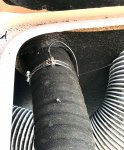
When I drilled a 4mm hole in the exhaust riser bellows the hole almost sealed itself when pulling out the drill. Shoving the sensor in was a satisfyingly tight fit. Remember these are service items that need regular replacement. Having done it myself I have no qualms about the integrity of the installation or any perceived danger should they fall out. The resulting hole in the rubber is about 1mm and about 3 inches above the waterline. should it ever leak it will be by drop rather than dribble
 
Top