Excessive fouling this year

Antifoul certainly 'ain't what it used to be as some thirty years ago I used to get two whole summers protection out of a two pack tin of premium International antifoul - and that's with leaving the boat afloat during the intermediate winter to save on haul out and storage ashore costs.

Fast forward to now and a April to October season calls for two pressure washes to have any hope of keeping a hull clean in the same geographical area.

Doubtless the antifoul manufacturers are happy with that because they'll sell more of the wretched stuff every year and the yards are happy with that because of all the extra income from lifts and scrubs during their quiet season but I'll bet my house you won't find any boat owners who're happy about that at all.
Describe the house.
 
I reckon that if you trawl the forums you will find posts, and evidence, going back > 10 years that fouling is much worse “this” year than it’s ever been. My 2p worth: 1. Rising sea and summer temperatures mean it is generally getting worse; 2. Legislation results in products getting less effective; 3. The worst locations for fouling change randomly year-by-year, even within a small area.

In my experience the performance of eroding antifoul is dramatically, er, eroded after the first scrub.

I remember a fisherman in my home town maybe 20 years ago saying it was cheaper and more effective for him to use gloss paint and scrub regularly.
 
I reckon that if you trawl the forums you will find posts, and evidence, going back > 10 years that fouling is much worse “this” year than it’s ever been. My 2p worth: 1. Rising sea and summer temperatures mean it is generally getting worse; 2. Legislation results in products getting less effective; 3. The worst locations for fouling change randomly year-by-year, even within a small area.

In my experience the performance of eroding antifoul is dramatically, er, eroded after the first scrub.

I remember a fisherman in my home town maybe 20 years ago saying it was cheaper and more effective for him to use gloss paint and scrub regularly.

I’d agree with all of that.

Somebody at MYC managed to paint his keel in primer thinking the used tin laying about was antifoul.

After a few months the keel looked like the boat hadn’t been touched for years and the rest of the boat not too bad.

Antifoul helps a bit but any claims about lifespan made by manufacturers shouldn’t be taken seriously.

‘Self Polishing’ - works until first scrub

‘Two season protection’ - not season years but possibly spring and summer if you regularly scrub.

‘Highest Strength Biocide’ - tiny bit of special jollop added, still doesn’t work

Etc
 
I've discovered, unfortunately, that even within a single mooring area there can be a fair bit of variation in fouling. Where I am (Queenborough) the depths and currents are really variable across the moorings. I got moved to somewhere where the boat seems to build up a thin skim of silt, after which it's near irrelevant what paint I put on. It seems to help if I take the boat out for a really good slightly overpowered thrash into chop (or am I deceiving myself?) at least every other week, but four weeks of no or gentle trips is enough to let the barnacles start, after which that hardly works.

I am sure the warm late spring hasn't helped - warmed the water up earlier.
 
What would the fouling been like if antifoul isn't used ?

Is it getting to the stage, where money spent on antifouling would be better spent on getting the boat scrubbed ?


I am beginning to wonder that.

A couple of years ago a brand new mooring buoy was fitted to my mooring shortly before I launched with two generous coats of similarly coloured antifoul on the boat. The rate of fouling build up between the immersed section of the buoy and my hull through that season appeared about the same.

Sooo... Scrubs on a muddy slip can be had for the price of a pub lunch and a couple of hours of fun with a pressure washer on a sunny afternoon whereas two coats of antifoul entails the laying out of almost ten times that much cash and endless sanding and painting on an inevitably bloody freezing cold March day and you just know that despite all that aggravation you'll be scrubbing off later on anyway.

Could be something in this ya knows.
 
Last edited:
I am beginning to wonder that.

A couple of years ago a brand new mooring buoy was fitted to my mooring shortly before I launched with two generous coats of similarly coloured antifoul on the boat. The rate of fouling build up between the immersed section of the buoy and my hull through that season appeared about the same.

Sooo... Scrubs on a muddy slip can be had for the price of a pub lunch and a couple of hours of fun with a pressure washer on a sunny afternoon whereas two coats of antifoul entails the laying out of almost ten times that much cash and endless sanding and painting on an inevitably bloody freezing cold March day and you just know that despite all that aggravation you'll be scrubbing off later on anyway.

Could be something in this ya knows.
An alternative for weekend sailors could be dry sailing. This was being done at Hamble Point marina (where our agents are based). As far as I remember they did something like twelve lifts in and out for about half the cost of a marina berth, about 20 years ago.
 
An alternative for weekend sailors could be dry sailing. This was being done at Hamble Point marina (where our agents are based). As far as I remember they did something like twelve lifts in and out for about half the cost of a marina berth, about 20 years ago.
I'm not surprised, their mooring fees are 20 times the cost of mooring at my Sailing club or 5 X a local commercial mooring.
 
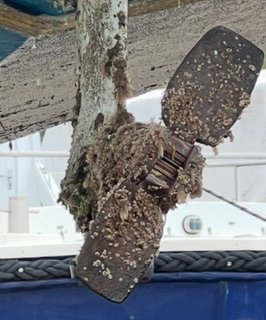
IMG_0162.jpeg

This was my poor little saildrive prop after three months on the Crouch at Bridgemarsh. The rest of the hull came out fine (other than the bottom of the keel). Not sure what else I can do other then lift and scrub twice in the summer, I can’t dry out due to the shape of the bottom of my wing keel.
 
I did make a discovery this year about Sea Squirts. When cleaning my prop. I squeezed one and the contents travelled about 3 feet and hit my mate in the eye.
Apparently, there are approximately 3000 species of Sea Squirts. Perhaps there is an East Coast variety.
 
I did make a discovery this year about Sea Squirts. When cleaning my prop. I squeezed one and the contents travelled about 3 feet and hit my mate in the eye.
Apparently, there are approximately 3000 species of Sea Squirts. Perhaps there is an East Coast variety.
And of all the things that grow on the bottom of boats, they're the most closely related to us. They belong to the Chordates! It's not apparent unless you see the larval forms.

See Ascidiacea - Wikipedia
 
Last edited:
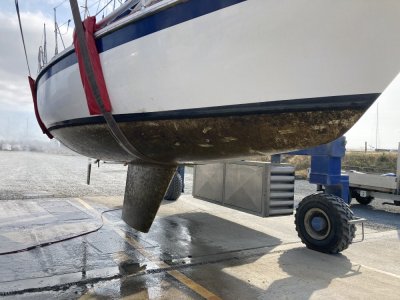
In 12 months without a scrub and little usage, Concerto was in Chatham Marina, then I sailed to Pwllheli and a few weeks later I had her lifted. This is how she looked. This shows why fouling in Chatham Marina is a lot lower than in the river. The antifouling is Micron 350 in Dover White.

IMG_2343 1000pix.jpg
 
In 12 months without a scrub and little usage, Concerto was in Chatham Marina, then I sailed to Pwllheli and a few weeks later I had her lifted. This is how she looked. This shows why fouling in Chatham Marina is a lot lower than in the river. The antifouling is Micron 350 in Dover White.

View attachment 199267
Re "This shows why fouling in Chatham Marina... etc"

Not really.
It shows the bottom of a boat.

Perhaps you are suggesting that water movement relative to the hull surface boundry layer reduces the effectiveness of antifouling?
 
Top