oldgit
Well-Known Member
WHY 



Cam 1 - Web Cams and Weather Station, Sheerness | IOS Sailing CommunityRather WHERE??? WindGuru is showing no more than 16kts Wednesday, the BBC (not that you can believe anything they say!) reckon 15mph in the afternoon???

Yes I've noticed the reports after the fact bare little resemblance to the forecast.Cam 1 - Web Cams and Weather Station, Sheerness | IOS Sailing Community
All I wanted was few quiet days away boating ... and perhaps a first time visit to the The Deben.

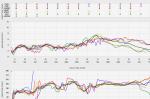
Just look at the variations between different forecast algorithms here (PWG,ECMWF etc top left) , some wildly different from the others. Just goes to show that the forecast depends largely on where you get it from - and they don't all agree by a long chalk.
The screenshot below is interractive on PredictWind.com
View attachment 118194

That is an amazing leap. On the other hand, because of the chaotic nature of the beast, I imagine that the law of dismissing returns applies and that we can expect accurate forecasts to go up from maybe five days to six at the most.Time for another lesson on weather models. Weather models are all based on virtual square of a certain size ... The GFS original square along with many others had a 25 km length. The model calculates on the basis of a single factor applying throughout the square (i.e. the wind force and direction are two variables, and so are constant across the square). Until recently the available computing power meant that the 25 km grid was as small as it could go. Now the Met Office is intending to reduce grid size to 100 METRES, with their new supercomputer...

As you say, an amazing leap. However, as you also suggest, there may be a limit to the reliability of longer-term forecasts imposed by the nature of the beast. The problem is that the modeling system can diverge given tiny differences in the initial conditions - the phenomenon known as computational chaos, which was actually discovered in the field of weather forecasting. The basic idea is that tiny differences - below the accuracy and precision of measurements - can end up being amplified, taking the model down divergent paths.That is an amazing leap. On the other hand, because of the chaotic nature of the beast, I imagine that the law of dismissing returns applies and that we can expect accurate forecasts to go up from maybe five days to six at the most.
Yes. I intended the word chaotic to be read in both common and mathematical senses.As you say, an amazing leap. However, as you also suggest, there may be a limit to the reliability of longer-term forecasts imposed by the nature of the beast. The problem is that the modeling system can diverge given tiny differences in the initial conditions - the phenomenon known as computational chaos, which was actually discovered in the field of weather forecasting. The basic idea is that tiny differences - below the accuracy and precision of measurements - can end up being amplified, taking the model down divergent paths.

And the weather here near Ely is different from one minute to the next!Yes. I intended the word chaotic to be read in both common and mathematical senses.
However. It's Wednesday and no wind to speak of at the moment.
It's not really a giant leap, it's gone through 10 km, and 3km, but the Met Office "business case" for the investment was driven by the Boscastle disaster a few years back. A very localised thunderstorm on the moors inland of the village, wasn't predicted due to the grid size... As AP says, there's still the chaos theory impact (a butterfly beating it's wings in South America can result in a storm in Europe)That is an amazing leap. On the other hand, because of the chaotic nature of the beast, I imagine that the law of dismissing returns applies and that we can expect accurate forecasts to go up from maybe five days to six at the most.
It's a pretty big leap in terms of numbers, or area, x2,500 if I'm right. As upgrades go, this sounds quite impressive. It will be interesting to see what the outcome is. You may be right that the local accuracy will improve greatly, but I think that in terms of time the effect will be less.It's not really a giant leap, it's gone through 10 km, and 3km, but the Met Office "business case" for the investment was driven by the Boscastle disaster a few years back. A very localised thunderstorm on the moors inland of the village, wasn't predicted due to the grid size... As AP says, there's still the chaos theory impact (a butterfly beating it's wings in South America can result in a storm in Europe)
