
Epoxy putty and plastic

webcraft

Well-Known Member
Joined
8 Jul 2001
Messages
40,410
Location
Cyberspace
www.bluemoment.com
IMG_20210828_135612.jpgRe. The thread below re. Our speed transducer leak.

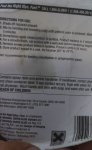
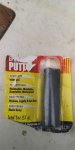
I just looked out the epoxy putty I have. It says 'not recommended for bonding polyethylene or polypropylene plastic'

The plastic nut that tightens the fitting onto the hull looks like polypropylene or polyethylene.

Is it?

IMG_20210828_140002.jpg9mIMG_20210828_140002.jpg
 
Last edited:
Having had a similar problem recently and not wanting to lift out especially, I volunteered my wife to go underwater and with some underwater epoxy rolled in to a thin sausage, she managed to push it around our skin fitting enough to stop a small leak. Once this was achieved, we used conventional 3:1 epoxy/glass to glass the skin fitting in on the inside. Worked a treat. I suspect on a plastic fitting you could simply use epoxy and colloidal silica on the inside to ensure the fitting stays waterproof. Sand everything first for a good key of course
 
I would not have expected a nut to be made of either of these polymers but could be wrong. However, the caution on the epoxy is not because of any possible reaction, it is because it is almost impossible to bond these two plastics, which are normally joined by welding. For sealing a leak the epoxy should be more effective than most alternatives.
 
I've never had any luck with that stuff. Don't bother to carry it now.

Your problem reminds me a bit of Bernard Moitessier describing how he would recaulk a wooden boat underwater by taking down a bucket of sawdust, and letting the dust get sucked into the cracks.

I don't know if that really works, but I have myself refitted a number of underwater skin fittings. Removing them while afloat sounds more alarming than it actually is, provided you are good at holding your breath and have a decent supply of bungs. With a leaky log skin-fitting, the procedure was: (1) swim down and push an oversize bung into the fitting attached to piece of string (other end attached to boat); (2) remove the log from the fitting, undo the locknut and push or tap out the fitting, quickly shoving another bung temporarily into the hole; (3) recover the fitting with the string; (4) clean and add a rubber washer to the fitting slubbed up with silicone sealant (probably marine grease would also work); (5) swim down, knock out the temporary bung in hull and quickly insert the fitting; (6) partner inside does up locknut with more sealant while I'm still underneath holding the bung firmly in the fitting to enable it to be done up tight; (7) knock out the bung from the inside and quickly replace the security cap (or the log itself) on the fitting; (8) bail out the gallon or so of water that got in while doing this. Like Geem, for good measure when it was dry I also glassed in the fitting on the inside .
 
If the through hull nut is white/pale plastic it is probably nylon or fiber reinforced nylon.

There are underwater epoxies that are very good, but the OP does not seem to be using one of those. Pettit Splash Zone is one of the best known. But they are different from other epoxies, more like thickened epoxies, and have their own learning curve. They can be very effective at stopping active leaks, often permanently. Pettit Splash Zone

I also like JB Weld Underwater Weld. Stiffer.

The trick with both is to mix with wet hands (so they do not stick) and then keep kneeding/pressing them to the surface for 5 minutes (this pushes the water out) or so until they stick. It's weird, it dos not seem like it should work, but it does and is well proven. They really do harden and bond well underwater. JB is stiffer and cures faster (good for leaks) and Splash Zone is stronger and more durable (repairs, such as hitting a rock).

Underwater Epoxy Tests
 
If the through hull nut is white/pale plastic it is probably nylon or fiber reinforced nylon.

There are underwater epoxies that are very good, but the OP does not seem to be using one of those. Pettit Splash Zone is one of the best known. But they are different from other epoxies, more like thickened epoxies, and have their own learning curve. They can be very effective at stopping active leaks, often permanently. Pettit Splash Zone

I also like JB Weld Underwater Weld. Stiffer.

The trick with both is to mix with wet hands (so they do not stick) and then keep kneeding/pressing them to the surface for 5 minutes (this pushes the water out) or so until they stick. It's weird, it dos not seem like it should work, but it does and is well proven. They really do harden and bond well underwater. JB is stiffer and cures faster (good for leaks) and Splash Zone is stronger and more durable (repairs, such as hitting a rock).

Underwater Epoxy Tests
We used Aqua-stick Made by Sylmasta, underwater epoxy. It says 15min work time, initial cure 29-30 mins.
 
Top