
Engine revs

Just looked up the technical spec for both the Beta 25 and 35 engines - they are in fact two different beasts, the smaller engine being a higher-revving engine by design - a reminder to be careful when making simplistic comparisons.

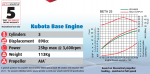
Interestingly, plotting off the theoretical curve, it looks like my 25 must be averaging 2300rpm to be delivering an overall consumption of about 1.5l/hr.
BETA 25.png

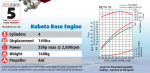
The equivalent consumption for the 35 is achieved at an average of about 1700rpm.
BETA 35.png
 
Last edited:
Just looked up the technical spec for both the Beta 25 and 35 engines - they are in fact two different beasts, the smaller engine being a higher-revving engine by design - a reminder to be careful when making simplistic comparisons.

Interestingly, plotting off the theoretical curve, it looks like my 25 must be averaging 2300rpm to be delivering an overall consumption of about 1.5l/hr.

The fuel consumption figures on the graphs relate to the power figure at the same rpm: in other words it's the fuel consumption at the max power the engine can produce at that particular rpm. Under most circumstances, a cruising boat will demand much less power than an engine can produce at whatever speed it's spinning, and therefore fuel consumption will also be less.

Taking the Beta 25 graph as an example, just because it can produce 16bhp at 2000rpm doesn't mean it needs to on any particular boat. It might only need, say, 12bhp at the boat speed made at 2000rpm. As you'll know, opening the throttle further at cruising speed usually causes acceleration...the thrust for that comes from the "missing" horsepower.
 
Just to add to macd's explanation, fuel consumption is a function of power produced, not revs. You will also find a graph which gives you specific fuel consumption - that is grams of fuel consumed for each hp/kw potential at any given revs. This is fairly flat and varies very little from engine to engine, make to make - that is the thermal efficiency of small high speed diesels such as these is much the same irrespective of make.

So, my boat has the optional 30hp engine (standard is 20), but if I cruise at the same speed I use the same power as the smaller engine, and therefore the consumption is the same, but revs are lower. The advantage of course is that the extra power potential enables the boat to maintain speed better in adverse conditions.
 
You will also find a graph which gives you specific fuel consumption - that is grams of fuel consumed for each hp/kw potential at any given revs.

...which is always optimal (i.e. most economical) at peak torque rpm. This is not to say that in a system, best fuel economy will be seen at that same rpm. Lots of other factors come into play.
 
...which is always optimal (i.e. most economical) at peak torque rpm. This is not to say that in a system, best fuel economy will be seen at that same rpm. Lots of other factors come into play.

Agree, but to generalise if the prop is appropriate and the weight of the boat in the range for the hp, this tends to come around that figure, which is usually 60-70% of max revs. The two examples here (Beta 25 is 2400, and 35 is 2000) fit neatly into this as being the typical cruising rpm.
 
The fuel consumption figures on the graphs relate to the power figure at the same rpm: in other words it's the fuel consumption at the max power the engine can produce at that particular rpm. .....

The fuel consumption on the Beta graphs is what to expect for a typical yacht with the right prop. (there is a note at the bottom of the graph)
so at 2800 rpm it's fairly flat out using 6 litres per hour givng a fair amount of its 35HP
At 2000rpm, it shows 2 litres per hour, the available power is about 27HP, but the actual power to cruise at 2000 rpm is much less, so the fuel consumption is much reduced.

If you load the boat so it struggles to do more than 2000rpm, e.g. a lot of weed, towing, driving into waves and wind, or having the wrong prop, the fuel consumption will be a lot more.
The fuel consumption for most engines is around 0.2 to 0.25 litres per hp per hour, so at 6 litres an hour it's probably putting out 25 to 30 HP and at 1.5 litres an hour, maybe 10?
 
Something wrong there! My 50hp MD22 in my Bene 381 uses 1.8 ltrs per hour, average checked over many hours.

Must admit when I'm motoring I find it a bit boring so crack on a bit, the tank is 186 litres, according to the literature it is designed to give 36 hours motoring. At 2 ltrs/hr I could motor for nearly 4 days.... mind you I'd have died of boredom by then!
 
Yes - macd, Tranona, lw395 - that all makes perfect sense.

That's why I chose the 25 over the 20 when re-engining in 2011 - giving me the extra 'power' when I really need it, which has been frequent enough over the years.
 
The fuel consumption on the Beta graphs is what to expect for a typical yacht with the right prop. (there is a note at the bottom of the graph)
so at 2800 rpm it's fairly flat out using 6 litres per hour givng a fair amount of its 35HP
At 2000rpm, it shows 2 litres per hour, the available power is about 27HP, but the actual power to cruise at 2000 rpm is much less, so the fuel consumption is much reduced.

If you load the boat so it struggles to do more than 2000rpm, e.g. a lot of weed, towing, driving into waves and wind, or having the wrong prop, the fuel consumption will be a lot more.
The fuel consumption for most engines is around 0.2 to 0.25 litres per hp per hour, so at 6 litres an hour it's probably putting out 25 to 30 HP and at 1.5 litres an hour, maybe 10?

So 6 ltr hr is say 28 divide ltr by 4 you get 10? I always thought it would be 7!
Old rule of thumb was 1gallon gives 20 hp for 1 hour still works for me
 
So 6 ltr hr is say 28 divide ltr by 4 you get 10? I always thought it would be 7!
...
Sorry you lost me there? (Or v/v)

So 6 ltr hr is say 28 divide ltr by 4 you get 10? I always thought it would be 7!
Old rule of thumb was 1gallon gives 20 hp for 1 hour still works for me
1 gallon is 4.54 litres, Using 0.2 to 0.25 litres per HP-hr, 20HP x 1 hr would be 4 to 5 litres so your rule of thumb is in agreement.

I find that the times when I've actually wanted to work out range or consumption seem to be when I'm using more power, either because I'm pushed to get somewhere in time or the boat is slow and weedy or a headwind, so I've become cautious/paranoid about guesstimates of fuel consumption. I'm happy to be pleasantly surprised at how little it uses at a relaxed pace in flat calm,
 
Your practice seems in every way appropriate. As said, it is bad practice to consistently run a marine diesel under very light load, particulalry a new one. But the way you've been using the engine is fine. If you do find yourself for some reason running yours very lightly for extended periods, just give it an occasional ten minutes hard running (aka an "Italian tune"). When started from cold, don't leave it idling while everyone faffs about: it's long-term health will be better if it's put under load as soon as possible and warms up quickly. Most engine wear occurs when it's cold. (This doesn't mean you should thrash it as soon as the key's turned, though.)

As to heel angles when motorsailing, your installation handbook probably tells you 25 degrees either way is OK.

I have often wondered about the fact that you should not let a diesel engine turn over without a load on it because of the risk of glazing.

You never hear of this being a problem when talking about diesel engines in eg HGVs. Or maybe it's just me who hasn't heard of such a problem.

As far as canting is concerned I know of twin diesel engine installations where the engines are canted in at 10° so that you have more scope to motor sail using just the leeward engine.
 
I have often wondered about the fact that you should not let a diesel engine turn over without a load on it because of the risk of glazing.

You never hear of this being a problem when talking about diesel engines in eg HGVs. Or maybe it's just me who hasn't heard of such a problem.

....

My 150hp car engine must average about 1 gal/hr so presumably is 'lightly loaded' the majority of the time.
 
Sorry you lost me there? (Or v/v)


1 gallon is 4.54 litres, Using 0.2 to 0.25 litres per HP-hr, 20HP x 1 hr would be 4 to 5 litres so your rule of thumb is in agreement.

I find that the times when I've actually wanted to work out range or consumption seem to be when I'm using more power, either because I'm pushed to get somewhere in time or the boat is slow and weedy or a headwind, so I've become cautious/paranoid about guesstimates of fuel consumption. I'm happy to be pleasantly surprised at how little it uses at a relaxed pace in flat calm,

Whichever way you try to argue it, that rule of thumb is way out of line with reality.

1l per 10hp per hour is more realistic and confirmed by most of the real life figures achieved by those posting on these threads. That is the typical mid 30' boat with a 25 or 30hp engine cruising at 2/3 power achieves average consumptions between 1.5-2l an hour, mostly near the lower of those figures.
 
Whichever way you try to argue it, that rule of thumb is way out of line with reality.

1l per 10hp per hour is more realistic and confirmed by most of the real life figures achieved by those posting on these threads. That is the typical mid 30' boat with a 25 or 30hp engine cruising at 2/3 power achieves average consumptions between 1.5-2l an hour, mostly near the lower of those figures.

You are confusing engine hp available with actual hp used which is a fraction of that
 
Whichever way you try to argue it, that rule of thumb is way out of line with reality.

1l per 10hp per hour is more realistic and confirmed by most of the real life figures achieved by those posting on these threads. That is the typical mid 30' boat with a 25 or 30hp engine cruising at 2/3 power achieves average consumptions between 1.5-2l an hour, mostly near the lower of those figures.
If you can get 20hp for less than 2ltr per hour you have saved the planet I believe
 
You are confusing engine hp available with actual hp used which is a fraction of that

No, I am not.

While the hp used at any revs is less than what is available except at WOT (assuming the boat is propped correctly) it is not less than 50% which is what your figure implies.

The real life average consumption of engines rated at 25-30hp is as quoted and reported by many. That is the only figure that has any meaning for planning passages or calculating ranges if using the engine.
 
Max speed of car 120? Ave speed 50 overall

I don't know what the max speed is supposed to be, but it'll go as fast as I want up hills, probably 130 on the flat, allegedly.
The trip computer seems to say I've averaged less than 40mph and more than 45mpg.
 
Top