Engine cooling thermostat, how does it work

dunno about MANs, but on mine there is definitely a siphon between the second in the line cooler (gearbox oil) and the last in the line one (coolant), meaning that seawater remains between ALWAYS in the engine oil and coolant coolers. Gbox oil is half full usually. Even the higher above all charge air cooler has seawater in it. Not much drains back through the impeller.
The interesting thing is that the anodes are on the pipe coming up from the impeller (ie. low in the circuit) and the charge air cooler cap (high in the circuit and half a meter away from the first...) There's nothing at all till after the turbo (so almost 1.5m route is clear of anodes)

So what you say most likely applies to some diesel marine engines (although I doubt all seawater drains out of yours tbh...)

V.
 
My heat exchangers have 2 large anodes each- d12.

They only part drain and when you take them to bits there is a calcium tide mark that eventually blocks the lower half. Fresh flush over winter is worthwhile in my view


Thing is by the time winter arrives I suspect they have stated to crud up .
As you say the Lower partial 1/2 will benefit from a flush as eventually after a shut down the salt will concentrate as it the heat evaporates off the water thus increasing its likelihood of cruder tougher less re dissolvable film sticking , getting a hold .
That could occur overnight, every overnight .
The more heat cycles with incomplete drain down the thicker the film will form .

By the time you give a good flush in Oct it’s too late as I suspect the majority of the crud thickness that you think you are preventing is already irreversibly attached from the multiple heat cycles over the season usage.

Anodes - yup it’s a wet system deliberately there will be plenty of salt stuck to the sides of the bottom 1/2 as said from the seasons usage for the protective sub atomic particles to move about in .
After a few days that last fresh water flush won’t be that fresh any more from a bit ( not all btw ) residual salt dissolving back in .
 
dunno about MANs, but on mine there is definitely a siphon between the second in the line cooler (gearbox oil) and the last in the line one (coolant), meaning that seawater remains between ALWAYS in the engine oil and coolant coolers. Gbox oil is half full usually. Even the higher above all charge air cooler has seawater in it. Not much drains back through the impeller.
The interesting thing is that the anodes are on the pipe coming up from the impeller (ie. low in the circuit) and the charge air cooler cap (high in the circuit and half a meter away from the first...) There's nothing at all till after the turbo (so almost 1.5m route is clear of anodes)

So what you say most likely applies to some diesel marine engines (although I doubt all seawater drains out of yours tbh...)

V.

Two issues that are separate .
Extending strip downs by flushing .
Anodic Protection .
Delving deeper into the anodic Protection we enter the world of dissimilar metals and more noble metals .
Some manufacturers go down majorly on more noble metals and , or less dissimilar components .
Some less so .
So if the metals right in the first place there less reliance on anodic protection when the engine drains or partially drains like yours Vas .

CAT has had a dreadful time with both culminating with a huge class action law suit and today there service manuals in a “ cover your arse “ kinda way suggest a timed change out of the charge air cooler.iirc it’s every 5 or 7 years .
In effect it’s become after the law suit a throw away part now .

Just google CAT cooler law suits or intercooler problems if you have a spare day :).

MAN coolers and to be fair VP seem made for life , obviously at some stage they need servicing with consumables- gaskets etc , but the cores and body / housing are made with suitable metals and have suitable corrosion protection systems ( does not matter which route ) to last as long as the engine .
There’s no evidence of any dissimilar metal issues with the MAN cooler s thankfully from a corrosion POV they seem on the ball .
 
Last edited:
This whole fresh water flush with a bodged DIY none OEM way in through a hose connection on the strainer with MAN s is nuts.
Tut, tut, L.
When someone is mad, you don't make him/her any good by disclosing it on a forum, you know.
Truly yours, Napoléon B.

the cores and body / housing are made with suitable metals and have suitable corrosion protection systems (...) to last as long as the engine
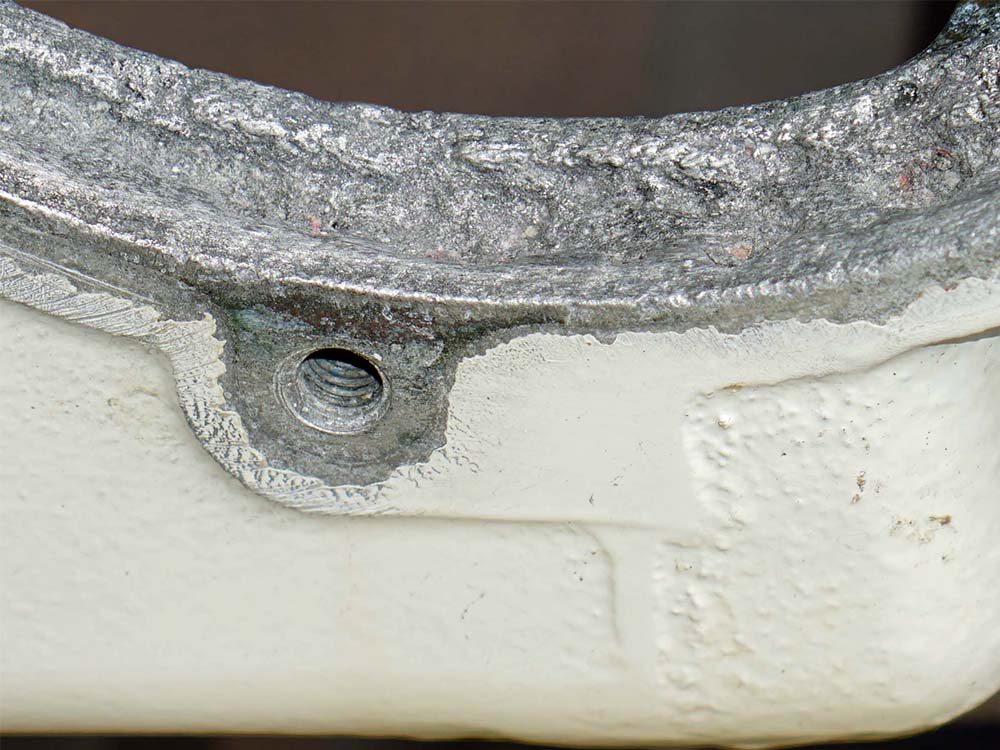
Do you mean like the bog standard EN AW 5083 aluminum below?
Thanks God they didn't use it also for the tube bundle! :ambivalence:

IZGblVZJ_o.jpg
 
Last edited:
although I doubt all seawater drains out of yours tbh...
You're right to doubt it V, because it doesn't.
In ANY marine engine, according to someone whose experience stretches to VP, Cat, MAN, MTU, FPT, DD, Cummins and God knows what else.
The engines installed in PF boat are obviously the exception confirming the rule. :rolleyes:
 
@mapishM , they say there’s a fine between madness and genius .
Thanks for that madness comment , but let’s refrain from going for the man .:encouragement:

Stick to the debate .
We were at flushing main engines to presume reduce corrosion and possibly extend cooler functionality before a strip down is warranted .

One of the reasons MAN hang onto to the 2 year strip down in the “ book “ as well as cleaning the tubes ( both sides unlike a ridlyme job ) is they state gasket Integrity.
Over time there’s some deterioration and this although may not manifest in a leak between the metals there could be micro climates of corrosion of the edges like your pic .
Any fresh flush is not gonna make an iota of difference or seeing as people are getting pedantic - any meaningful difference .This is because tight in the crevice between the failing gaskets and lips of parts there’s no fresh flow , it’s a micro climate of salt , so we end back at the original anodic protection .

However the pic damage is most likely due to inadequate anodic protection, weak contact to the earth cable , not enough mass of zinc hanging in the sea , or my point long periods of lack of use leading to , localised loss of electrical continuity .

You need that continuity- Every where all the time .
Otherwise what’s the point putting Zincs on that will
only to be effective while the engines running ??


When I say they drain down I don’t mean bone dry I mean most of the tubes run dry except the last , bottom ones .Not 1/2 drain like J Rudge has reported.
So keeping protective continuity, but loosing the crud up / salt up , steady rise in temps as time goes on .

Here’s a pic of the main cooler removed after many years .
As you can see 90 to 95 % of the tubes are fine .
The MAN engineer thought they had never been off .I did challenge that btw .
The I 6 ,s do virtually , is that a better word ? - drain down as you can see .

It’s on its side sat on top of the other engine tipped on its side by nearly 90 degrees .
Green line is the bottom for orientation.
Blue the tide mark after draining thus exposing basically all the useable tubes to dry .
If you look carefully there’s some faint green hue on the paint where the end cap meets the body it’s lower side , as said gasket weep .
58219F1B-E082-4322-B2DE-E661D54059DE.jpg

Regarding V MANs (which I,am unfamiliar with )or others if you are unsure re drain down , simply pull a hose off , a lower hose next time you go the boat .
I have changing clamps and they are empty , ok better worded nought runs out but if you poke your finger in and dangle it down comes out wet .
So that’s what I called a drain down .
Talking raw water hoses here btw .
How ever it’s the V,s that the MAN engineers do recommend regular strip downs , I think it’s your charge air cooler sat on top that particularly is prone fouling and the bigger V12 s may not be installed as high enough in bigger boats to get sufficient height difference at the lateral aspects of the main coolers to completely drain and some of those 12:s also have a two impellers in the raw water pumps .

Then there’s relative strainer heights
The top inch of my strainers are approx one inch above the WL AND more or less same height as the raw water pump .
So after a period of inactivity they drain down to an inch from the perplex lid .
Seacocks are as low as you could get them .
The instal was done by Ranerie Tossini .
https://www.tonissi.com/en/start-page/
They removed the factory 510 hps and fitted 700 s , rearranging the plumbing / seacocks location etc .
There must have been reasons for the precise relocation of that stuff , they could have tapped into the existing factory fitted hardware as the foot prints and engine mounts are identical.
 
Good lord the posts get longer ...

Will it gum up a bit in the season. Almost certainly yes.

Does it sit there for 7 months ? Yes. Would I rather have fresh or salt in there? Fresh. Less corrosions, less anode wear, takes 5 mins - makes me happy.
 
I don’t have enough time left in my life to read porto’s posts and sort the wheat from the chaff, but I’m a firm advocate of freshwater flushing. And in case his description “bodged” referred to my own installation, you can FRO Porto because it is a properly engineered installation constructed by proper stainless steel welders - the very same company that made the entire oem strainer assembly at build. And it uses lockable ball valves for x2 safety, and other proper details. You can obviously choose not to freshwater flush Porto but if you want to fling around the word “bodge” let’s start please with your non oem airco that has pipes running uphill.

Porto, serious comment: your posts are too long. It’s killing debate. I’m replying to you without reading all you say, because I’m just not prepared to consume the time. Many others feel the same. You post good stuff:encouragement: but please try getting to the point faster.
 
I don’t have enough time left in my life to read porto’s posts and sort the wheat from the chaff, but I’m a firm advocate of freshwater flushing. And in case his description “bodged” referred to my own installation, you can FRO Porto because it is a properly engineered installation constructed by proper stainless steel welders - the very same company that made the entire oem strainer assembly at build. And it uses lockable ball valves for x2 safety, and other proper details. You can obviously choose not to freshwater flush Porto but if you want to fling around the word “bodge” let’s start please with your non oem airco that has pipes running uphill.

Porto, serious comment: your posts are too long. It’s killing debate. I’m replying to you without reading all you say, because I’m just not prepared to consume the time. Many others feel the same. You post good stuff:encouragement: but please try getting to the point faster.

Bodged word not aimed at you .
Not sure what the airco comment fits this debate or why or if true tbo .Had and continues to silently work away uneventfully for the past 5 summers . Shouldn’t it have ?

Re post L
Sorry chaps but sometimes feel a bigger helicopter view - see it all or as much as poss is better than focusing on 1 sq M point the ground , eg the crevice corrosion point at gasket joints re a flush is supposed to prevent.
The devil like most things is in the detail , so hard not to attempt to include .

Are you gonna change out your charge air coolers at the recommended interval ( 5 or 7 y ) or hopefully expect a longer first time stint by flushing ?
Just thinking residuals and fielding explanations why it’s not been done .
 
Last edited:
@mapishM , they say there’s a fine between madness and genius .
Thanks for that madness comment , but let’s refrain from going for the man .:encouragement:
Ahem. My madness comment was actually related to myself.
You suggested that "a bodged DIY none OEM way in through a hose connection on the strainer with MAN s is nuts".
So, based on terms logic, in your opinion, I am the one who is nuts. :ambivalence:

Seacocks are as low as you could get them
Not exactly shocking news, is it? I've never seen seacocks on the flybridge of any boat!
That aside, to my simple mind, an installation where you are supposed to NOT close seacocks after turning the engines off is indeed weird.
In fact, I don't think that MAN states anything like that, anywhere in their manuals.
 
And in case his description “bodged” referred to my own installation
I'm sure it didn't, J - as per my previous post, PF specifically referred to MAN engines, so the bodged installation is bound to be mine, not yours.
In fact, nobody in his right mind would dare challenging a flush system for Cat engines, which is an understandable attempt to make all their disposable components last more than one season......... :D :p
 
Sorry chaps but sometimes feel a bigger helicopter view - see it all or as much as poss is better than focusing on 1 sq M point the ground , eg the crevice corrosion point at gasket joints re a flush is supposed to prevent.
L, I'm very tempted to ask you on which basis you call the above crevice corrosion, considering that no less than 4 MAN official engineers and 3 fabricators, one of which refurbished more of those shells than he can remember, told me that it isn't.
But I'll resist such temptation, 'cause I fear the answer......... :rolleyes: :p
 
L, I'm very tempted to ask you on which basis you call the above crevice corrosion, considering that no less than 4 MAN official engineers and 3 fabricators, one of which refurbished more of those shells than he can remember, told me that it isn't.
But I'll resist such temptation, 'cause I fear the answer......... :rolleyes: :p

Analogy.

It’s a point not actual crevice corrosion like SS shafts .
It’s the micro climate between the gaskets and parts .
Any fresh flush will make knack all difference to corrosion protection in those areas that you think you are protecting .
Only good anodic continuity works that’s clear evidence.
It’s your nick picking away at the tiny 1sq m ( my analogy) that kinda forces me write long posts .

If your parts “ shells “ are corroding just replacing / fabricating etc with out determining the aetiology is point less .
Stuff like that should last the life of the engine if the correct anodic protection is there all the time .

JRudge has got it in his post “ makes me feel happy “ That’s all flushing does .
That bit I totally agree .

Here’s the bit from the long post #26 that mentions” crevice “

Quote me
Any fresh flush is not gonna make an iota of difference or seeing as people are getting pedantic - any meaningful difference .This is because tight in the crevice between the failing gaskets and lips of parts there’s no fresh flow , it’s a micro climate of salt , so we end back at the original anodic protection .


“ tight in the crevice “ is what I said .

As you read this there’s salt tight in everybody’s crevices in everybody’s HE,s

Either the anodes work or are you and your the folks you get advice from , saying they are part time or intermittent or don’t work = waste of time ?
 
Last edited:
Any fresh flush is not gonna make an iota of difference or seeing as people are getting pedantic - any meaningful difference. This is because tight in the crevice between the failing gaskets and lips of parts there’s no fresh flow , it’s a micro climate of salt
Porto, I deliberately didn't comment this statement before, but since you are now reiterating it, I feel obliged to tell you in not unclear terms how spectacularly wrong it is. So much so, that I can only deduct that you never saw one of these things open.
And since I just did, I can confirm you that your micro climate "aetiology" is, beyond any reasonable doubt, completely laughable.

The HE in MAN V engines are sealed (with a toric joint and not a gasket, btw) in such way that a seal failure can create three different types of leak, no less:

1) with a contamination between cooling liquid and raw water.
This is arguably the most critical, because it can happen behind the scenes, with no external evidence aside from the contamination of the cooling liquid. But unless spotted rapidly, this can seriously damage all the engine components which are designed to be cooled by "324 NF" compliant liquid, not by salt water!

2) with an external leak of cooling liquid.
This is the easier to spot (also because the cooling liquid is coloured) and the less dangerous.
Depending on how bad is the leak, over time a top up might be necessary, but that's no big deal.

3) with an external leak of salt water.
This is the one that leaves salt deposits inside the shell flange, slowly corroding it over time, with the result shown in my previous pic.

So, in a nutshell: micro climate my @rse!

Now, of course it is impossible to avoid "feeding" the leak (3) above with salt water while under way, unless cruising only on lakes.
And a fresh water flush is not going to remove the salt deposits accumulated on the shell flange while cruising, if any.
But that's not the point: there are still good reasons why flush makes sense.
Preventing damages driven by flawed design/materials just doesn't happen to be one of them.

All that aside, if degraded anodes is all it takes to make you happy, who am I to argue?
But if your statement "they are not ornaments" is meant to teach me (or anyone else here in the asylum, for that matter) anything, well, you can save yourself the effort. I'm pretty sure to not be alone in being already aware of how eggs should be sucked.
Btw, when I brought my HEs to the fabricator who rebuilt their flanges, another couple of identical shells were in progress.
And when I came back 2 days later to grab them, they had just received another four for the same treatment.
Hard to imagine that all these things came from boats with neglected anodes.....
 
Porto, I deliberately didn't comment this statement before, but since you are now reiterating it, I feel obliged to tell you in not unclear terms how spectacularly wrong it is. So much so, that I can only deduct that you never saw one of these things open.
And since I just did, I can confirm you that your micro climate "aetiology" is, beyond any reasonable doubt, completely laughable.

The HE in MAN V engines are sealed (with a toric joint and not a gasket, btw) in such way that a seal failure can create three different types of leak, no less:

1) with a contamination between cooling liquid and raw water.
This is arguably the most critical, because it can happen behind the scenes, with no external evidence aside from the contamination of the cooling liquid. But unless spotted rapidly, this can seriously damage all the engine components which are designed to be cooled by "324 NF" compliant liquid, not by salt water!

2) with an external leak of cooling liquid.
This is the easier to spot (also because the cooling liquid is coloured) and the less dangerous.
Depending on how bad is the leak, over time a top up might be necessary, but that's no big deal.

3) with an external leak of salt water.
This is the one that leaves salt deposits inside the shell flange, slowly corroding it over time, with the result shown in my previous pic.

So, in a nutshell: micro climate my @rse!

Now, of course it is impossible to avoid "feeding" the leak (3) above with salt water while under way, unless cruising only on lakes.
And a fresh water flush is not going to remove the salt deposits accumulated on the shell flange while cruising, if any.
But that's not the point: there are still good reasons why flush makes sense.
Preventing damages driven by flawed design/materials just doesn't happen to be one of them.

All that aside, if degraded anodes is all it takes to make you happy, who am I to argue?
But if your statement "they are not ornaments" is meant to teach me (or anyone else here in the asylum, for that matter) anything, well, you can save yourself the effort. I'm pretty sure to not be alone in being already aware of how eggs should be sucked.
Btw, when I brought my HEs to the fabricator who rebuilt their flanges, another couple of identical shells were in progress.
And when I came back 2 days later to grab them, they had just received another four for the same treatment.
Hard to imagine that all these things came from boats with neglected anodes.....

3 - my terms crevice or micro climate seems appropriate in describing it .
It’s corrosion from salt water localised without enough Zinc protecting it .

The zincs protect against the galvanic currents that are set up by dissimilar metals on your boat that are immersed (In a suitable electrolyte) and that are in electric contact with one another.

So
Continuity issues -
Lack of immersion
Lack of Zinc.

While chucking new or refurbed parts at it solves the prob in the short term if you don’t understand the aetiology it’s gonna be a repeat disease so to speak .
 
Last edited:
What part of "flawed design/materials" you don't understand?

Why it only happens in Italy?

Unheard of in other markets like eg America .

What’s the common denominator? Dry winter hangering = cutting continuity in the “ crevices “ micro climates of how you want to describe salt water in contact with a cathode .
 
Last edited:
I don’t have enough time left in my life to read porto’s posts and sort the wheat from the chaff, but I’m a firm advocate of freshwater flushing. And in case his description “bodged” referred to my own installation, you can FRO Porto because it is a properly engineered installation constructed by proper stainless steel welders - the very same company that made the entire oem strainer assembly at build. And it uses lockable ball valves for x2 safety, and other proper details. You can obviously choose not to freshwater flush Porto but if you want to fling around the word “bodge” let’s start please with your non oem airco that has pipes running uphill.

Porto, serious comment: your posts are too long. It’s killing debate. I’m replying to you without reading all you say, because I’m just not prepared to consume the time. Many others feel the same. You post good stuff:encouragement: but please try getting to the point faster.

I'm sure it didn't, J - as per my previous post, PF specifically referred to MAN engines, so the bodged installation is bound to be mine, not yours.
In fact, nobody in his right mind would dare challenging a flush system for Cat engines, which is an understandable attempt to make all their disposable components last more than one season......... :D :p

Personally, I think the fresh water flush mod is genius and shocked it isn't standard! :encouragement::cool:
 
What’s the common denominator? Dry winter hangering
So, let me try to summarize.
Somewhere in MAN operating manual they must have specified that:
1) Dry storage of MAN powered boats should be avoided;
2) Their engines should never be flushed with fresh water;
3) They should never be used in lakes;
4) Engines seacocks should always be left open.
Oh, and as an aside, also that engines should never be used under 75% load, to avoid too low EGT.

Now, may I ask you on which page(s) such restrictions are mentioned?
I can't for the life of me find any of the above.
 
Top