Engine cooling thermostat, how does it work

Personally, I think the fresh water flush mod is genius and shocked it isn't standard! :encouragement::cool:
Glad of your appreciation, because even if (IIRC) jfm was the first forumite to implement this system, I believe to have been the first to suggest it in this thread, almost 10 years ago.
Btw, after finding it, I just had a quick look at a few posts made back then, and interestingly the first and very positive feedback was from Latestarter, no less.
Now, since LS agreed that fresh water flush is good for diesel marine engines, knowing who the chap behind the keyboard is, there's nothing else I need to know - all the rest is noise! :encouragement:

Otoh, on my previous boat, laziness prevailed and I never made such modification.
But when I bought the DP, I took the opportunity of some other refitting jobs for throwing in also a full monty flushing system, so to speak.
As a result, for a/c, genset and shaft seals, all it takes me now to flush them is closing the respective seacocks and open a valve on their own fresh water lines, job done.
Just for practical reasons, on the engines it would have been difficult to make a permanent connection, so a 3/4" valve with a quick coupling connector was fitted on the strainers cover.
Which means that for the engines I need a couple of minutes more, just to bring the hose inside the e/r.
A problem I can leave with.
Pretty much as I can live with anyone calling such system "bodged DIY"... :cool:
 
Glad of your appreciation, because even if (IIRC) jfm was the first forumite to implement this system, I believe to have been the first to suggest it in this thread, almost 10 years ago.
Btw, after finding it, I just had a quick look at a few posts made back then, and interestingly the first and very positive feedback was from Latestarter, no less.
Now, since LS agreed that fresh water flush is good for diesel marine engines, knowing who the chap behind the keyboard is, there's nothing else I need to know - all the rest is noise! :encouragement:
...
Pretty much as I can live with anyone calling such system "bodged DIY"... :cool:
Well said, and completely sensible Mapism. Nice to see LS's erudite comments. You are however -with much sympathy from me- banging your head against a brick wall in this thread.
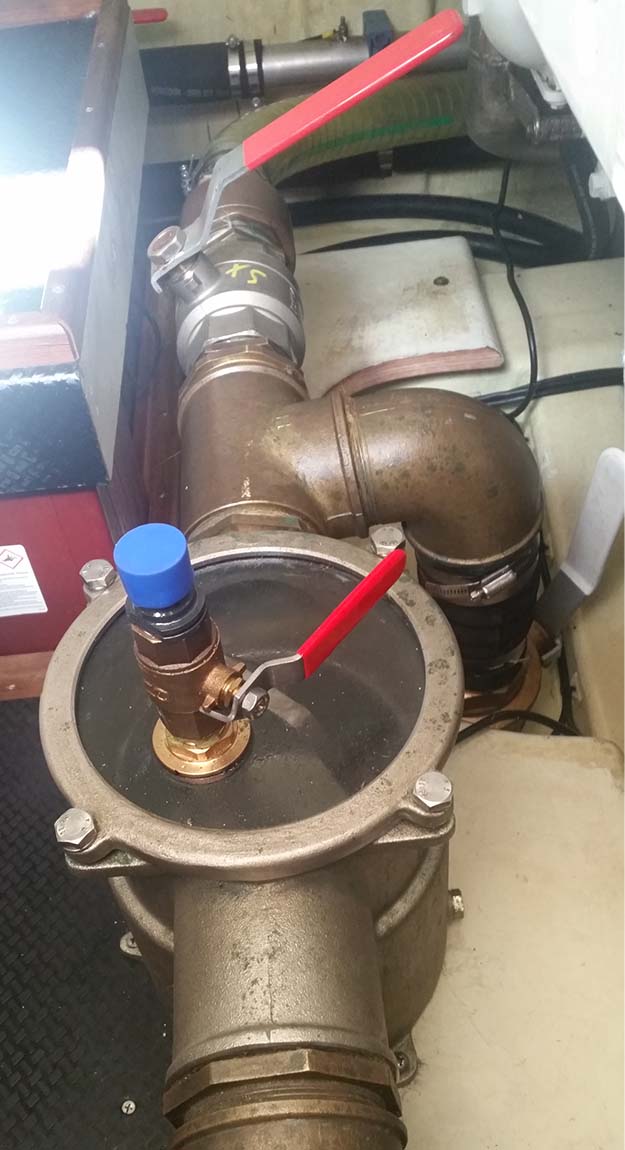
Here's a pic of my bodge. I love the system :) . For the big winter shut down, I have taken to flushing with RO water rather than street water, so the water inside the engines has zero electrolyte function. Just for the hell of it - I'm not seriously saying it makes a meaningful difference :D. The pic also shows a pair of brand new 4inch bronze Italian seacocks - when I get the time I'll do a refit post covering that and much more.

edited-image.png
 
Last edited:
So, let me try to summarize.
Somewhere in MAN operating manual they must have specified that:
1) Dry storage of MAN powered boats should be avoided;
2) Their engines should never be flushed with fresh water;
3) They should never be used in lakes;
4) Engines seacocks should always be left open.
Oh, and as an aside, also that engines should never be used under 75% load, to avoid too low EGT.

Now, may I ask you on which page(s) such restrictions are mentioned?
I can't for the life of me find any of the above.

Page 27 of the service manual for industrial engines states that MAN should be flushed annually at average hours or bi-annually for higher hours.
Page 3 of the service manual states that they should be limited to 50% of maximum load for their first 2.5 hours in the "running in" section.
 
I'm surprised to hear than MAN went that route with inline 6 engines.
In my V8 (as well as in any other V engines, afaik) there is a double pulley with separate belts for the alternator and the circulating pump.
Placed BTW on opposite sides, which makes sense for load distribution, I reckon.

Correct, because in marine applications they have a damped pulley which is in two parts and this damps the engine vibrations and having them balanced in this way prolongs the life of the pulley.

In industrial applications they have the solid one piece pulley as these don't need damping.
 
I stand to be corrected but as the wax melts at a certain temp the valve will only open and quite quickly at that temp. My KADs have two thermostats. Partially to cater for water flow I presume but I believe one opens at a slightly lower temp than the other. This I think controls the all on or all off tendency.

I may be talking complete BS here mind, just repeating what I have been informed when I raised a similar question.

There is no on off as they constantly move to control water flow and water flow affects temperature.

What you have is some serious under and over cooling, when you load your engine and produce heat the lower temperature opens first to give some flow to your coolers, this warms the engine quicker and allows it to work in low temperatures; as the heat rises and the second stat opens and allows even more flow and if you are in an exotic climate it gives some serious cooling ability.

Basically its simple, your engine and set up can work in the coldest or hottest of climates and maintain temperature.
 
There is no on off as they constantly move to control water flow and water flow affects temperature.
I don’t think that is correct. There is no mechanism to open the valve partially and hold it there. The valve opening is done by expansion/contraction of a bit of wax as it changes state (liquid/solid), which is a binary thing. Therefore the valve opening is mainly a binary thing where the valve is either open or closed but not varied like a throttle. Anyway, there is no need for it to operate like a throttle.
 
Nice to see LS's erudite comments.
Absolutely.
Anyone who might be still in doubt about the logic of engine flushing should re-read what LS (aka marine diesel bible, for those who don't know who he is) had to say about that! :encouragement:

Btw, am I right in understanding that your additional flushing connection is placed in such way that it can also backflush the strainer basket, as LS suggested?
I considered doing something similar, but my OEM Guidi strainers were still in such good conditions that my man math didn't stretch to replacing them.
So, I went for the simpler route of having new strainer lids made, with a hole for a 3/4" ball valve.
Obviously, in that position the fresh water flow doesn't backflush the basket, but it can still reverse flush the strainer itself and the whole pipe uphill, all the way to the thru-hull.
No big deal anyhow: in my cruising area, the need to clean the basket it is an extremely rare occurrence.
Btw, since Guidi strainers are widely adopted by several boatbuilder, someone might be interested to know that the 8mm thick polycarbonate lid (which is already very strong) can be replaced with a 10mm one, because the cover screws are more than long enough.

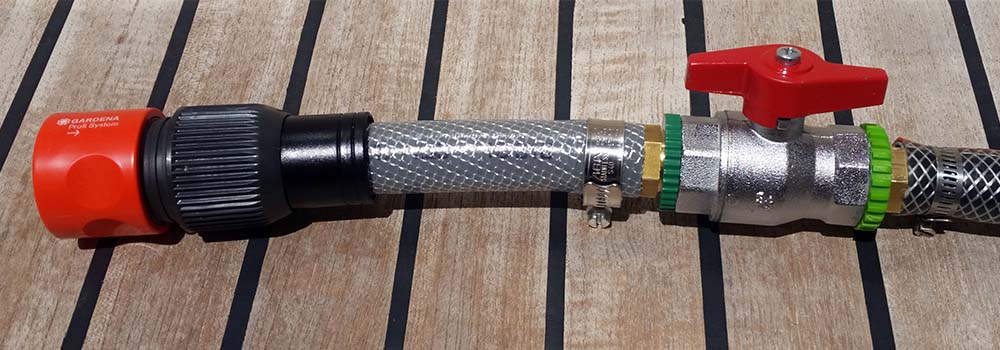
Oh, and one last tip, which you might also be interested in, if I'm right in getting the proportions of your quick coupling vs. the ball valve size:
The typical quick coupling for hoses has an internal diameter of 9mm, which is more than enough for watering the garden, but could be borderline for the flow required by marine engines, even at idle.
Otoh, Gardena makes a whole line of quick coupling connectors, called "Profi", whose internal diameter is a whopping 14mm, which means more than twice the passage. When coupled with a 19mm hose the difference in water flow is impressive - assuming to have an adequate dockside supply, of course.
These Gardena Profi things are the larger quick connectors that I found, and they can easily be bought on Amazon, btw.
Highly recommended. :encouragement:
 
Last edited:
Yes mine are set up for back-flushing exactly as was discussed in your old thread where LS commented. In other words, the freshwater hosepipe injection is on the engine side of the strainer. TBH, I don't see the need to back flush in the med but they are set up for it if I want.

In a pedantic way I don't love back flushing because it relies on the water pump to block the passage of the hosepipe water. If any water passes the pump impeller it gets to the exhaust elbow injection, and then you rely on the detailed design of the elbow to prevent water draining back to the engine (because, when back-flushing, the engine can't be running). That makes me a bit uncomfortable so I don't back flush in this way. I may be over worrying this but there you go.

Your method of drilling the polycarbonate lid is good imho - I think we discussed on another thread. It doesn't back flush but that really doesn't matter.

Thanks for the info re Profi. Mine are as you say the "standard" garden sizes, so smaller than Profi, but they provide enough flow for Cat c32 at idle, even if borderline. I use a soft hosepipe and it doesn't compress as the pumps suck. I have two idle speeds - 650 normal and switchable 550 slow idle - and I flush at 550.

On the next boat I will use Profi but imho the fittings are better if they are all metal as per my picture because I don't trust plastic to retain its properties (strength, non brittleness, etc) after spending a lot of time at (say) 60 degrees ambient temperature. Obviously the Gardena stuff would be on the dry side of the valve so it's no big deal if they snap off, so I'm over thinking this :D The profi might let me flush 2 engines simultaneously!
 
I don’t think that is correct. There is no mechanism to open the valve partially and hold it there. The valve opening is done by expansion/contraction of a bit of wax as it changes state (liquid/solid), which is a binary thing. Therefore the valve opening is mainly a binary thing where the valve is either open or closed but not varied like a throttle. Anyway, there is no need for it to operate like a throttle.

Bad physics there... As a solid melts to a liquid it requires energy (to change state, not increase temperature) that is not instantly available, it takes time to melt. Similarly to transition from liquid to solid, energy must be removed. Both these are very significant to the material used in thermostats due the the desired expansion and contraction.

Anyway, never mind if you believe me,have a look at what the manufacturers say...http://www.ybw.com/forums/showthread.php?522378-Engine-cooling-thermostat-how-does-it-work&p=6818552#post6818552
 
when back-flushing, the engine can't be running
Actually, a touch of genius from LS in that old thread was the suggestion to have a fresh water supply with a capacity higher than the engine pump at idle.
This allows to kill two birds with one stone, because leaving the seacock valve open, the fresh water in excess has nowhere to go other than backwards through the seacock, also with the engine running.
And eventually, after shutting the engine down and closing the fresh water supply, even without closing the seacock, you are still going to leave fresh water everywhere, because it's lighter than sea water.

And on top of that, by not closing the seacock, the engine is also allowed to drain (assuming it does, which to some extent I think is actually true), exactly as much as it would with sea water.
In turn, this might make also PF happy. LOL, by this rate we will soon see the flushing system installed on his boat, too.... :rolleyes:

Below a couple of pics of my own bodge, just for the records.
Apropos, coming to think of it, why not christen this forum flushing thing as the "Bodge"?
You know, along the lines of the LBOK, AnCam, and several other items discussed here in the asylum.... :D :cool:

fv46rV9i_o.jpg


vHc9on2G_o.jpg
 
Last edited:
Thanks P - I'm very tempted to fit this to mine. My only concern is that I need to step over the strainers to get to the backs of the engines - worried that they'll be a PITA. Nevertheless, very tempted. Did you drill your existing lids or make new ones?
 
Did you drill your existing lids or make new ones?
I thought it was a good idea to keep the original, non-holed lids as spares, just in case.
So, I had new ones made to measure, as well as already holed, by these folks.
Made of polycarbonate as the original ones, at around 15 quid for the pair, IIRC.

Btw, Ferretti used to fit the same strainers that I've got on my boat (made by Guidi, model "Mediterraneo", in nickel-plated bronze).
If so, I can confirm that the original 8mm thick lid can be replaced with a 10mm one.
Not because you have to, but just along the lines of better safe than sorry - the cost difference is irrelevant anyway.
The lid diameter for the 3" strainer is 197mm, but for V8 engines the standard size is 2" 1/2, so maybe that's what you've got, I'm not sure.

Don't forget to let us know, if and when you will join the Bodge club! :cool:
 
way too busy (for a change) with work, so haven't followed carefully the thread, just to note that it seems I've used a slightly different approach as I have a 1.25inch pipe from the freshwater tanks going via a stopcock to the 3way toilet valves (by Trudesign) in between the strainer and seawater pump. Engine inlet and strainer are also 1.25in
So when I want to flush the engines, I have to go to the e/r open the freshwater stopcock, close the main inlets to the strainers, then start the engines for a few mins, turn them off and then go down there again and do the opposite to leave the system at sea mode.
I missed the point of flushing without running the engines, but I guess your bigger engines need tons of water that even the pressurised system wont do. Mine just sucks as much as it needs (in idle obviously) for a few mins and it's done.
Main problem with the bodge, is that I think, OK, I'll go out again, wont flush now, and eventually reach Dec and haven't used the boat since Oct and then I forget it alltogether :D. That's what I did this winter...

V.
 
Yup Vas, letting the engine raw water pump suck fresh water from the boat tank is indeed a good alternative.
In my boat, routing a pipe from the tank to the strainers would have been a proper PITA because the e/r is a fully w/tight compartment, with pipes from the aft lazarette to the forward cabins routed inside the stringers, hence not accessible.
But if it weren't for this "layout-dependant" restriction, I would have considered that.

In fact, I don't think that engine size is relevant towards the choice of using a pressurized hose from the dock vs. sucking as much water as the engine pump draws from the boat tank - in both cases, it's just a matter of having a sufficient water flow.
Of course, in your setup, you can't backflush the strainer and the seacock, but in your boots I wouldn't lose one minute of sleep on that.
That's pretty much in the hair splitting category, and its relevance vs. the general principle of engine flushing is like 1 vs. 10, imho.

Ref. forgetting to flush, yeah, that sounds familiar! :D
Otoh, since in your setup you don't need to deal with any dock hose, and all you have to do is open/close some valves, you might consider motorizing them.
This way, engines flush could become just a normal routine upon every boat usage, since you could do it literally at the push of a button from the dashboard once moored, before turning the engines off! :cool:
 
@mapism & vas, one of the problems with motorised valves is that the motor boxes can be huge. I have motorised 1.5inch valves and its hard to find space to mount the boxes. Totally impossible for me with the 4 inch engine intakes. So you would have to rely on flushing with a freshwater supply that you are 100% confident is greater than the engine's raw water pumps consume, so that you can leave the main engine raw water seacock open (as described above) and then you only need a small (say) 3/4inch BSP electric valve in the freshwater supply. But this means you need a big pump forcing the fresh water into the engines, not a suction pipe from the freshwater tank (because seawater will also be sucked).

At least that's how I see it - correct me if my logic is mixed up

I have a pretty big Gianneschi fresh water pump, so I'm now thinking of a pair of small electric valves supplying the fresh water from the boat's domestic water circuit to the strainers with the main sea-cocks left open, with a salinity meter on the dash to tell me I have fresh water pushed down to the bottom of the strainer or down near the sea-cock. That would be a BodgeFlowTM Gold System.
 
Last edited:
That would be a BodgeFlowTM Gold System.
Every time I thought that something discussed here was off the triviality scale, something else followed that raised the bar further.
Hard to think of an example better than this! :D :D :D

Guilty as charged for having thrown a rock in the pond, though: I didn't seriously think that Vas would have considered power valves.
Then again, who am I to put a limit at what he can do with his boat...!? :rolleyes:

PS: no corrections from my part. Your logic is flawless, as far as I can tell.
 
Me again breaking up the party .
Dam I,am a bit slow out of the blocks trade marking this name :):):) Oh hum .

Take a Gardena hose nozzle and turn it on @ the dock to say wash the boat down .
What do you see when you twist the tip ?
Turn it one way and the thing develops a jet , seemingly high pressure 15 ft long great for blasting bird shit etc .Turn it the opposite way and it turns into a spray , the more you turn the finer .
Agreed ?

But the pressure ( P ) before the nozzle has not changed , ie in the hose pipe , the water vol coming out to fill a bucket is the same for the jet and spray pattern .
Buy your bucket fills up the rate which ever way you set it .Vol / min is constant.

It’s the dia of the hose that sets the base P
So with the “ bodge “ ( Gardena fittings or similar in the Perspex not JFM ,s ) surely the tiny hole in the nipple is gonna act as a choke .
This will limit the vol of water .
Remember it’s the gross vol that’s needed to keep up with the tick over impeller demand not the pressure .
A tiny way in compared to the seacock pipage surely can’t meet that demand .
Say going from 3 inch or 2-3/4 to 5/8 th of an inch the nipple will cut the vol down .

Doing it with the main seacocks open just masks this as the pump does not care where it’s source is .

Ideally if you are gonna fresh flush ( reasons aside ) you need the same or near as dam it dia inlet pipage .
As said Gardena from 3 inch or whatever even with a domestic water pump the nipple kills it .

That why fresh flush is viable in jet skis , Williams , OB ,s etc because the garden hose is near enough the same size or if not the perceived pressure differential is actually enough to do the job .

The same dock or tap pressure can do a poxy petrol engine NOT 15 or 32 L of diesel
That’s why it’s not a OEM fitting.Practicalities .

A salinity meter ( drill another hole guys ) is the way to go in the apparatus you hope to protect .
But as said by JRudge ) if it “ makes me happy “:

@ MapisM Have you thought about just adding pencil anodes , more hole drilling ?

@ JFM perfectly understandable why you arranged professional fabrications at build a few year ago in the pending court case against CAT re failed c32+intercoolers ( a subcontractor btw ) .As it turned out they revised the design of the C32 coolers but with fingers burnt with a huge payout in 2016 when the case concluded and despite using titanium parts they still life them for 7 years . Completely understand your anxiety at the build time over this and the remedial action taken .

@MapisM I would try and work out as I said above the common denominator and go from there .As I said I feel it’s Zinc related .

The CAT problem was .
The intercoolers drained down like I said earlier on and iirc one of the two or even all the Zincs dried out ( think hangering) .They we’re positioned in daft places . Dissimilar metals now without the Zinc reacted and out of sight the seal between the water and air corroded.
Water found its way eventually into the cylinders .
Small amount = corrosion of walls and valves , drop off in performance.
Large amount = hydrolock , bust engine .

JFM s point about carefully accessing the exhaust water in position re potentially allowing a back flow , is valid for those thinking of joining the club .

So turn the hose off first .
I see if the cock is open it sucks a shed load of sea in Hmm defeats the object .
If the dock pressure is inadequate you run the risk of shortening impeller life .
If you switch the engines off first AND the dock pressure is as claimed enough to feed 2 3/4 and 3 inch pipes then you run the risk of flooding your turbo .

I can see why builders have ran a mile fitting OEM gear and letting joe public attempt a dockside water flush .

If it’s was that good we would all be doing it .
 
Last edited:
I
Btw, Ferretti used to fit the same strainers that I've got on my boat (made by Guidi, model "Mediterraneo", in nickel-plated bronze).
If so, I can confirm that the original 8mm thick lid can be replaced with a 10mm one.
Not because you have to, but just along the lines of better safe than sorry - the cost difference is irrelevant anyway.
The lid diameter for the 3" strainer is 197mm, but for V8 engines the standard size is 2" 1/2, so maybe that's what you've got, I'm not sure.

Yep, I certainly have Guidi Mediterraneo and they're 3" (well, they have 3 embossed on the side!)
 
They are definitely 3", then.
On top of the dimensions I already mentioned, if you wish to use the same 3/4" thru-hull+valve as I did (Maestrini bronze stuff), the hole is 27mm. :encouragement:
 
@ porto, #57, that is the worst bit of analysis you've written for a long time. Virtually every bit of your fluids analysis (hosepipe nipples, filling buckets, needing a 3inch pipe not a hosepipe) is just wrong. I don't have time/willpower to explain why - another too long post.
The Cat risk of failed peripheral component part may be correct. No matter - you just buy new parts when you need them :) It's only a truck/digger engine, though the c32 is a thing of beauty. (mine = 6 yo now). One of these days, if you can write it succinctly, I'd be interested in what engine you would choose @1400-1600bhp/60 tonne boat. There are iirc only 3 to choose from and it each its downsides (and upsides)
 
Last edited:
Top