Electrical Equipment Upgrade

sgjfrods

New Member
Joined
23 Jul 2012
Messages
21
Visit site
Hi all,

I have a boat with dated electrical equipment and I am interested in upgrading but i am out of touch with what typical equipment a more modern boat would have. It has an auto helm 3000+, GPS plotter, very old depth sounder and old radio (all of which still work).

Are there any upgrades that people would recommend? Wondering if there are any fancy "all in one systems". I am on a budget so would not like to overspend on features that aren't all that useful.

As a starting point I would like a GPS over-ground speed sensor (doesn't currently have) and a more modern depth sounder that is mounted in a place were i can read it from the cockpit. (the old depth sounder is down below near the chart table, not much use when you are at the helm).

I realise this is quite a vague, open question but i am interested to know what equipment other people have on their boats with a view to improving mine. Any advice is much appreciated.
 
An open question indeed!

It'll vary hugely depending on what kind of sailing you do, how much you want to spend, and your attitude to technology.

At one end, I'd say the modern-day basics are a depth sounder built into the boat, a waterproofed phone or tablet running a charting app, and a VHF (which could be a handheld, but fixed gives much better range especially on a boat with a mast). If you sail alone, an autopilot is almost essential too.

My boat is not the perfect example of the other end of the scale, and like many it's evolved over time so isn't necessarily how I'd do everything today, but you wanted examples so here is one.

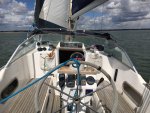
Cockpit Instruments

IMG_0264.jpeg

Left to right across the forward end of the cockpit, we have:

  • Remote unit for the stereo. Rarely used in fact, I've never really got into the habit of music while sailing. Sometimes gets used to play audiobooks on boring Channel crossings.
  • Vesper Watchmate AIS display. Used to be the best available for predicted situation at CPA, though I think modern plotters and OpenCPN have caught up now.
  • Electronic compass display. Good for hand-steering to a compass course, but we rarely do that, relying on the autopilot instead. With the old autopilot it usefully displayed how well it was keeping to the course, but sadly that feature doesn't work with the new pilot. So the instrument is a little redundant at this point.
  • Depth sounder. I'd always want a dedicated depth display so I always know where to look and never have to press any buttons in a hurry. The seabed coming up to hit you is the one thing you can't detect with your own senses so for inshore sailing this is the most important instrument.
  • Wind indicator. Nothing much to say about that. Not essential, our previous boat just had a burgee at the masthead, but it's convenient.
  • Speed display, selectable GPS or paddle-wheel depending on when I last cleaned the latter...
  • Old-school GPS repeater for the "chart nav" setup - see below. Rarely used these days.
  • Plotter. This is an old Raymarine C70, now replaced with a modern Axiom which is vastly better, especially in the radar department.
  • Custom-made switch panel for navigation lights, deck power sockets (cockpit and foredeck), deck lights (car LED running lights glued under the spreaders) and windlass. (This doesn't actually control the windlass, just enables and disables it for safety so that someone lying on the foredeck untangling the jib can't start it accidentally by rolling onto a foot button.)
On the binnacle, we have:
  • Compass, obviously. Rarely used if we're honest, since most of the time we want to steer a fixed compass course I'll just get the pilot to do it. When I'm hand-steering it's most by eye. Compass light comes on automatically with the nav lights.
  • VHF remote controller. 95% of VHF use happens here rather than at the main unit in the cabin.
  • Second plotter. The idea of this one was for those times when you're steering up an unfamiliar harbour, really want to look at the chart but you're stuck behind the wheel, the crew are milling about with warps and fenders so you can't even see the main plotter properly... having your own one right there would be a great stress-reliever. It's certainly been useful on occasion, but I don't use it much now. Partly because I'm more likely to be sailing with people I can trust to do the steering while I do the pilotage, as it should be. It does of course provide a useful backup, including when the original main plotter started failing.
  • Autopilot controller. I have a new one now along with the new pilot, but the purpose is much the same. As well as controlling the pilot it provides the helmsman his own direct view of the wind, speed, and depth information.
  • Engine display and engine control buttons. Not much to say about these.
Also loose around the cockpit I have compass binoculars and, when singlehanded, a wireless remote for the autopilot. I find I use that less than I used to these days, I'm more likely to just stroll back to the cockpit to adjust the course.

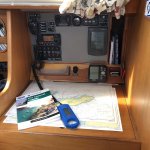
Chart Table
IMG_0410.jpeg

Starting from the top left...
  • VHF handset. Rarely used down here, I only really use the radio when under way, and when underway I'm mostly on deck
  • Placard with callsign and other magic numbers in case needed on the radio
  • External alarm panel for the Vesper Watchmate, mostly for when in anchor watch mode. Unfortunately I never finished building this so it doesn't do anything...
  • Shore power panel. Master switch and polarity / earth test button and neons.
  • Water tank gauge
  • Smartgauge battery monitor
  • Chart table lighting controls - red/white, dimmable, dedicated light for the chart itself (LED strip under the bottom wooden panel that washes across the chart only, so you can see colours despite red ambient light)
  • VHF itself. Used to also be my AIS receiver, but I've since upgraded to a transmitter.
  • Navtex display, also functions as the below-decks nav data repeater, for making log entries on cross-Channel passages etc, and to keep an eye on wind and depth in questionable anchorages over dinner.
  • Electrical switches. Top row "operational", bottom row "domestic". Fuses are behind the panel (notice the latch top-left) and while all circuits are fused, not all have switches where they're included in the equipment itself.
  • Yeoman plotter (the blue puck on the table). Works with an electromagnetic mat under the table surface to do automated picking and plotting with the paper chart. Rather old-fashioned now and I use it a lot less since getting the new plotter, but I still like to plan and track longer passages on paper and this makes it far easier to do so.
  • Garmin GPS. Works with the Yeoman and the repeater in the cockpit to do old-school waypoint-based navigation. Again only really used on passages like across the Channel, and then mostly just to put an ETA to an arrival waypoint on the deck repeater for people's general awareness.
I have a few other interesting bits that are purely electrical, but it sounds like you're asking more about navigation so I'll leave it there for now ?

Pete
 
You already have a “gps speed over the ground sensor”: it’s built into your chart plotter, you just need to figure out how to display the data....
As to what to do in the future, for the sake of simplicity I’d upgrade my equipment using a single manufacturer so as to easily achieve “plug and play” compatibility between the various bit of the system. There’ll be folks advocating this make over that make: I like Raymarine myself but that’s mainly because that’s what came with the boat.
Minimum requirements for me would be depth, plotter and VHF. I’d make sure that the plotter is capable of displaying AIS as well as other instrument data (depth, speed through the water etc) and being networked to the autopilot.
 
...
As to what to do in the future, for the sake of simplicity I’d upgrade my equipment using a single manufacturer so as to easily achieve “plug and play” compatibility between the various bit of the system.

...

Minimum requirements for me would be depth, plotter and VHF. I’d make sure that the plotter is capable of displaying AIS as well as other instrument data (depth, speed through the water etc) and being networked to the autopilot.
I agree with all of that. I've had Garmin and Raymarine in teh past, and the new boat has Simrad which I must say I do like.
 
An open question indeed!

It'll vary hugely depending on what kind of sailing you do, how much you want to spend, and your attitude to technology.

At one end, I'd say the modern-day basics are a depth sounder built into the boat, a waterproofed phone or tablet running a charting app, and a VHF (which could be a handheld, but fixed gives much better range especially on a boat with a mast). If you sail alone, an autopilot is almost essential too.

My boat is not the perfect example of the other end of the scale, and like many it's evolved over time so isn't necessarily how I'd do everything today, but you wanted examples so here is one.

Cockpit Instruments

View attachment 94000

Left to right across the forward end of the cockpit, we have:

  • Remote unit for the stereo. Rarely used in fact, I've never really got into the habit of music while sailing. Sometimes gets used to play audiobooks on boring Channel crossings.
  • Vesper Watchmate AIS display. Used to be the best available for predicted situation at CPA, though I think modern plotters and OpenCPN have caught up now.
  • Electronic compass display. Good for hand-steering to a compass course, but we rarely do that, relying on the autopilot instead. With the old autopilot it usefully displayed how well it was keeping to the course, but sadly that feature doesn't work with the new pilot. So the instrument is a little redundant at this point.
  • Depth sounder. I'd always want a dedicated depth display so I always know where to look and never have to press any buttons in a hurry. The seabed coming up to hit you is the one thing you can't detect with your own senses so for inshore sailing this is the most important instrument.
  • Wind indicator. Nothing much to say about that. Not essential, our previous boat just had a burgee at the masthead, but it's convenient.
  • Speed display, selectable GPS or paddle-wheel depending on when I last cleaned the latter...
  • Old-school GPS repeater for the "chart nav" setup - see below. Rarely used these days.
  • Plotter. This is an old Raymarine C70, now replaced with a modern Axiom which is vastly better, especially in the radar department.
  • Custom-made switch panel for navigation lights, deck power sockets (cockpit and foredeck), deck lights (car LED running lights glued under the spreaders) and windlass. (This doesn't actually control the windlass, just enables and disables it for safety so that someone lying on the foredeck untangling the jib can't start it accidentally by rolling onto a foot button.)
On the binnacle, we have:
  • Compass, obviously. Rarely used if we're honest, since most of the time we want to steer a fixed compass course I'll just get the pilot to do it. When I'm hand-steering it's most by eye. Compass light comes on automatically with the nav lights.
  • VHF remote controller. 95% of VHF use happens here rather than at the main unit in the cabin.
  • Second plotter. The idea of this one was for those times when you're steering up an unfamiliar harbour, really want to look at the chart but you're stuck behind the wheel, the crew are milling about with warps and fenders so you can't even see the main plotter properly... having your own one right there would be a great stress-reliever. It's certainly been useful on occasion, but I don't use it much now. Partly because I'm more likely to be sailing with people I can trust to do the steering while I do the pilotage, as it should be. It does of course provide a useful backup, including when the original main plotter started failing.
  • Autopilot controller. I have a new one now along with the new pilot, but the purpose is much the same. As well as controlling the pilot it provides the helmsman his own direct view of the wind, speed, and depth information.
  • Engine display and engine control buttons. Not much to say about these.
Also loose around the cockpit I have compass binoculars and, when singlehanded, a wireless remote for the autopilot. I find I use that less than I used to these days, I'm more likely to just stroll back to the cockpit to adjust the course.

Chart Table
View attachment 94001

Starting from the top left...
  • VHF handset. Rarely used down here, I only really use the radio when under way, and when underway I'm mostly on deck
  • Placard with callsign and other magic numbers in case needed on the radio
  • External alarm panel for the Vesper Watchmate, mostly for when in anchor watch mode. Unfortunately I never finished building this so it doesn't do anything...
  • Shore power panel. Master switch and polarity / earth test button and neons.
  • Water tank gauge
  • Smartgauge battery monitor
  • Chart table lighting controls - red/white, dimmable, dedicated light for the chart itself (LED strip under the bottom wooden panel that washes across the chart only, so you can see colours despite red ambient light)
  • VHF itself. Used to also be my AIS receiver, but I've since upgraded to a transmitter.
  • Navtex display, also functions as the below-decks nav data repeater, for making log entries on cross-Channel passages etc, and to keep an eye on wind and depth in questionable anchorages over dinner.
  • Electrical switches. Top row "operational", bottom row "domestic". Fuses are behind the panel (notice the latch top-left) and while all circuits are fused, not all have switches where they're included in the equipment itself.
  • Yeoman plotter (the blue puck on the table). Works with an electromagnetic mat under the table surface to do automated picking and plotting with the paper chart. Rather old-fashioned now and I use it a lot less since getting the new plotter, but I still like to plan and track longer passages on paper and this makes it far easier to do so.
  • Garmin GPS. Works with the Yeoman and the repeater in the cockpit to do old-school waypoint-based navigation. Again only really used on passages like across the Channel, and then mostly just to put an ETA to an arrival waypoint on the deck repeater for people's general awareness.
I have a few other interesting bits that are purely electrical, but it sounds like you're asking more about navigation so I'll leave it there for now ?

Pete
I dread to think what that all adds up to?

Long time since I've bought any yacht electronics.
Years ago, I bought a Nasa Clipper speed log and depth sounder. Then a GPS repeater for another boat. Those bits of kit were great, good value, worked well big displays.
Next boat I bought a Nasa GPS cockpit repeater. I liked that, but it's 'not quite last century' sailing to waypoints.
I had one of the first Nasa AIS 'radar' receivers, which was great in its day, but that was 'business'.
I bought a Navico Wheelpilot which was never really a happy crew member.

Starting out today, I'm really not sure what I'd go for.
A 20 year old Magellan GPS, a bunch of charts and an Almanac does most of what I actually 'need', but I enjoy sailing with a B and G system that some other mug has paid for. Once you've had the big repeaters on the back of the mast, everything else seems a bit .... small really.
I've been through a couple of HH GPS's.
Most recent thing I've bought in this line is a TackTick digital compass for the dinghy, which is a superb piece of kit.
 
I dread to think what that all adds up to?

No idea, since it wasn’t bought all at once and some of it came with the boat. If I was starting from a blank canvas the end result would probably be a little simpler. Also bear in mind everything at the chart table except the VHF was either home-made or second-hand, and likewise none of the Raymarine gear in those pictures was bought new (though there is a new plotter since the cockpit picture was taken, and some new autopilot parts. The autopilot drive is still the same “broken” one I bought on eBay and rebuilt.)

The previous boat had a depth sounder, a log, a basic GPS and a Yeoman, a simple VHF hung inside the hatch, and a tillerpilot. Oh, and a St Piran’s Cross burgee for wind information ;)

Pete
 
Last edited:
You already have a “gps speed over the ground sensor”: it’s built into your chart plotter, you just need to figure out how to display the data....
As to what to do in the future, for the sake of simplicity I’d upgrade my equipment using a single manufacturer so as to easily achieve “plug and play” compatibility between the various bit of the system. There’ll be folks advocating this make over that make: I like Raymarine myself but that’s mainly because that’s what came with the boat.
Minimum requirements for me would be depth, plotter and VHF. I’d make sure that the plotter is capable of displaying AIS as well as other instrument data (depth, speed through the water etc) and being networked to the autopilot.
So you can get a GPS that talks to the auto-pilot, this is interesting!
 
I've been through your pain in the last 3 years. I like what I've bought but ultimately people will probably recommend what they've got, so I'm not going to do that. My learning would be to build in maximum future-proofing and compatibility, so I'd suggest you get a mainstream manufacturer that uses NMEA 2000. On that basis I'd avoid Raymarine unless you like buying expensive adapters or have really good eyesight and enjoy joining tiny wires (I don't, but I've done it and don't want to do it again - Raymarine's Seatalk ng is NMEA 2000 but with different connectors, which is very annoying). If you put in an NMEA 2000 backbone (like a CANBUS system in a car) then you can largely plug and play when you want to change or adapt things.

For example, I have different manufacturers as follows:

Depth, wind and log - Raymarine
Plotter and autopilot - B&G/Simrad (they're from the same family)
VHF - Standard Horizon
AIS - McMurdo

They all talk to each other as they all have an NMEA 2000 interface or have an NMEA 0183 interface that can plug into one of the NMEA 2000 components.

It can be a bit baffling if you've not looked in to it before so have a quick Google or drop me a line. I needed a friend to explain it to me when I made the big changes, but mostly for trying to mate 1970s kit to 2010s kit. Stick to NMEA 2000 and you'll be fine.
 
So you can get a GPS that talks to the auto-pilot, this is interesting!

You can... but getting anything modern to talk to an ancient Raymarine/Autohelm autopilot is tricky. I tried for ages to get my Autohelm to interface with XTE from my B&G plotter and gave up in the end. I replaced the Autohelm with a Simrad NMEA 2000 course computer this winter.
 
So you can get a GPS that talks to the auto-pilot, this is interesting!

You can

Whether it's a good idea or not is another question. Whilst i think all systems do ask you to confirm before they alter course to take you to the next waypoint, it's quite possible that someone just accepts the course change without actually checking and alters course just as someone else over takes. Dialling in a couple of plus 10's and plus 1's makes someone look
 
If it works why bother upgrading?

Perhaps a new DSC VHF. If you want GPS there are enough mobile phone applications that will give you that including the RYA SafeTrx
If it works why bother upgrading?

Perhaps a new DSC VHF. If you want GPS there are enough mobile phone applications that will give you that including the RYA SafeTrx

At a very basic level, a DSC VHF with AIS & GPS built in would be a huge step forward. Like others I would also highly recommend having a remote mic at the helm. I use mine all the time and I can't remember when I last used the one at the chart table. Without a doubt equipment with NMEA 2000 is a must, so that you can then upgrade in stages.

I've got a B&G Vulcan at the helm which allows you to mirror the screen and control it from an iPad. This means that I can sit at the chart table or even in my bunk and control the plotter to check the chart, view AIS contacts etc.
 
Thanks everyone it has been a very helpful discussion. I will have a think and will post what i decide, Any more thoughts are appreciated!
 
Top