Electrical delights

MagicalArmchair

Well-Known Member
Joined
11 Jan 2013
Messages
1,540
Location
Kings Hill, Chatham Marina
Visit site
I am adding a few bits to my trusty Albin Ballad including a new bilge pump that uses this new fangled 'electricity' to run (as oppose to the more traditional bucket/elbow grease/terror affair), a fridge to keep the first mate happy (and the skipper in bacon sandwiches) and a few other bits to boot.

The electrics are somewhat venerable and have been augmented by the previous owner already leading to a bit of a lash up. My initial thoughts were to stick a piggy back off the top of the fuse panel, add an inline fuse to run each new electrical device and a new switch, however it pains me to leave it all in such a pickle. The piggy backs on the top of the fuse bar with inline fuses already there are obviously attempts to get around the fact the bar is at capacity and to individually fuse each device with an appropriate amp fuse.

My question are:

Without commentary:

dncf77dh.jpg


With commentary:

JYg0m76h.jpg
 
Hi

I fitted one of these a couple of years ago and it's been reliable and useful. It has a common live feed like a buss bar so you only need to run one +ve wire (make sure it's big enough mm2) from your battery isolator up to the fuse box. Also has a -ve buss bar so it makes a tidy installation.

http://www.ebay.co.uk/itm/12-Way-Bl...898?pt=LH_DefaultDomain_3&hash=item337d156f82


Also have a look at these circuit breaker fuses, I've never used them but they look useful.

http://www.ebay.co.uk/itm/Circuit-B...t=LH_DefaultDomain_3&var=&hash=item4acd11bbed


If you are not sure which side of your existing fuse box is the 12v feed. Just take the fuse out and check with a multimeter. The side with 12volt on it will be the feed from the battery.

Have a look here, loads of 12 volt electrics info...

http://www.tb-training.co.uk/cover.html
 
The Bluesea stuff is brilliant. I installed these with blade style miniature circuit breakers. These have an internal busbar for the power with a single feed connection.

The Bluesea stuff as very good value at Barden Batteries, near Farnham. I got the blade fuse style MCBs from RS.

While you doing it very worthwhile numbering each cable and then making up a decent wiring schematic for future reference. Maplins do a simple booklet of sticky numbers for a few quid.

To finish the job then some bootlace ferrules will finish it off under the screw terminations, but ideally buy the proper crimper for them, although pliers are fine for the smaller sizes to say 0.75mm2.
 
When I re-wired Kindred Spirit, I brought each wire to its associated switch directly, and clamped the bare wire-ends into the terminals. This worked adequately, but routing the wires was a bit fiddly and the bare ends not very professional looking. The labelling tape stuck out from the wires like flags, and after a year or two was starting to fall off.

I learned from this, and when I re-wired Ariam I installed a long row of barrier strip along the top of the wiring board. Stuff like this, but two 20-position lengths of it end to end for a total of forty terminals:

4148.Jpg


All the incoming wires from around the boat came into the compartment at the two top corners, and immediately terminated on the strip. I could then have neat tails from the other side of the strip to the switch panel, all bundled together. Where a circuit (such as the cabin lights, or instruments) had numerous wires, it was spread across several terminals, connected together by bridging pieces sold along with the strips themselves. A few other special wiring configurations (for example, where things are controlled by cockpit switches) were easily assembled on the terminal strips too.

I also had a long negative busbar parallel to the terminal strip a few inches away, so that the incoming two-core wires could be split and neatly connected to both.

All these connections used crimp-on fork terminals, which were quick to do, quick to connect and disconnect on the terminals (including for later troubleshooting, not just initial assembly) and look smart. The switches came with male spade terminals, so I used crimp-on insulated female spades there. For labelling I used a Brother TZ label printer on 6mm tape, which was stuck along the wire and then covered with clear heatshrink.

For the fuses I used a 12-way fusebox with a common positive taking automotive blade fuses:

5029cover.jpg
5029nocover.jpg


I deliberately didn't get the one that included a negative busbar as I thought that would make the wiring too crowded. The negative busbar / positive terminals running across the top of the compartment were far neater and easier.

For the switch panel I designed my own, had it laser-cut and -engraved, and inserted switches from RS.

Pete
 
I was trying to find a picture of the inside of my electrics panel, but sadly I don't seem to have one.

The nearest I have, which at least shows the (rather dull) switch panel, is this one from when I was building the new back to the chart table and temporarily balanced all the bits roughly into their holes to give an impression of the final result:

IMG_0526_zpscc1jpe5q.jpg

http://i1168.photobucket.com/albums/r494/ybw_prv/IMG_0526_zpscc1jpe5q.jpg

The little dot below the "cabin lights" label is a 3mm LED, which runs through several resistors to give a faint glow. Not enough to be disturbing at night, but enough to let you easily find the switch in the dark on returning from the pub :)

Pete
 
Thanks all, I think I am going to keep the fused set up I have and just swap the fuse box for a blade style fuse boxe with a common positive, and then get a bunch of new switches and make a switch panel up like you Pete. The things I need to 'common' together (as you say, like lights etc) will put together using separate labelled bus bar - I have the wiring diagram for the boat so all the myriad unlabelled wires I have coming in I should be able to identify...

Thanks for your advice. Oh, and glad someone else is still banging the drum for a Yeoman Plotter, I have a wizzy Garmin 600 now too but I wouldn't trade the Yeoman for the world.
 
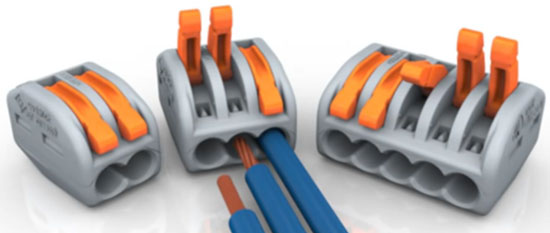
Anyone else tried "WAGO" lever connectors for this sort of thing? The five-hole ones seem a neat way of splitting one output to up to four devices, eg cabin lights, and the threes make a handy way of breaking a ring to connect something. I've used them that way on Allegro and they've worked well so far, as well as being easy to fit.

Cheers
Patrick

Wago-Lever-Nuts-222.jpg
 
Last edited:
I know you describe that wiring as venerable but it looks better than many boats I've seen, nicely tided up and well organised, I know someone will come along now and tell you you're going to sink/die/burn imminently but it's not a bad installation.
 
I know you describe that wiring as venerable but it looks better than many boats I've seen, nicely tided up and well organised, I know someone will come along now and tell you you're going to sink/die/burn imminently but it's not a bad installation.

+1, my first reaction was "I've seen much worse" :)

It's very satisfying to re-wire things neatly and feel like you really understand the system, so definitely go ahead if you want to. But I wouldn't say it demands urgent replacement.

You could just add another fusebox to the left of the existing two, to add new circuits without bodging onto the existing ones.

Pete
 
When I re-wired Kindred Spirit, I brought each wire to its associated switch directly, and clamped the bare wire-ends into the terminals. This worked adequately, but routing the wires was a bit fiddly and the bare ends not very professional looking. The labelling tape stuck out from the wires like flags, and after a year or two was starting to fall off.

I learned from this, and when I re-wired Ariam I installed a long row of barrier strip along the top of the wiring board. Stuff like this, but two 20-position lengths of it end to end for a total of forty terminals:

4148.Jpg


All the incoming wires from around the boat came into the compartment at the two top corners, and immediately terminated on the strip. I could then have neat tails from the other side of the strip to the switch panel, all bundled together. Where a circuit (such as the cabin lights, or instruments) had numerous wires, it was spread across several terminals, connected together by bridging pieces sold along with the strips themselves. A few other special wiring configurations (for example, where things are controlled by cockpit switches) were easily assembled on the terminal strips too.

I also had a long negative busbar parallel to the terminal strip a few inches away, so that the incoming two-core wires could be split and neatly connected to both.

All these connections used crimp-on fork terminals, which were quick to do, quick to connect and disconnect on the terminals (including for later troubleshooting, not just initial assembly) and look smart. The switches came with male spade terminals, so I used crimp-on insulated female spades there. For labelling I used a Brother TZ label printer on 6mm tape, which was stuck along the wire and then covered with clear heatshrink.

For the fuses I used a 12-way fusebox with a common positive taking automotive blade fuses:

5029cover.jpg
5029nocover.jpg


I deliberately didn't get the one that included a negative busbar as I thought that would make the wiring too crowded. The negative busbar / positive terminals running across the top of the compartment were far neater and easier.

For the switch panel I designed my own, had it laser-cut and -engraved, and inserted switches from RS.

Pete

195A worth of fuses! Hope your positive is very capable :)
 
195A worth of fuses! Hope your positive is very capable :)

That's not actually my fusebox, obviously. It's just the maker's sales pic.

I can't remember what my fuses add up to, but in any case the principle of diversity applies just like in a domestic mains install. It's quite unlikely that the autopilot will be forcing the rudder hard over against a wave at the same moment that the eberspacher is firing up and the 25amp dinghy pump is hard at work.

For what it's worth though, I think my positive supply is in 25mm2, which is rated to 170a and well over the sum of all my fuses, diversity be damned :D

Pete
 
I don’t think anybody has mentioned a large fuse in the feed close to the battery, but if you haven’t one already it is recommended - and will of course require you to consider the total current draw, against which you can assess the adequacy of the existing main positive and negative ‘feeds’.

A big plus for the ‘barrier strip’ in prv’s first first picture - it does help produce a neat installation; I used crimp rings rather then forks, as being more secure against vibration, but they are admittedly less easy to connect and disconnect.

Not I think an issue for you, but the Wago connectors shown by YachtAllegro are neat and can deal with fine cables - e.g. for instruments. But if there are a lot of them together, something like this (also by Wago) may be easier: http://uk.rs-online.com/web/p/non-fused-terminal-blocks/0815868/?origin=PSF_435792|rel (available in other sizes, up to 12 way).
 
Agree with all that. I have an 80amp slow blow fuse from the main supply in the junction cupboard and a 120amp slow blow right at the positive lead itself, 2 inches from the battery it comes off. The rationale is that if I'm using more than 80amps continuous in total there's a problem! Each circuit is individually protected, none with breakers higher than 10amps except the 40amp auto pilot. The 120amp fuse at the battery is in case of a catastrophic short in the battery locker where even a slow blow fuse will blow in an instant if there's a total short.

Pete's barrier strip is neat, I discovered they also come with bridging plates which means you can make a low amp bus bar, all my Seatalk uses one to create a neat three wire bus bar, likewise the junction of shower pump, electric toilet and forward LEDs all use one of those at a higher rating for the negative bus, makes the wiring much simpler.
 
Pete's barrier strip is neat, I discovered they also come with bridging plates which means you can make a low amp bus bar

You can, although if you're going to connect the whole thing together then you might as well use a busbar in the first place. What I use the bridging links for is where one "circuit", for example the interior lights, has lots of wires leading away from the panel. You can stack two, maybe three, rings or forks onto one terminal screw, but if you need more than that then you spill over onto the next slot and bridge the two together. I have several such pairs, and a couple of triples, in Ariam's wiring.

Pete
 
Top