
Electric Windlass Advice

I sail quite a lot single-handed and find flaking out a decent length of chain on the deck before dropping and having the boat moving down wind/tide solves that part. Because I have to stop/start and clear the chain pile I have to be on the foredeck to hoist and I too pull in then let the boat move forward and repeat.
I rarely sail singlehanded, but I have the same issues. Laying the rode out on the foredeck means I know exactly how much scope I'm laying out, plus I can pay it out far quicker than the windlass. Yes, pay it out, not just dump it in a heap!

With a mixed rode and a shallow chain locker, the rope just doesn't feed down unless I'm there to pull it through the hawse, and the anchor can be guaranteed not to feed into the roller properly without a good poke, so I have to be on the foredeck. A remote means I can be where I need to be - nose in the locker or leaning over the pulpit and control the rode as needed.
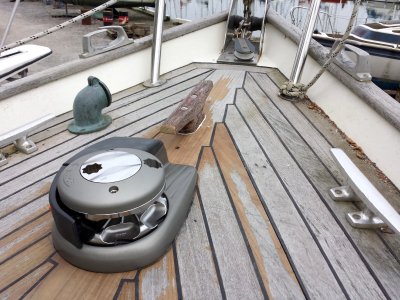
 
I fitted a Quick to my 27 footer a decade ago, along with 50m of new calibrated chain and 50m of anchor-plait spliced on, the gypsy handles both.

With limited room on my foredeck and to avoid trip-hazard, the low-profile design is ideal, and the motor and wiring is all in the dry below.

As I mainly single-hand, I fitted their wired-remote with counter (although expensive compared to the non-counter version this is excellent, convenient and very accurate). The deck-fitting for the remote is mounted at the base of the mast, and the curly cable is long enough so I can operate the windlass from both the helm and the foredeck, and when not in use is stowed below.

If the event that the remote fails for any reason (it never has), I have for redundancy an up/down switch mounted just inside the companionway.
 

Attachments

  • Quick Windlass.jpg
    Quick Windlass.jpg
    789.5 KB · Views: 3
We too have a Maxwell and it has been excellent.
We have foot switches and a remote socket at the bow, and a remote socket at the helm, all of which were there for our previous Lewmar windlass. We also fitted a chain counter and the control panel for that also can be used to control the windlass.
We tend to just use the foot switches.
The chain counter is a great improvement. My wife rates it as highly as headsets for de-stressing anchoring.
The 10mm gypsy is engineered to take both iso and din chain.
 
I thought an update would be helpful for any readers in my position. Having pondered all these answers.
I am about to install a Lofrans X1 800w, which is more than I need. I have a wired switch which will be temporarily installed by the companion way, and a cheap remote from Ebay. I will sort out 2 pre spliced snubbers. The chain has been checked and marks resprayed. The correct cable has been secured. I have help for the install as electrics are not my best skill. So I can't wait to see how it goes.
 
Yes, defintely no foot switches. I would still install the switch at the helm, as a failsafe.
I guess we all have different experiences. We did away with the remote. We never used it. We have foot switches, perfectly located at the bow. The windlass and foot switches are mounted on a plinth such that nothing sits in standing water. The foot switches have been installed for more than 12 years (when we bought the boat) and work perfectly. We rarely use marinas so anchoring is our preferred solution.
We do have windlass controls st the helm but rarely use them.
We installed a new Lofrans Falkon when we bought the boat to replace the original Falkon that we suspect was 30 years old. At 12 years old, the new Falkon has needed zero parts and little maintenance even though it is used a lot. We have worn the chrome of the rope gypsy through use. A great piece of kit
 
Top