Electric Narrow Boat article in pbo

When I was at college, many years ago , our lecturer got very annoyed when one referred to "cement" mixers. He pointed out that they were generally either "concrete" mixers or "mortar" mixers. ie cement was only a constituent part of the final product. If one wanted to call it a cement mixer one might as well call it an "aggregate" mixer.
As a builder, I purchased different plant for producing mortar for the bricklayers or plasterers, to that used for concrete for the groundworkers. The drums were a slightly different shape. So the difference has always stuck with me.
Hence I have always tended to look upon the term "cement mixer" as a DIY term suitable for the domestic B&Q customer
That's no use, you can't blithely introduce that they're different shapes and expect to leave it like that; what is the difference?
 
That's no use, you can't blithely introduce that they're different shapes and expect to leave it like that; what is the difference?
Smaller holes on the ‘paddles’ inside to produce a smoother mix. Although it has been many years since i saw one specifically bought for brickies. If they get that fussy on my sites they are issued with a shovel ?
 
I realise it is a 'traditional' narrow boat, but surely you need space to swing the tiller?

Felonious_Mongoose1.png

About right. Means you can stand in the doors while steering the thing for 8 hours in Jan.
 
That's no use, you can't blithely introduce that they're different shapes and expect to leave it like that; what is the difference?
The paddles inside & the taper on the front of the drum. We bought Benford, or Millars for concrete & smaller Liner for mortar. They just seemed to work better. :unsure: Also the size. One would not mix mortar in a 10/7. Of course large gangs, such as my grandfather would engage, would have pan mixers. But I never used any, except at college.
As for the Donk Donk ,we specified that they all ran on Lister LT1's, so engines could be swopped around when one broke down. That engine was normally configured at 1.5HP, but could produce 7.5 HP with ballanced flywheel etc
With air cooling & throttle it could be connected to a Watermota variable pitch prop adjusted through a gear lever . The workshop manual had set up details in it for such a configuration.
I would imagine some were used on canals. Even a big barge does not need a big engine once it is moving.
I expect some forumites will have experience of them.
 
Smaller holes on the ‘paddles’ inside to produce a smoother mix. Although it has been many years since i saw one specifically bought for brickies. If they get that fussy on my sites they are issued with a shovel ?
My experience with concrete mixers is that the holes get smaller automatically if the operator isn't paying attention. :ROFLMAO:
 
Friends of mine had an electric narrowboat, which they bought maybe 10+ years ago (they had it built). Their system had a smallish (perhaps 1 m2) solar panel, which charged their batteries. Their experience was that a week's charging would give them enough charge to operate for a weekend, They also had a separate generator which cut in if the battery voltage dropped below some preset amount; this was needed for longer periods of operation. When they bought it, solar panels were much more expensive than they are now, and they had ample room for a much bigger bank of solar panels. Of course, space for batteries is not a problem in a narrowboat. It seemed to work for them, and they were on the rivers of East Anglia, so there was often a current to contend with. Of course, using a generator to charge the batteries used fossil fuel, but was more efficient than using it directly to drive the boat.
 
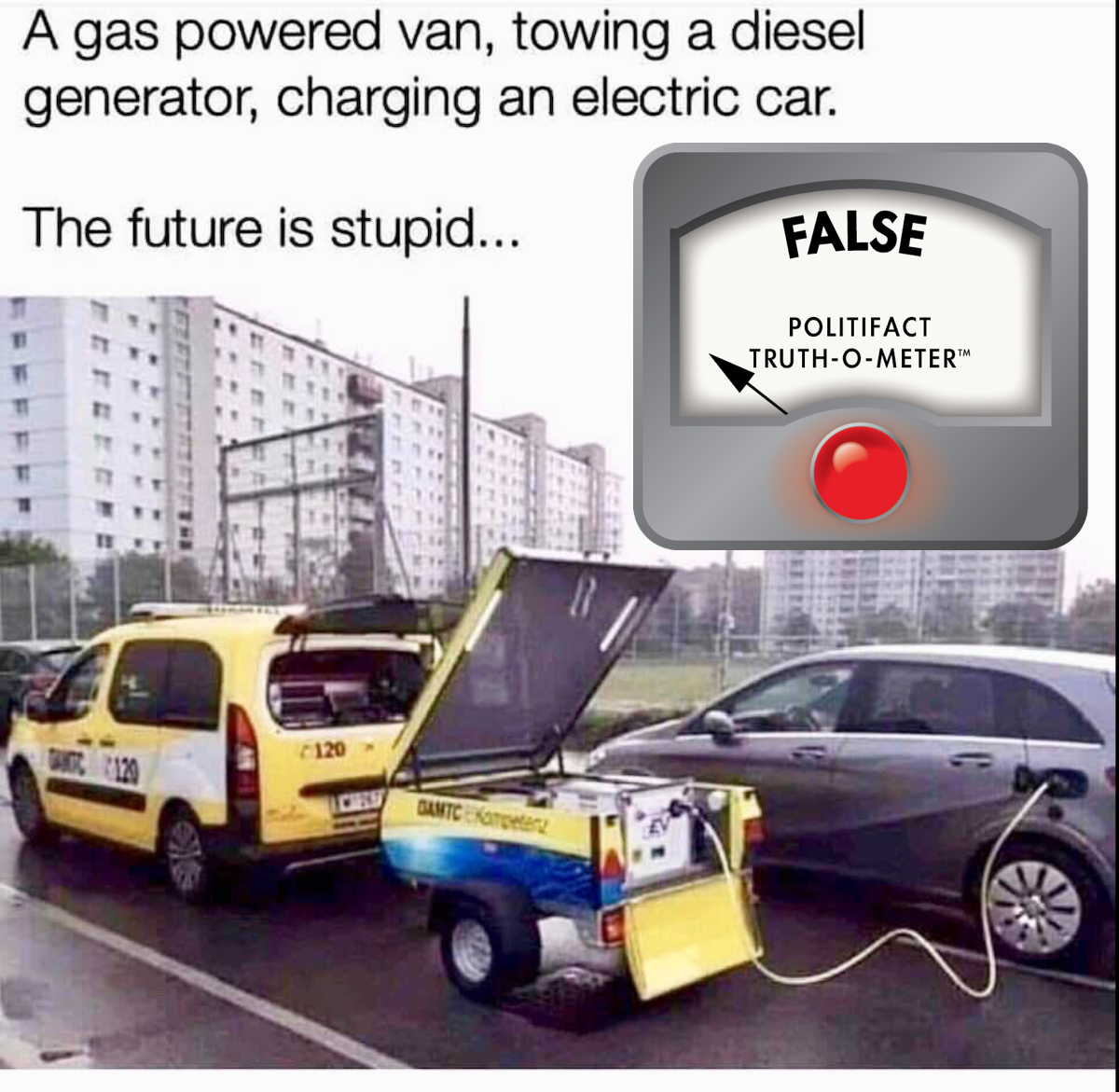
The first picture is factually incorrect, real story here
PolitiFact - No, that’s not a van towing a diesel generator to charge an electric car
No, that’s not a van towing a diesel generator to charge an electric car
OAMTC member told fact-checkers at AFP that the photo was "wrongly interpreted, this is not a portable generator, but a mobile power bank for electric cars." The power bank, AFP reported, is made of lithium battery packs that can provide electricity for an electric vehicle for about 12 kilometers (or about 7.5 miles).

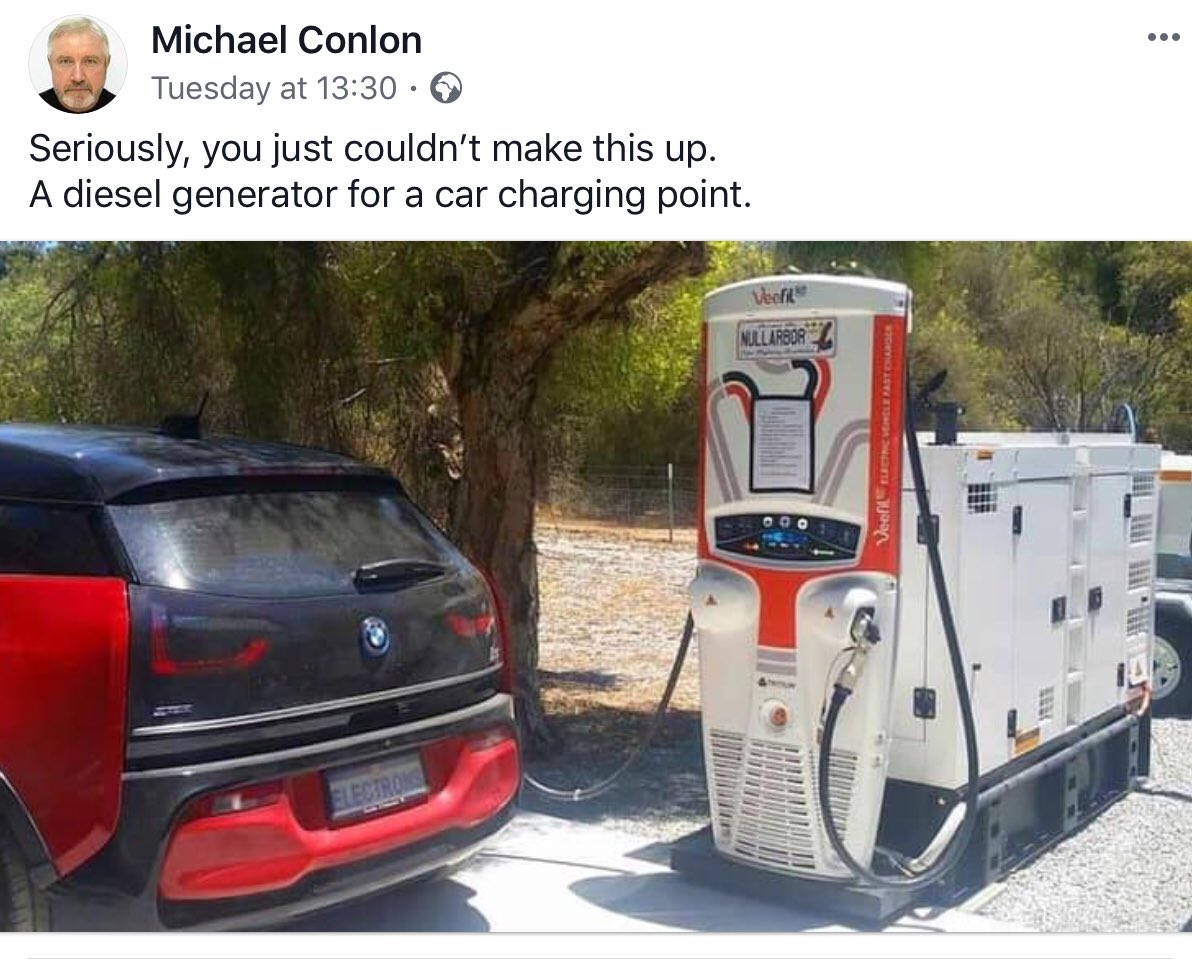
Second picture only partially correct
Is This a 'Diesel Car Charging Station' for Electric Cars?
What's True
This photograph shows an electric car charging at a diesel generator in 2018.
What's False
This image does not depict a typical circumstance for electric vehicles. The photograph was taken in the Australian outback, not the United States, where gas stations are scarce (and electric charging stations are even scarcer). The picture documents a privately-funded project, not one backed by a major electric car company, and the diesel fuel used provided the equivalent of 42 MPG, not 5.6. By the time of this writing in 2021, the charging station (dubbed the "Chargepod") was running on biodiesel fuel.


Have not got an electric car and not likely to buy one in the near future, but it does make you wonder to who's advantages are these fake news stories that appear widely circulated on social media
 
The first picture is factually incorrect, real story here
PolitiFact - No, that’s not a van towing a diesel generator to charge an electric car
No, that’s not a van towing a diesel generator to charge an electric car
OAMTC member told fact-checkers at AFP that the photo was "wrongly interpreted, this is not a portable generator, but a mobile power bank for electric cars." The power bank, AFP reported, is made of lithium battery packs that can provide electricity for an electric vehicle for about 12 kilometers (or about 7.5 miles).

Second picture only partially correct
Is This a 'Diesel Car Charging Station' for Electric Cars?
What's True
This photograph shows an electric car charging at a diesel generator in 2018.
What's False
This image does not depict a typical circumstance for electric vehicles. The photograph was taken in the Australian outback, not the United States, where gas stations are scarce (and electric charging stations are even scarcer). The picture documents a privately-funded project, not one backed by a major electric car company, and the diesel fuel used provided the equivalent of 42 MPG, not 5.6. By the time of this writing in 2021, the charging station (dubbed the "Chargepod") was running on biodiesel fuel.


Have not got an electric car and not likely to buy one in the near future, but it does make you wonder to who's advantages are these fake news stories that appear widely circulated on social media

Just a couple I picked on. Do a Google image search for "diesel generator charging EV". (About 2,660,000 results (0.59 seconds)

What was your explanation for Tesla (in the link) using diesel generators to re-energise their unsold cars.
Tesla. Aren't they they people who manufacture and sell battery wall banks? Surely they could have used then. In fact, don't their (ex) car sales sites have mains fed chargers?
 
Just a couple I picked on. Do a Google image search for "diesel generator charging EV". (About 2,660,000 results (0.59 seconds)

What was your explanation for Tesla (in the link) using diesel generators to re-energise their unsold cars.
Tesla. Aren't they they people who manufacture and sell battery wall banks? Surely they could have used then. In fact, don't their (ex) car sales sites have mains fed chargers?
No idea about Tesla, may be true, may not be, may be more to it, which is why I didn't comment on it. I was just pointing out the fake news about the pictures. I was already aware of them I have seen them come up on my social media feed before. I do find it interesting that some people or organisation is obviously spending time to put these false/misleading stories stories out
 
Just a couple I picked on. Do a Google image search for "diesel generator charging EV". (About 2,660,000 results (0.59 seconds)

What was your explanation for Tesla (in the link) using diesel generators to re-energise their unsold cars.
Tesla. Aren't they they people who manufacture and sell battery wall banks? Surely they could have used then. In fact, don't their (ex) car sales sites have mains fed chargers?
Charging EVs using diesel generators, even if used in some situations, is most certainly NOT usual. I own an EV, and a) I charge it at home more often than not, and b) I deliberately chose a "green" electricity tariff. When I charge away from home, the charge is taken from the normal electricity grid, and in the UK, this means that a substantial proportion of the electricity is generated from renewable resources and an even higher proportion from sources that do not generate CO2 (i.e. nuclear). This website is interesting: G. B. National Grid status

Given that the audience are yotties who (like me) are "careful" with their money, my motoring costs have dropped dramatically by changing to an EV. I used to spend £30-£40 a week on fuel; now it's more like £5.
 
Charging EVs using diesel generators, even if used in some situations, is most certainly NOT usual. I own an EV, and a) I charge it at home more often than not, and b) I deliberately chose a "green" electricity tariff. When I charge away from home, the charge is taken from the normal electricity grid, and in the UK, this means that a substantial proportion of the electricity is generated from renewable resources and an even higher proportion from sources that do not generate CO2 (i.e. nuclear). This website is interesting: G. B. National Grid status
Are we to infer from that that you think your home elctricity is different from that available elswhere? (Excepting that it is more expensive of course.)
 
I realise it is a 'traditional' narrow boat, but surely you need space to swing the tiller?

Felonious_Mongoose1.png

Neither of them ought to be standing on the counter. The steerer should be standing in "the 'atches" (traditional canal terminology) or what yotties would usually call "the companionway". T'other fella shouldn't really be there at all :)

You might step out of the 'atches occasionally if you need to push the tiller right over

Not only is standing on the counter incorrect from a tradition point of view, it's also dangerous especially when manoeuvring astern. If the rudder hits the canal bank or another boat, or a boat hits your rudder (and bear in mind that canal boating is a contact sport) the tiller can all too easily knock you overboard ... I've seen it happen several times and know of one occasion when a limb was lost (caught in the prop) and another when it had fatal consequences (albeit there were other factors in play)

Steering a working or trad style narrowboat is not a social activity. If you want someone to talk to get a cruiser stern (large aft deck) or that bastard hybrid a semi-trad (don't like 'em meself)
 
Are we to infer from that that you think your home elctricity is different from that available elswhere? (Excepting that it is more expensive of course.)
My home electricity is different (by generation method) - I could choose to charge an ev for free & 100% renewable from our solar array - depending on mileage, of course. My energy supplier is also introducing a 4hrs/ day free tariff to charge EVs & assist in balancing grid demand/ supply.
 
Are we to infer from that that you think your home elctricity is different from that available elswhere? (Excepting that it is more expensive of course.)
No; I am pointing out that at home I use a "green" energy tariff, where the provider provides evidence that they are either offsetting carbon generation or are buying the proportion of supply that I use from renewable sources. Away from home, this is less certain, as I don't control the supplier, so I don't claim that it is as environmentally sustainable as my home charging point.

I also have solar panels on my roof, so on balance, the electricity at home is more carbon-free than most.

If you look at the site I linked to earlier, you will see that a surprisingly high proportion of UK electricity generation now comes from zero carbon sources and an even greater proportion from low carbon sources. I just did a quick addition on the site I linked to, and zero-carbon generation exceeded 50%, of which about 14% was nuclear). Further, the amount generated by non-zero carbon forms of generation is dominated by CCGT, which I understand to be the least polluting form of generation.

There is a possibility that EVs may be useable as mobile energy banks; there is research going on into the feasibility of "smart" charging systems where an EV's batteries can contribute back to the grid at times of peak load, and be charged during low demand periods. Of course, this depends on a suitable system of rewards and prices being developed. I am privy to detailed research on this, but as usual, may not go into detail until after the research is published.

Incidentally, the surcharge for a "green" electricity account is a small proportion of the overall cost, and is offset by the (very) low rate I pay for overnight charging.
 
Last edited:
I'd guess a generator could be far more efficient & far less polluting than an ordinary engine, as it runs at a fix rpm & can be tuned more finely for it.

On balance, surely it'd actually be more eco than a big battery pack, no? So you'd get a muffle "donk donk whee" noise. Sounds like it would makes sense for a sailing boat, doesn't ? (Never looked at power output) with the additional benefit you can pull it out when it needs repaired or serviced.
 
No blow lamp in this video, but some nice 'donks', and smoke rings of sorts.
Develops the biceps working the screw reverser.... Yep no smoke rings but took blowlamp to get it going. Something the Youngsters here might not have seen before but have enjoyed the sound of a fleet of similar boats heading to sea in You Only Live Twice when the pearl divers headed out from their island. To me this is the sound of old Japan.
 
Neither of them ought to be standing on the counter. The steerer should be standing in "the 'atches" (traditional canal terminology) or what yotties would usually call "the companionway". T'other fella shouldn't really be there at all :)

You might step out of the 'atches occasionally if you need to push the tiller right over

Not only is standing on the counter incorrect from a tradition point of view, it's also dangerous especially when manoeuvring astern. If the rudder hits the canal bank or another boat, or a boat hits your rudder (and bear in mind that canal boating is a contact sport) the tiller can all too easily knock you overboard ... I've seen it happen several times and know of one occasion when a limb was lost (caught in the prop) and another when it had fatal consequences (albeit there were other factors in play)

Steering a working or trad style narrowboat is not a social activity. If you want someone to talk to get a cruiser stern (large aft deck) or that bastard hybrid a semi-trad (don't like 'em meself)

That's what struck me about the pic.
 
  • Like
Reactions: Bru
No; I am pointing out that at home I use a "green" energy tariff, where the provider provides evidence that they are either offsetting carbon generation or are buying the proportion of supply that I use from renewable sources. Away from home, this is less certain, as I don't control the supplier, so I don't claim that it is as environmentally sustainable as my home charging point.

I also have solar panels on my roof, so on balance, the electricity at home is more carbon-free than most.

Zero carbon sources. It cannot be. You have merely displaced the carbon to an earlier point in the infrastructure chain. Wind turbines are not zero carbon. What is their life?

A good quality, modern wind turbine will generally last for 20 years, although this can be extended to 25 years or longer depending on environmental factors and the correct maintenance procedures being followed. However, the maintenance costs will increase as the structure ages. Wind turbines are unlikely to last much longer than this because of the extreme loads they are subjected to throughout their lives.
Then you'll have to build and reinstall a new one.
 
Zero carbon sources. It cannot be. You have merely displaced the carbon to an earlier point in the infrastructure chain. Wind turbines are not zero carbon. What is their life?


Then you'll have to build and reinstall a new one.
They have repeatedly been shown to be carbon efficient over their design life. From Forbes magazine: How Green Is Wind Power, Really? A New Report Tallies Up The Carbon Cost Of Renewables, "Good news: amortizing the carbon cost over the decades-long lifespan of the equipment, Bernstein determined that wind power has a carbon footprint 99% less than coal-fired power plants, 98% less than natural gas, and a surprise 75% less than solar. "
 
Top