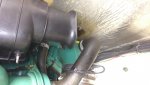
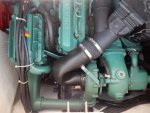
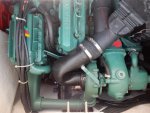
Turbo has a gasket and that fails over time. I have just had mine replaced.
For an alarm it should work - just accept that the temperature of all of these things is related to location, so you will need to decide an alarm temp you can live with that does not usually go off - you wont be able to look up a value as the value will vary with location.
tnx, the gap in the silver foil you can see above the turbo is the only ready access, that enough to replace the gasket ?
does this 'just' come apart, as in no fluid leaks ?
and that would be the best time to fit an EGT sensor too ?
drill the hole just above the existing external EGT alarm ?
I strongly suspect what you have fitted is an exhaust temperature sensor that is there to warn you if you loose cooling water. It doesn’t measure EGT. You need an adaptor between the turbo and the exhaust elbow with a screw in sensor suitable for 800 degs C. If you google it you will find pics.
Tnx, yes it does appear to me to be in a location that is water cooled, not appropriate for internal EGT
Bruce, does the rust / corrosion look like a ‘problem’ gasket issue to you ?
How to check, or leave it alone ?
’
Having seen the immense damage over emphasis on the importance of exhaust gas temperatures can have when an idiot then lets loose with his spanners inside the fuel pumps of some very large diesel generators, my clear view of this is that EGT is a subject best entirely avoided by boaters. Plenty of other things to worry about, which is why there is so little emphasis or gauges available and fitted to measure such a nicety.
Far better to be measuring the temperature after the water injection - if the seawater flow fails for any reason, then the outlet will be the first part to (rapidly) overheat, and if you strip leave space for extra gauges then something far more useful such as Turbo boost pressure, or fuel filter pressure after the pre-filters (vacuum level).
If you understand 'POI' and 'Lift Pressure' without having to google or do other research upon these terms then fine, spend lots of money on a measurement that realistically is giving you highly refined measurements, that are even then open to considerable misinterpretation.I don’t think anyone is suggesting pratting about with the fuel rack in order to effect a change of EGT .
I think it’s more to be kind to the engines and thus extend the longevity and minimise forward repairs .
To do with fouling , overloading in terms of kg,s and in this case changing the props to effectively a bigger one .
The OP has already said he can’t reach max rated rpm ( from his instruments thus far ) with his new prop .
They are a useful in a basket of measurements particularly with load .
A lot of Americans, professional sport fishers run for a few hours to the grounds and back don’t like exceeding 80 % load or prolonged raised EGTs .
These guys are doing 1000 ,s of hrs and heavily invested in there kit .
Shine the spotlight on ave leisure boater , perhaps seasonal and you may have a point as they don’t just do the time / hrs to justify looking after there “ babes “ in terms of making a difference between lasting 2000 hrs or 15000 hrs .
Or are serial boat buyers who in a you reap what you sow kinda way will never see the effects of prolonged elevation of EGT because they sell the boat every 3 years or sooner !That parcel is passed on .
Personally I,am fortunate to have 16 parameters available via the MAN screens .
I set my cruise on load 80 % based on the consensus from the professional American sport fishing community.
EGTs I keep sub 600 ,currently running at 1780 rpm 540 degrees and 27/ 28 knots at 77 % load burning 89 L per side . 1/2 tanks
Those numbers change as the season progress or Kg,s are added .
You see it’s not a 2017 boat with a view to dump it after a few seasons .
It’s a boat with 2003 , 890 hrs engines , I feel it needs a bit of sympathy and TLC as I have zero plans of getting rid of it .
I feel the load and EGTs are particularly useful in prop fouling .
Don’t underestimate the damage of running about with fouled props .
It’s not just the reduced speed ( which you may accept?) it’s the elevated EGTs .
Kinda extra motivation for a stern gear scrub .
As far as water pressure goes we have ( MAN s ) “ inlet water pressure “ delta anyhow .
“Turbo boost pressure “and even “charge air temp “ so plenty to go at really to monitor engine health .
Having seen the immense damage over emphasis on the importance of exhaust gas temperatures can have when an idiot then lets loose with his spanners inside the fuel pumps of some very large diesel generators, my clear view of this is that EGT is a subject best entirely avoided by boaters. Plenty of other things to worry about, which is why there is so little emphasis or gauges available and fitted to measure such a nicety.
Far better to be measuring the temperature after the water injection - if the seawater flow fails for any reason, then the outlet will be the first part to (rapidly) overheat, and if you strip leave space for extra gauges then something far more useful such as Turbo boost pressure, or fuel filter pressure after the pre-filters (vacuum level).
I'm afraid it's not that simple, P.If you want to avoid unnecessary load on your engines then run them under 75% throttle. Don't push them forward to compensate for fouling / excess weight.
I sympathize with your view, since I also don't have EGT on my mechanical engines.If EGT gauges were that necessary, VP would have fitted them. To me, adding them is just yet another thing to go wring.
There’s a lot of things VP could or should do , let’s not drift there suffice to say it’s not clear which side of the corporation makes the most , the sales or after sales .I'm with you T. If EGT gauges were that necessary, VP would have fitted them. To me, adding them is just yet another thing to go wring.
.