E-Loran

14K478

Well-Known Member
Joined
15 Aug 2023
Messages
693
Visit site
E-Loran

If this has been covered already I apologise.

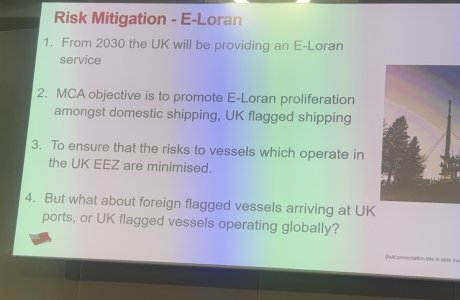
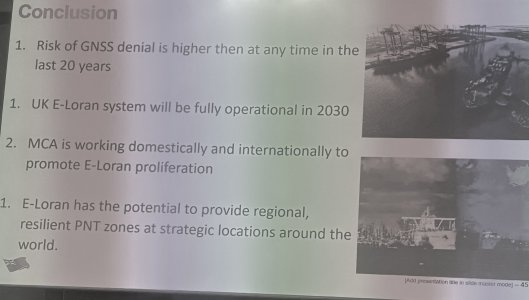
I was at a presentation by the UK Maritime and Coastguard Agency (“MCA”) in London last Thursday and there was a short presentation on their plan to instal an E-Loran system covering the British Isles, to be operational in 2030.

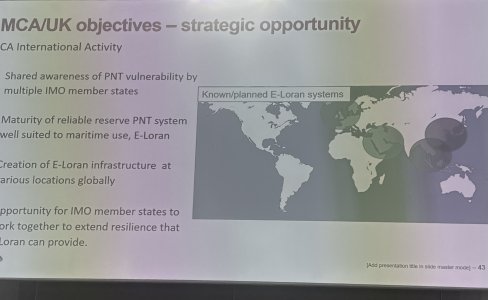
This is because of the increased risk of GPS “spoofing”. Some other areas are planning to do this also - the Arabian Gulf, the Singapore Straits and China.

The presenter said that GPS and the other GNSS satellite systems like Galileo and GLONASS are “reliable but not resilient” because they depend on detection of a very weak signal which can be “spoofed”.

This E-Loran system is not to be confused with the old LORAN system which could be hilariously vague (unless you were at sea and relying on it!). This is accurate to within 5 metres.

I took some photos of the screen, they are quite dreadful but I hope they give some idea:

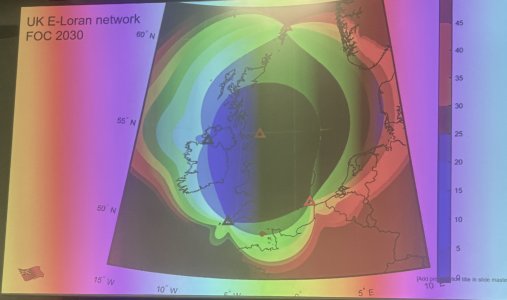
This shows the planned locations of the five transmitters ( the triangles) and the area of 5 metres accuracy and the rate at which the accuracy degrades:
IMG_0350.jpeg


IMG_0352.jpeg
 

Attachments

  • IMG_0351.jpeg
    IMG_0351.jpeg
    705.4 KB · Views: 12
  • IMG_0353.jpeg
    IMG_0353.jpeg
    1.2 MB · Views: 12
I think we can assume that small boat friendly E-Loran receivers to work with existing plotters will be along presently; the MCA are very clear that they want everyone in British waters to have access to this.
 
GNSS is a miraculous system - transmitter powers (ERP) are a couple of hundred watts, by the time it hits a receiver the signal is around a thousandth of the noise level. It's only because you know the form the signal takes that you can extract it. A small localised increase in noise at the correct frequency makes the signal unrecoverable.
 
Interesting. Good to see a U.K. government department being sensibly proactive about potential trouble ahead.
It would be sad, though, if the miraculously cheap, accurate and useful GNSS positioning were to become seriously unavailable. Though perhaps London taxi drivers might regain their mojo, if any are left.
 
E-Loran

If this has been covered already I apologise.

I was at a presentation by the UK Maritime and Coastguard Agency (“MCA”) in London last Thursday and there was a short presentation on their plan to instal an E-Loran system covering the British Isles, to be operational in 2030.

This is because of the increased risk of GPS “spoofing”. Some other areas are planning to do this also - the Arabian Gulf, the Singapore Straits and China.

The presenter said that GPS and the other GNSS satellite systems like Galileo and GLONASS are “reliable but not resilient” because they depend on detection of a very weak signal which can be “spoofed”.

This E-Loran system is not to be confused with the old LORAN system which could be hilariously vague (unless you were at sea and relying on it!). This is accurate to within 5 metres.

I took some photos of the screen, they are quite dreadful but I hope they give some idea:

This shows the planned locations of the five transmitters ( the triangles) and the area of 5 metres accuracy and the rate at which the accuracy degrades:
View attachment 209577


View attachment 209574
Was there any hint at coordinating this with the EU? I can’t believe they are not considering similar measures given what has been happening in the Baltic the past few years. If/when E-Loran is rolled out at least parts of the French/Belgian/Dutch/Irish waters will be covered, so cooperation seems the way to go.
 
Was there any hint at coordinating this with the EU? I can’t believe they are not considering similar measures given what has been happening in the Baltic the past few years. If/when E-Loran is rolled out at least parts of the French/Belgian/Dutch/Irish waters will be covered, so cooperation seems the way to go.
British civil servants are not allowed to talk about the EU!

But I think it must be.
 
This is because of the increased risk of GPS “spoofing”
A ground based system would be exactly as likely to suffer spoofing as a satellite system. The fix for spoofing would be identical too, and is already implemented and available commercially for GNSS solutions - signing the data. If this simple fact wasn't covered in the presentation then you were listening to someone who intends to profit from gullible taxpayers, not to an expert.

The ONLY difference between GNSS and ground based is the potential signal strength used. This could in theory help with jamming of signals which can be an issue for users of GNSS who happen to be near to Russian territory right now. This is not an issue in UK waters whatsoever, aside from Navy training exercises. The Navy would absolutely also jam land based signals for training purposes as well, they'd just use a slightly stronger transmitter (but not strong in the grand scheme of things).

Replacing a radio based system which uses signals to triangulate position with a different radio based system which uses signals to triangulate position is not a sensible way forwards.

DGPS already exists and is quite effective, but was mostly switched off as unnecessary.
Certificate signing already exists and is quite effective, but not available to civilians. Easily corrected via firmware.
Both spoofing and jamming are laughably easy to trace and eliminate with the exception of when they are done on sovereign territory of an aggressor (Russia). This is an issue for those in line of sight of the transmitter. Everywhere else, we find the bad actor and shut them down within hours (minutes if necessary).
 
There are actual real life problems with jamming and spoofing all over the Eastern Baltic. I've experienced it myself.
There is Russian territory in the Eastern Baltic. That's where they transmit the signal from and it reaches...line of sight.

If they did it from elsewhere, they'd have been stopped.
 
A ground based system would be exactly as likely to suffer spoofing as a satellite system. The fix for spoofing would be identical too, and is already implemented and available commercially for GNSS solutions - signing the data. If this simple fact wasn't covered in the presentation then you were listening to someone who intends to profit from gullible taxpayers, not to an expert.

The ONLY difference between GNSS and ground based is the potential signal strength used. This could in theory help with jamming of signals which can be an issue for users of GNSS who happen to be near to Russian territory right now. This is not an issue in UK waters whatsoever, aside from Navy training exercises. The Navy would absolutely also jam land based signals for training purposes as well, they'd just use a slightly stronger transmitter (but not strong in the grand scheme of things).

Replacing a radio based system which uses signals to triangulate position with a different radio based system which uses signals to triangulate position is not a sensible way forwards.

DGPS already exists and is quite effective, but was mostly switched off as unnecessary.
Certificate signing already exists and is quite effective, but not available to civilians. Easily corrected via firmware.
Both spoofing and jamming are laughably easy to trace and eliminate with the exception of when they are done on sovereign territory of an aggressor (Russia). This is an issue for those in line of sight of the transmitter. Everywhere else, we find the bad actor and shut them down within hours (minutes if necessary).
The reason why eLORAN is being revived is because it is in fact many orders of magnitude harder to jam or spoof. It is not indeed "as likely to suffer spoofing".

GNSS and LORAN are really totally different. GNSS is UHF, between 1.2 and 1.8GHz; LORAN is 90-1100khz, LF, requiring enormous antennae. GNSS is digital; LORAN is analogue (eLORAN overlays a low rate data channel). GNSS transmitters have less than 50 watts of ERP; LORAN transmitters are at least several hundred kW. GNSS wavelength is a few centimeters and can use tiny antennae; LORAN wavelength is several kilometers -- meaning a quarter-wave antenna is 750 metres long, and a typical one is 200 metres long.

GNSS is typically received at -130dBm, which is below the noise threshhold, which means it can't be received at all without digital processing.

LORAN is typically -60dBm at the receiver. The difference is 10^7, that is, a LORAN signal is 10 million times more powerful than a GNSS signal, at the receiver. The proposed new eLORAN systems have transmitters up to even 1MW, which will add a couple more orders of magnitude of difference.

A GNSS jammer can fit in the trunk of a car. To even hope to jam LORAN you would need a whole radio tower and at least many kilowatts of transmission power. And jamming one LORAN transmitter would only degrade position calculations, not falsify them as with GNSS spoofing. You would need to jam several of them to take the system down even in a limited area.

LORAN is VASTLY more robust and resilient than GNSS. And that's why it's being revived.

It should never have been decommissioned, if you ask me. It's not right to have so much of civilization so dependent on a single, vulnerable system. And it would be a lot cheaper if we hadn't shut it down. It's only been 10 years! At least the main facility at Anthorn was mothballed instead of being dismantled.
 
There is Russian territory in the Eastern Baltic. That's where they transmit the signal from and it reaches...line of sight.

If they did it from elsewhere, they'd have been stopped.
Sorry, GNSS jamming can be done from a device which fits in the trunk of a car. It can be carried on any kind of vessel, and no doubt even on a sea drone. There have been actual cases in the Northern Baltic and the North Sea, far from Russian territory. It is extremely difficult to "stop it", if it's even possible. This is a real vulnerability of our society.
 
Sorry, GNSS jamming can be done from a device which fits in the trunk of a car. It can be carried on any kind of vessel, and no doubt even on a sea drone. There have been actual cases in the Northern Baltic and the North Sea, far from Russian territory. It is extremely difficult to "stop it", if it's even possible. This is a real vulnerability of our society.
In a pocket, actually, and is laughably easy to trace and eliminate as I said. Unless it's on sovereign territory such as the very well documented case in the Baltic from Russian soil.
As for your other post, you clearly have no clue what spoofing is or how it's achieved. Or do you have an interest to declare?
 
Finding GNSS jamming devices may be "laughably easy" if the device is transmitting continuously and is not mobile. However if that device is intermittently transmitting while in motion and/or is not otherwise transmitting predictably it becomes less easy to get a fix and by the time the fix is made the transmission source has moved elsewhere or is off. This, of course, becomes an even greater problem when there are several coordinated devices operating randomly and from changing locations.
 
Finding GNSS jamming devices may be "laughably easy" if the device is transmitting continuously and is not mobile. However if that device is intermittently transmitting while in motion and/or is not otherwise transmitting predictably it becomes less easy to get a fix and by the time the fix is made the transmission source has moved elsewhere or is off. This, of course, becomes an even greater problem when there are several coordinated devices operating randomly and from changing locations.
Unfortunately Marsali, others are the Oracle and a slave to modern infallible electronics.
 
In a pocket, actually, and is laughably easy to trace and eliminate as I said. Unless it's on sovereign territory such as the very well documented case in the Baltic from Russian soil.
As for your other post, you clearly have no clue what spoofing is or how it's achieved. Or do you have an interest to declare?
It doesn't have to take place on anyone's territory. As I wrote, the equipment required is very compact and is usually mobile.

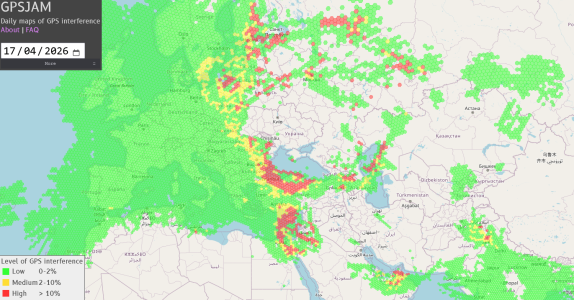
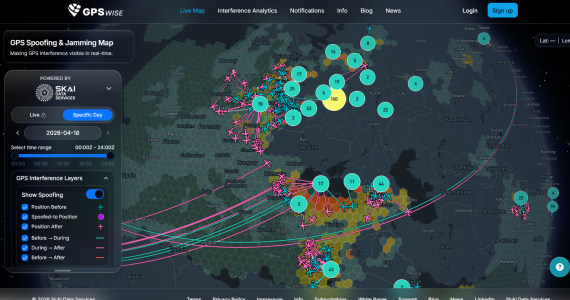
You talk about the the Gulf of Finland cases, but there are thousands of reported cases of jamming and spoofing every day in all kinds of places. This is a map of just a single day's incidents:

Screenshot 2026-04-20 210635.png

GPSJAM GPS/GNSS Interference Map

You are deeply mistaken if you think these happen only in "line of sight from Russian territory."

N.B. that no one has yet invented mobile equipment that can jam LORAN. Jamming LORAN is theoretically possible if an adversary were to, say, take over radio towers in strategic locations. Spoofing LORAN -- which is ANALOGUE -- is theoretically possible but probably not practical.
 
Top