Dynema Dilemma

billyfish

Well-Known Member
Joined
6 Oct 2020
Messages
989
Visit site
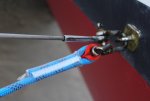
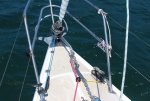
Just made a loop in 4mm dynema by sowing it and shrink tube over it for guard wires . can't think of a better way to do it to get the tension tight. Pelican clip one end and direct to the pulpit the other. Must be strong enough, if you knot it they say you lose 50% strength. Not sure how. Anyone know any different?
 
I’m just about to do the same job, soft eye on pull put with small shackle and then push pit tie off with small dia line wiped and tight, should allow to be tensioned, I’ve seen on YouTube some stretch softeye with winch first to get tight
 
strength reduction depends on the knot. slow curves have less impact. Figure of 8 reduces strength by 25 to 30%. Overhand by 43 to 61%. So as you say knots are negative

A whipped loop might be easier than using shrink tube and obviously if you insert the teardropshaped eye in the loop that increases the bending radius.

However stainless steel with its slight elasticity seems more usual so why go for dynema with its odd and sometime catastrophic behaviour. Under excess load it snaps as it wont stretch.

I know its much lighter than steel but whats the driver?
 
A splice round a thimble is effective as long as you bury a long tail. I've not spliced 4mm but I have successfully spliced 8mm and 10mm
 
The reason for going this way is . 1 I can do it myself 2 its cheaper 3 it's more flexible so when both top and bottom pelican hooks are released the lines fall to the deck better so that her indoors and me wee scabby dog can get on and off easier ?
 
Just made a loop in 4mm dynema by sowing it and shrink tube over it for guard wires . can't think of a better way to do it to get the tension tight. Pelican clip one end and direct to the pulpit the other. Must be strong enough, if you knot it they say you lose 50% strength. Not sure how. Anyone know any different?
I believe the scaffold knot has a more proven record for minimal strength reduction and slip resistance when making a loop fastening in dyneema.

www.solocoastalsailing.co.uk
 
I believe the scaffold knot has a more proven record for minimal strength reduction and slip resistance when making a loop fastening in dyneema.

www.solocoastalsailing.co.uk

We used scaffold knots and a thimble when we replaced our stainless steel life lines with dyneema.

I'm not sure what people mean when they say they use shrink tube (which is commonly used for electrical wiring - but is different to shrink tube for cordage). You can buy shrink tube specifically for cordage - we use it when making loops on our snubbers (sewn) and then apply the shrink tube over the 'joint'. We sew using braided dyneema fishing line. If you don't fancy sewing - any sailmaker would sew loops (or eyes) for you. But sewing eyes is something you can leave for a cold winter's night or a day on the yacht when its raining - or if you live in Oz - sitting on the deck under some shade with a chilled stubby :)

Professionally sewn eye in a cat bridle, aka snubber, (with, since removed, plastic thimble) with shrink cover

IMG_4761.jpeg


Hand sewn eye on mono snubber with shrink cover. The eye retains or hold the chain hook, being used here to secure the anchor

IMG_4837.jpeg

Take care, stay safe

Jonathan
 
Sewing single braid and sewing double braid are very different. I've done a lot of both, broken hundreds of samples open a test rig... and there is no reason I can think of to sew or use knots in single braid when making lifelines. None. The race inspectors will flunk it, because it is not as strong as a splice and 4 mm is already the minimum. Neeves shows sewn splices one climbing rope, which is totally different. I like sewn splices for some things. But NOT Dyneema single braid.
  • Sewing is not as strong in single braid.
  • Splicing is easier and faster.
  • Knots generarlly slip. Even if they do not, they are weaker, and not really faster, since single braid is piss easy to splice.
  • You can't get a rope lifeline tight by ANY knot or splice. It will stretch in use and require tightening, which is why you close it with a lashing.
I don't understand why you would not go up to 5 or 6 mm. 4 mm will not pass within a few years of chafe and sun damamge.

If you really want to make a splice adjustable, look at the whoopie sling. Common in US arborist practice, and useful for tensioning lifeline gates. It does weaken the line 25% compared to a long bury splice (but is stronger than sewing or any knot), so use 5 or 6 mm line.
 
Our guardrails, which I called lifelines) are single braid 6mm dyneema secured with a halyard or scaffold knot. Our jackstays are tape. We have used them, dyneema guard rails for around 10 years - without issue. They are adjustable, we have a turnbuckle at one end of each. Thinwater is correct they did stretch, beyond the limits of the turnbuckle - you learn from your mistakes. We had to tie the scaffold knot a second time, carefully ensuring the completed lifelines were a very tight fit, at the maximum extension of the turnbuckle. We did tighten the turnbuckle with time - but have not done so now for a number of years, and still have some room to play with. We have not noticed that the scaffold knot has slipped - after it was 'bedded' in - in fact once bedded in the knot cannot be untied.

The advantage of the scaffold knot is that as it beds in it tightens round the thimble. maybe I need more practice (undoubtedly so) but I found that as my splices tightened and bedded in the thimble become 'loose'

I have not tested the lifelines to failure.

We had sleeves at the stanchions - with fear of chafe - there has been none. There is a much more real fear of chafe on dyneema from sheets continuously rubbing on the dyneema life lines - the dyneema melts - this is not an issue for us (on our catamaran - we were cognisant of a failure that did occur on a yacht and double checked this would not be an issue before we installed our dyneema lifelines).

We have never used shrink covers on single braid dyneema. I'm not sure of the effect of heat, needed on a shrink cover, when applied to dyneema. We have only used shrink covers to cover sticking where we have a double length of cordage.

Most people who modify to dyneema use cordage chosen for its tactility as well as strength. They could use an even thinner cordage but it would be, very, uncomfortable to handle. When racing we used to use 2mm kevlar for spinnaker sheets in light airs - plenty strong enough but well beyond the ability to handle it in stronger winds. Thus a knot that reduces strength is really not an issue - because the size chosen is grossly overstrength.


Having completed blue water races we were cognisant of Cat 1 regulations and our cat largely meets the requirements - they seem very sensible and applicable to anyone sailing (even at leisure) in waters with limited support should issues occur. I'd recommend anyone sailing in 'unfriendly' waters to at least read them and actually use them as a basis for equipping a yacht. There are always compromises - these are decisions the individual owner makes after weighing up the options. For example we don't carry a trysail - I could not envisage using it with a crew, total, of 2 - our decision.

Stainless lifelines (guardrails) are not problem free (our originals were 'plastic' coated).

The original reason to close stainless lifelines with a lashing was to allow you to cut it easily - turnbuckles were used to tighten. Dyneema is a devil to cut - and maybe lashings still have their place - but lashings also stretch.

Jonathan
 
Last edited:
Single braid Dyneema is more common for lifelines. A buried splice is superior to a knot, or whipping and the splice is very simple to do.
I can see the utility of dynema for lifelines. I dont much like wire due to its underfoot roll, and now find that tape can cause the clip to snag as one moves forward. If I did change from tape to dyneema I think I would go for 6mm not 4mm

I also use 6mm dynema with a knot for our solent stay due to its stowability, but am a lot less worried about loosing a light weather sail due to line failure than I would be worried about lifeline or guardwire failure.
 
I can see the utility of dynema for lifelines. I dont much like wire due to its underfoot roll, and now find that tape can cause the clip to snag as one moves forward. If I did change from tape to dyneema I think I would go for 6mm not 4mm

I also use 6mm dynema with a knot for our solent stay due to its stowability, but am a lot less worried about loosing a light weather sail due to line failure than I would be worried about lifeline or guardwire failure.
To clarify, when using the term "lifelines" I am referring to the lines that thread through the stanchions. For lines that you clip onto I would use the term "jacklines".
 
I think there is confusion in terminology - which Noelex has addressed, as I type.

The things, that commonly are located on the deck, to which you attach your tether (that is then attached to a harness) I call jackstays.

We replaced our 4mm stainless lifelines, between the stanchions, with 6mm single braid dyneema, attached with self tightening halyard or scaffold knots. See post No 9. Our jackstays are removed when we are pottering about and are only installed when offshore. We have adequate hard points if conditions for pottering deteriorate.

Our jackstays are sewn tape. I would not use dyneema as a jackstay, especially 6mm dyneema as if you ever actually had to grab the jackstay - you would be unable to hold it - but you could grasp and hold 25mm tape.

I call the things that run between the stanchions as lifelines, not guard rails (as a rail, to me is a solid inflexible device). I understood the OP was referring to the devices between the stanchions, not jackstays nor, replacing rails.

I apologise if I have added to the confusion.

I think there is a danger for introducing a scare function - as common installation of dyneema is usually over engineered, to allow it to be handled by hand, the emphasis on splicing (because it is stronger) is unnecessary.

Jonathan
 
To clarify, when using the term "lifelines" I am referring to the lines that thread through the stanchions. For lines that you clip onto I would use the term "jacklines".
Noted. I tend not to use the term jackline due to confusion with a jackstay, which it is not. It is however a lifeline.

UK usage often refers to things between stanchions as guard rails, though I suppose strictly they are guardwire. In my safety related mind a lifeline is something expected to be attached to by a user but a guard might never be neared

Jonathon: I am not sure why 6mm dyneema would be worse for a jackline/lifeline than the very commonly used 5 or 6mm plastic coated steel.
 
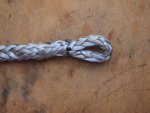
Why don't you use a Brummell splice for the ends? As noelex said - very easy to do, neat and strong. I used 6mm dyneema. Would have thought 4mm too thin. Attached a picture of Brummell Splice in 6mm dyneema
 

Attachments

  • brummel splice.jpeg
    brummel splice.jpeg
    67.3 KB · Views: 21
Jonathon: I am not sure why 6mm dyneema would be worse for a jackline/lifeline than the very commonly used 5 or 6mm plastic coated steel.

Ah! But I would not use 5 or 6mm plastic coated steel either (for the same reasons, you cannot hold onto it) and because it rolls underfoot. We used 25mm tape when we raced and use the same (but new :) ) tape now.

I like the security of being flat footed :)

If your steel wire followed the toe rail it would not be the same issue, but we don't even have toe rails

Jonathan


Why don't you use a Brummell splice for the ends? As noelex said - very easy to do, neat and strong. I used 6mm dyneema. Would have thought 4mm too thin. Attached a picture of Brummell Splice in 6mm dyneema

Does it tightly grip a thimble - or does it suffer slight stretch (as the splice beds in)

Jonathan
.
 
Does it tightly grip a thimble - or does it suffer slight stretch (as the splice beds in)

Jonathan
.

I have done this method and as the splice beds in the thimble does become slightly looser - no where enough for it to fall out but with a bit of flexing I can subsequently remove the thimble which then allows me to remove the line from the stanchions for cleaning. I have thimbles on either end - one end fixed with a shackle and the other with a lashing. If I remember it requires a reverse Brummell splice if you don't have access to the other end for splicing.
 
According to World Sailing:

  • The ropes around the outside are lifelines.
  • The lines you attach harnesses to are jackstays. In US jacklines is more common, but what is important is that jackstay or jackline is one word, since a jack line or jack stay is something different.
 
I don't under stand the fixation with Brummell splices. I know how to do them, but they are slightly weaker and more difficult to form tightly around thimbles and LRFs, so I make burry and lock stitch splices at least as often. If you use heavy whipping twine or a strand of the rope for the stitching, there is no need for chafe protection on the stitching. Done properly, the stitiching will be almost entirely below the surface. Unlike a sewn splice, the splice stitching carries none of the load and only serves to stabilize the splice when unloaded. If the bury is less than about 40:1 the stitching starts to carry progressively greater load.
 
If you read the history of Dyneema lifelines, most of the failure result from:
  • Hanging rail meat from the lifelines. Don't do that. If you lean on them in the cockpit, be very careful about chafe protection on the stanchion holes. Not a mutihull problem, since we don't lean on lifelines.
  • Prior use of bare metal lifelines. The bare metal can really make a nice burr.
  • Poorly prepared stanchion holes. You need to de-burr and polish them.
  • One maxi burned through the lifeline in a rough jibe with a spin sheet. No reaility for most of us, but do protect areas where a sheet might rube under load.
 
Top