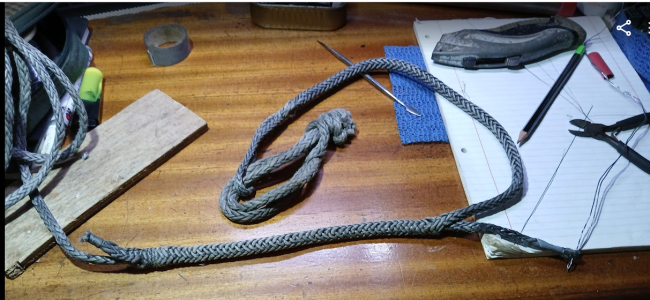
Dyneema

You could also consider tapering a dyneema line. If the splice has to take the load, then that is technically a better option. It’ll be fine on Will’s size boat of course, but a 38 ft racer, I think I’d rather taper if losing some diameter is necessary.
 
Hello Nigel. I have sort of decided to go for dyneema halyard perhaps 5mm spliced to 10mm polyester. You tube seems top make a splice easy.
I will report in due course on success or failure. I could go all dyneema but small diameter required to suit mast top sheave (for wire) will make handling and cleating more difficult. So will try splice ol'will
Honestly I think a far better bet would be to go all Dynema, but splice in an extra cover where it goes through the clutch. This is what we do.

 
Hello Nigel. I have sort of decided to go for dyneema halyard perhaps 5mm spliced to 10mm polyester. You tube seems top make a splice easy.
I will report in due course on success or failure. I could go all dyneema but small diameter required to suit mast top sheave (for wire) will make handling and cleating more difficult. So will try splice ol'will
Been doing that for lots of years from that same ytube, jib sheets have a good few metres 5mm dyneema spliced into the old sheet, works great, no weight to pull the clew down & runs easy. Same with roller reefing line, mostly 5mm dyneema. Also with the main slab reefing lines, dyneema to just before the clutch, runs freely & next to no weight on the sail. Useful splice to learn.
 
I have to admit - that 10yrs ago ... I was diehard braid on braid standard lines ....occasionally if feeling 'flush' splashing out on Marlowbraid ... but usually going for the Indian equivalent Kingfisher brand at lower cost.

I have never been a fan of wire to rope halyards .... and with Dyneema now regarded as a mainstream product ... maybe time to swap.

I do have reservation about its reputation as 'slippery' on winches / clutches etc. which I believe why covered Dyneema was on market ...
 
I have to admit - that 10yrs ago ... I was diehard braid on braid standard lines ....occasionally if feeling 'flush' splashing out on Marlowbraid ... but usually going for the Indian equivalent Kingfisher brand at lower cost.

I have never been a fan of wire to rope halyards .... and with Dyneema now regarded as a mainstream product ... maybe time to swap.

I do have reservation about its reputation as 'slippery' on winches / clutches etc. which I believe why covered Dyneema was on market ...
On winches, not really. In clutches yes.
There are a few ways to mitigate that. If the use allows, a constrictor clutch is a good option. If not, then sewing in an additional cover over the portion that goes through the clutch is a good idea. For reference we have a sewn in cover section on our kite halyards and jib halyard as they were tending to slip. We still leave the jib halyard on the winch upwind though. I think really that's more about the limitations of the clutch than the rope though. The main halyard, which is a 2:1 doesn't need it.
 
Seven & a half months ago my dog broke his right hand rear cruciate ligament, He is a Saluki x 10 years old & has always been a fast runner. This put him out of action & the only way out was surgery.
By good fortune our vet is the last independent vet for miles & also had recently trained in Sweden on how to use & fit Vetlig synthetic ligaments, So Pip had the operation a week later, done with keyhole surgery & a Dyneema ligament with titainium anchors each end. The operation was a success & recovery fast as it was far less invasive then the commonly used Tplo op. Now you would not think he had ever broken it.
So another use for Dyneema!
 
I made the dyneema to polyester splice yesterday. A bit messy due to 5mm dyneema and 10mm poly tail. The core of poly splicced ok with dyneema using brumel hitch but could not get all the poly core inside the dyneema. There was no way the outer cover would go inside the dyneema so taperred and whipped it to the outside sewing through the dyneema at various places. Seems like a tidy enough splice to pass through the hole in the mast when pulling main sail down. I will fit it to confirm all ok this morning. (boat at home) I built an eye spklice in end of dyneema first.
The experience resulting is that I should have gone for 8mm polyester and if possible a larger dyneema. The 5mm is strong enough but quite small to handle and splice.
My cheap supplier only had 5 and 10mm dyneema. ol'will
 
Top