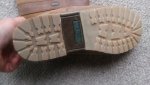
Dubarry boots - slippery sole - solutions?

I wear wool socks all the time - thick in winter, thinner in summer - never felt cold in rubber boots.

When I wash my all-wool beanie, I re-shape it on my head - warms up in a trice and stays that way until dry.
 
In fact I've just ordered some more wool socks from these people, who I've been buying from for years, using their own yarns from various breeds of British sheep:

https://arbonsocks.co.uk/shop/

Thicker socks for general winter-wear and walking, thinner for summer, and either for sailing depending on how parky it is.

I got into all-wool socks (with just a smidge of nylon to help them keep shape) when I discovered that my once-smashed left ankle didn't ache so badly (in all weathers, not just cold or damp) compared to cotton or synthetics.
 
OK. I give you a challenge: In low temperatures, put on woolen socks, on one foot a dry sock, and the other a wet sock. I look forward to your report back to us. :D

I'm not so sure that putting on wet woolen articles is the right approach. An already warm sock encasing a warm foot which then gets wet is the scenario I had in mind. My ancient Dubarrys, while "splash proof" are not up to keeping out water on repeated or prolonged submersion. In this scenario I have found that while sailing in wet conditions my feet gradually become wet, but not cold, and this would be in spring and autumnal temperatures.
 
Last edited:
Wet wooden socks keeping you warm is a myth.
The advantage of wool socks is that wool has good wicking properties, ie wool will disperse moisture, sweat and condensation, throughout its thickness and that wool can absorb about a third of it weight in moisture before it starts to feel wet.
Problem with wool is that it will shrink easily if washed too hot and it doesn’t like to keep its shape.
Look for socks with a little bit of nylon in the mix.
 
Wool is an excellent product
As a teenager sailing a Hornet I knew very well the advantages of a pair of kaki shorts (with beer mat sewn on in strategic position) & 2 woolen jumpers over the top of a cotton shirt.
They kept me fine & warm in spite of numerous swims. They started out with hem at waist level but by the end of the season the hem would be somewhere just above the knees. But as a vital piece of warm sailing wear they were second to none- Until someone came along with a black rubber suit with great strap between the legs & loads of stitching & glue etc.
My mother gave a huge sigh of relief, as she always spoke about the great soggy mess dropped on the kitchen floor every Sunday evening.

And you try telling kids of today !!!!!!!!!

Did not Francis Chichester have a wool sponsor for his round the world trip. The oil in the wool being good for shedding light rain/mist- or so they said
 
Last edited:
Interesting to read many of the opinions about rubber boots on here that I share; they are cold and damp!

Having spent most of life in climbing boots, ranging heavy WWII stuff to the then very modern Koflach plastic ones, and experimented with all sorts of socks to keep my feet from frostbite. Five hours on a climbing belay during a white out was a test of feet, socks and boots!

My current solution is a pair of Musto HPX Ocean boots, by the looks of it no longer sold but with a leather shoe and gortex boot, and mohair socks [https://corrymoor.com/socks/7-explorer]. I have an intolerance of wool, can't stand it next to skin.

During night watches my feet are as warm as toast, I'll update you how things are once I get past 60 degrees north. :D
 
There are specialist firms that will resole good quality walking boots with Vibram soles, usually for about 1/3 the price of replacement; if they can do this you would think that modern Dubs with glued on soles would be easy.
 
There are specialist firms that will resole good quality walking boots with Vibram soles, usually for about 1/3 the price of replacement; if they can do this you would think that modern Dubs with glued on soles would be easy.

+1

I looked this up as a result of this thread and Vibram have a catalogue showing various soles that can be purchased just for this job. Some of the materials were definitely suitable fir gripping decks.

What would it take, a good buff of the old dole, a specialist glue, a former fir the inside and a wright to keep pressure on while the glue set and a sharp knife to trim to size post cure.

Not that difficult I would have thought.
 
+1

I looked this up as a result of this thread and Vibram have a catalogue showing various soles that can be purchased just for this job. Some of the materials were definitely suitable fir gripping decks.

What would it take, a good buff of the old dole, a specialist glue, a former fir the inside and a wright to keep pressure on while the glue set and a sharp knife to trim to size post cure.

Not that difficult I would have thought.

I did my own normal shoes this way using a glue called klebstoff or something like after being quoted a prohibitive price by a cobbler. Just clamped the shoe in a woodwork vice overnight. It's lasted 4 years so far and been very successful. I tried it on a pair of deck shoes but found the sole was hollow and after linishing the remains of the tread there was nothing left to glue to. I subsequently bought 2 cheap pairs of deck shoes. One has been kept on the boat at low temperatures the other at home at high temperature. The ones stored at low temperature still have plenty of grip but the ones stored at home are like ice skates. Sounds daft but maybe keeping your expensive deck shoes in the fridge over the winter would slow down the reaction and prolong the life of the soles. Probably be OK in the cheese compartment.
 
...The ones stored at low temperature still have plenty of grip but the ones stored at home are like ice skates. Sounds daft but maybe keeping your expensive deck shoes in the fridge over the winter would slow down the reaction and prolong the life of the soles. Probably be OK in the cheese compartment.

Most interesting.

Both pairs of my now discarded Henri Lloyd boots were in fact habitually kept on the boat, but had I kept them at home in the fridge I'm not sure whether I'd have had to stow them with the Caerphilly or the Camemberts... or maybe just in the made-up-name compartment!
 
We have 2 sets of Dubarry boots and 1 pair of deck shes with the offending construction/sole formulation. Declared un- repairable.
However , grasping at straws we took them to a real cobbler who came up with a non-marking sole he was confident of fitting. Less than a week later - at £28 a pair we have repaired footwear. Not the micro zigzag but a decidedly grippy sole.
DSC_0077.jpg

Beyond this work he said he can buy in "sailing sole inserts" for a similar result.
We'll try this for a season and report back
 
Well done. I reckon one could do a complete, slow circumnavigation in those - in complete safety, without marking anything and without needing any further re-soling!
 
Top