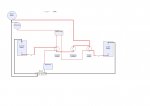
dual battery solar charging and 1 2 both switch

FairweatherDave

Well-Known Member
Joined
28 Sep 2009
Messages
2,089
Location
Solent
Visit site
So I have just received my 50W solar kit including a dual battery solar charge controller, and reading the instructions it emphasizes "independent charging assumes batteries should be electrically isolated from each other". At the moment I have a 1 2 both switch and two batteries identical in size (altho one is older and tends to read a fraction lower). I want the ability to use solar to keep both batteries topped up all year round. Should I treat both batteries as a single battery bank or ditch the 1 2 both? If the later I need to know the simplest, economic solution for independently wiring a starter and a house battery. I've read several old threads and don't want to start another epic, and I know there are several ways to do things. I'm not connecting to shore power and my basic yacht has little in the way of electricity demands, usual tiller pilot, tablet nav, a few led cabin lights etc. I just want a nice easy to install solution......:)
 
My dual bank solar controller charges the domestic bank until it reaches a set voltage, then switches to the starter battery. Does yours not do that?

That's how my dual solar controller works BUT I also have a 1 2 Both switch - I don't change it when sailing, I usually leave it on both. I don't touch the Solar controller and assume it just carries on working, charging each battery.
But I'm still thinking about a VSR...
 
Last edited:
1) Fit the dual solar controller and a VSR, leaving the 1-2-B switch. No need to mess around changing switch setting, but don't use "both". This is a nasty messy solution :disgust:

2) Ditch the switch and fit separate switches. The solar controller will charge both batteries. You then need a split charge solution for the alternator, in your case i'd recommend a Victron ArgoFET. See the diagram below.
 

Attachments

  • Charging Schematic - ArgoFET.jpg
    Charging Schematic - ArgoFET.jpg
    64.9 KB · Views: 22
Last edited:
What a THOROUGHLY unhelpful post. This is the 'PRACTICAL Boat Owner' forum Rupert. We look for PRACTICAL solutions for folk like me, who aren't necessarily qualified enough to know the answers.

This is why we seek the answers here.

I accept your point but the 1:2:Both has come up plenty of times here and the answers are always the same - it works well only for those who don't even have to think hard to understand 12v systems. If electrics are outside your immediate comfort zone then you should use tried and tested technology that avoids the need to learn about how electricity works.

My advice was trying to save time for the OP and be helpful. Perhaps I should have said, "read a 12v boat electrics text book then come back to us once you understand the options. Or look up VSR circuits instead"
 
Hmmm. Done some more reading and still find it confusing. I wonder if I should wire the solar with the batteries as a single bank over winter and for summer just use the solar panel on the domestic battery, (which obviously ignores the ability for the controller to charge two batteries independently). I would then still be in my understanding comfort zone. I am a bit frustrated my choice of controller does not seem as straight forward to install as I thought.
 
That's how my dual solar controller works BUT I also have a 1 2 Both switch - I don't change it when sailing, I usually leave it on both. I don't touch the Solar controller and assume it just carries on working, charging each battery.
But I'm still thinking about a VSR...

With respect, that's a very bad way of doing things. It is absolutely not how the switch was designed to be used and is about the most dangerous way of doing it. You should only ever use the both setting for emergency starting.

For charging you should charge on each position independently. All of the time the switch is on "Both" all of your batteries are hard wired together, so why have separate banks ?

It's even worse doing it whilst sailing. There is no charge going into the batteries, so you could deplete them all and be unable to start the engine. Also, if a battery failed in a certain way it could rapidly deplete all of your batteries and leave you without power altogether.

If you don't want to change the switch to the vastly superior system of having separate switches, at least fit the VSR you are considering. That way, you can adopt one of two (better) methods. Either, start the engine on "1" then switch to "2" or always just use "2", keeping the engine battery in reserve for emergencies. With either method your batteries remain independent and both will get charged without having to fiddle with the switch.
 
1) Fit the dual solar controller and a VSR, leaving the 1-2-B switch. No need to mess around changing switch setting, but don't use "both". This is a nasty messy solution :disgust:

2) Ditch the switch and fit separate switches. The solar controller will charge both batteries. You then need a split charge solution for the alternator, in ypur case i'd recommend a Victron ArgoFET. See the diagram below.

Gad! I can't keep up. Thanks Paul. I suspect option 2 is what I am looking for. I was pricing it up from an old post while you were posting.
 
That's how my dual solar controller works BUT I also have a 1 2 Both switch - I don't change it when sailing, I usually leave it on both. I don't touch the Solar controller and assume it just carries on working, charging each battery.
But I'm still thinking about a VSR...


The only way you can ft a VSR would be to connect the solar panel to the domestic bank and never connect the other output. If you connect a VSR and connect the controller to both batteries, when the controller start to charge it will close the VSR and both batteries will be connected together.

VSR or dual controller, one or other, not both.

IMO, best system using the dual controller is as per my diagram. You do also have the option of following my diagram and fitting a VSR instead of the ArgoFET, but only connect the controller to the domestic bank. Here is a simple diagram for that option : http://www.ybw.com/forums/showthrea...ice-for-a-Southerly-115&p=6574862#post6574862
 
Gad! I can't keep up. Thanks Paul. I suspect option 2 is what I am looking for. I was pricing it up from an old post while you were posting.

IMO, option 2 is the very best for you installation Dave. Fit BEP switches like these http://www.bepmarine.com/en/701

Batterymegastore are very good on price for the Victro ArgoFET

This makes for a super system, you just turn up and turn two switches on, turn them off when you leave. All charging is done automagically.

The middle switch is for emergency use ;

Flat engine battery, turn it on and start the engine, turn it off.
Dead engine battery, turn it off, turn the emergency switch on.
Dead domestic battery, turn it off, turn the emergency switch on.

Simple :encouragement:
 
So I have just received my 50W solar kit including a dual battery solar charge controller, and reading the instructions it emphasizes "independent charging assumes batteries should be electrically isolated from each other". At the moment I have a 1 2 both switch and two batteries identical in size (altho one is older and tends to read a fraction lower). I want the ability to use solar to keep both batteries topped up all year round. Should I treat both batteries as a single battery bank or ditch the 1 2 both? If the later I need to know the simplest, economic solution for independently wiring a starter and a house battery. I've read several old threads and don't want to start another epic, and I know there are several ways to do things. I'm not connecting to shore power and my basic yacht has little in the way of electricity demands, usual tiller pilot, tablet nav, a few led cabin lights etc. I just want a nice easy to install solution......:)

You will be OK provided you do not parallel the batteries by selecting the " both" setting of the switch.

But what we do not know if briefly/ temporarily selecting the "both" setting eg when switching between batteries or paralleling them in an emergency for engine starting is totally forbidden or if this is permissible .

It might help to provide meaningful answers if you told us the details ( make, model, etc of the controller)

If you feel inclined ditching the 1,2, both switch in favour of separate isolators and some from of split charging ( diode splitter type of thing , VSR or Sterling A to B charger) for charging both from the engine may be a sensible move. A BEP VSR switch cluster may be an attractive option.
 
Before deciding on a VSR, check how much current it takes to keep it closed. You may find that during winter it amounts to a proportion of the 50W panel output that is not insignificant.
You might want to reconsider the idea of using the panel for both batteries. If you use the boat and run the engine from time to time also during the winter, the alternator should make up for battery self discharge.
 
You will be OK provided you do not parallel the batteries by selecting the " both" setting of the switch.

But what we do not know if briefly/ temporarily selecting the "both" setting eg when switching between batteries or paralleling them in an emergency for engine starting is totally forbidden or if this is permissible .

It might help to provide meaningful answers if you told us the details ( make, model, etc of the controller)

See post #6

You cannot parallel the banks then expect the controller to give charge preference to one bank.

If you feel inclined ditching the 1,2, both switch in favour of separate isolators and some from of split charging ( diode splitter type of thing , VSR or Sterling A to B charger) for charging both from the engine may be a sensible move. A BEP VSR switch cluster may be an attractive option.

I have already explained why he cannot fit a VSR. The solar controller output will close the VSR and the two banks will be in parallel.
 
IMO, option 2 is the very best for you installation Dave. Fit BEP switches like these http://www.bepmarine.com/en/701

Batterymegastore are very good on price for the Victro ArgoFET

This makes for a super system, you just turn up and turn two switches on, turn them off when you leave. All charging is done automagically.

The middle switch is for emergency use ;

Flat engine battery, turn it on and start the engine, turn it off.
Dead engine battery, turn it off, turn the emergency switch on.
Dead domestic battery, turn it off, turn the emergency switch on.

Simple :encouragement:

Thanks Paul. That's what I was hoping for ......... basic question. Where to locate the ArgoFET? 20x12cm box. Batteries are currently under the quarter berth. Does the ArgoFET need a more open location?
 
Before deciding on a VSR, check how much current it takes to keep it closed. You may find that during winter it amounts to a proportion of the 50W panel output that is not insignificant.
You might want to reconsider the idea of using the panel for both batteries. If you use the boat and run the engine from time to time also during the winter, the alternator should make up for battery self discharge.


He cannot fit a VSR with the dual output controller.
 
The OP's requirements seem similar to mine. One solar panel feeding a dual output controller. The controller is configured 90% to house battery 10% to engine start battery.

On the mooring my 1/2/Both/Off is switched to the Off position. The batteries are isolated from any load (except the Eber controller) and the solar panel keeps things topped up.

When sailing I select the house battery.

When motoring I start the engine on the engine battery (when I remember) and switch to Both.

A VSR would spare me having to remember switching the 1/2/Both/Off switch.
 
Top