

Piddy
Well-Known Member
Morning all,
After replacing the engine last year I am now starting to address things like Solar and battery management systems.
The boat is 30+ years old so there are quite a few legacy issues such as two separate auxiliary battery banks (all FLA) separated by a 1-2-1-off switch and a pretty power hungry fridge. I know these aren’t great but that is what we’ve got! The budget isn’t huge but I know there is money to be spent.
Up ‘till now we have coped with this arrangement mainly weekend sailing but with regular 2-3 week holidays. Our plans for the next few years are to spend 3-5 months aboard hence requiring better battery management. I don’t want to be marina dependent for all of this time so solar will be added (I’m currently looking at 2 x 200W panels on a gantry) but I’m getting stuck on how to monitor the batteries. All of the bms systems seem to be designed for 1 battery but with an option to monitor just the voltage of another. Ideally I want to monitor volts and amps on both banks. Currently I run with both banks joined together at the 1-2-1 switch using the theory that partially discharging one big bank is better than really hammering 1 smaller bank and then switching over but that's not to say it couldn't be done better. I do like the idea of being able to separate them for isolating duff batteries.
What would the best way to monitor the batteries?
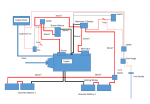
The picture below is how it is arranged at present:
After replacing the engine last year I am now starting to address things like Solar and battery management systems.
The boat is 30+ years old so there are quite a few legacy issues such as two separate auxiliary battery banks (all FLA) separated by a 1-2-1-off switch and a pretty power hungry fridge. I know these aren’t great but that is what we’ve got! The budget isn’t huge but I know there is money to be spent.
Up ‘till now we have coped with this arrangement mainly weekend sailing but with regular 2-3 week holidays. Our plans for the next few years are to spend 3-5 months aboard hence requiring better battery management. I don’t want to be marina dependent for all of this time so solar will be added (I’m currently looking at 2 x 200W panels on a gantry) but I’m getting stuck on how to monitor the batteries. All of the bms systems seem to be designed for 1 battery but with an option to monitor just the voltage of another. Ideally I want to monitor volts and amps on both banks. Currently I run with both banks joined together at the 1-2-1 switch using the theory that partially discharging one big bank is better than really hammering 1 smaller bank and then switching over but that's not to say it couldn't be done better. I do like the idea of being able to separate them for isolating duff batteries.
What would the best way to monitor the batteries?
The picture below is how it is arranged at present:


