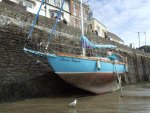
Drying out against a wall

SteveSarabande

Well-Known Member
Joined
3 Apr 2012
Messages
1,304
Location
Solent
Visit site
This is something that was never covered on the courses I did so far. So how do you go about it. Drying out against a harbour wall would be handy to make a few more stops available for my fin keel Sabre 27.

I didn't find too much online explaining it. I assume I need lots of fenders and a board on the wall side. My problem is with high tidal ranges how do I stop the board and fenders popping out as the boat moves up and down the wall. Does it mean a disturbed nights sleep when staying over a few tides or is there some secret to it.

Another thng I worry about is whether drying out on the keel will put undue stress on the structure of the keel joints.
 
We often dry our fin keeled boat out against a wall.

The tips we follow are:

LOOOONG warps fore and aft and a rope around the mast JUST tight enough to encourage the boat to lean inwards.

The fenders never ride up as they basically just sit there until the keel touches, then as the boat leans in they take the weight.

MOST important to check the bottom first. But you knew that :)

79377190a939e5385de0cfabfc81d000_zps790530a7.jpg


DSC04019_zps6ca19515.jpg


c6aba299e88e3b9830e663b99d1277e7_zpsf9351ee8.jpg


If it makes you feel happier you can always lay the chain along the deck like here to encourage an inward lean

DSC04021_zpscfc386d2.jpg


but I don't bother any more ... the mast rope is sufficient

Just an afterthought re keel stress ... just walk round any boatyard ... it's what they sit on!
 
Last edited:
It's never going to be a recipe for a peaceful night but shouldn't present much of a problem. It might be a good idea to do a practice dry on a single tide before trying to stay a night. Virtually all cruisers will be quite happy sitting on their keels and a Sabre should be straightforward.
 
cheers, nice photos. So do you need to tend to the length of the lines all the time

Actually I just realised there isn't as much movement as I thought. If the wall is only accesible two hours either side of high tide, then after HW+2 it is on he sand and not moving for a good while. I was sort of imagining it was going to move constantly

Good idea about doing it over one daytime tide as practice.

So where is the nearest drying harbour wall to Cardiff, I feel a practice sail coming on.
 
See first if your boat lists naturally to one side or another. Mine has a slight tendance to starboard.
Check the asperity of the wall if you have to slide against it.
Have a look at the bottom if possible first at a previous low tide.
Ask if the bottom is ok for drying out. (However I did this once and was told it was ok. I settled on huge concrete blocks which were designed for trawlers with long keels. The tip of my keel was on one and the rudder post on another...)
I use the spinaker halliard to attach the top of the mast to the quay. If no convenient attachment point, I run a line between rings etc parallel to the boat and then attach the halliard to that. You need to adjust the slack as the boat moves up and down.
It's unlikely that you will dry out at an angle that is comfortable for sleeping.
At low tide, how far below the wall are you going to be and how will you get out?
Somebody jumped down onto my cabin roof and cracked a window.
 
Last edited:
We tie the boat up pretty much normally, i.e. no tighter than usual, but with long head and stern lines (this helps with the drop), springs, sometimes a line going from the outside of the boat to the quay (first photo) , and the all important mast line.

As the boat settles for the first time it is deffo necessary to do some adjustment ... normally releasing ... make sure all your lines are adjustable from the boat, not the shore (ask me how I know) :) and once she's down that's pretty much it.

Two of those shots are Ryde, the others are Brittany.
 
make sure all your lines are adjustable from the boat, not the shore (ask me how I know) :) and once she's down that's pretty much it.
Top tip, I can just see me stuck on the boat with the lines tied off ashore and the boat hanging from the cleats

Ilfracombe is the nearest
Ilfracombe was what got me thinking about it, seems a nice place to go alongside and let the girlfriend get ashore for a shopping fix
 
At low tide, how far below the wall are you going to be and how will you get out?
these are the sort of things I was hoping this thread might raise. Hopefully moored up by a ladder, but if not then maybe I need to think about that.
 
Ouch, that doesn't look good. Avoiding becomming a tourist attraction is high on my list.

was that due to an unbalanced boat or just soft sand under the front of the keel? Maybe moving some weight to the back would have helped,
 
Last edited:
Soft sand. I deliberately dried out to change the Volvo prop shaft seal. It was extremely hard trying to stay put in the engine bay whilst I swapped it over.
Perhaps I should have unloaded the anchor and chain.
No damage was done.
 
2241885_3.jpg


My old boat but not my work!

'The New glenan's Sailing Manual' is good to have on board for such instances, covers pretty well everything. Good to have a copy of it at home also. Only a few quid from the web or charity shops.
 
Last edited:
My tips, any heavy bits on shore side deck, if possible halyard from top of mast secured ashore adjustable from on board, water containers on warps to keep tension on lines, launch tender so you can keep a eye on whats happening, be very vigilant with shore lines and helpfull members of the public ,they can really spoil your day, be ready for horrible sounds as she touches the bottom, keep an eye on angle of lean shorewards it needn't be dramatic, I found an old car tyre topsides protected by old blanket much better than fenders, you only need one and you'll know where it goes as she slides down wall. My boat a Sigma 362 doesn't like drying out no matter what I do she settles towards the stern sitting on her rudder ,not nice
Keith
 
We often dry our fin keeled boat out against a wall.

The tips we follow are:

LOOOONG warps fore and aft and a rope around the mast JUST tight enough to encourage the boat to lean inwards.

The fenders never ride up as they basically just sit there until the keel touches, then as the boat leans in they take the weight.

MOST important to check the bottom first. But you knew that :)

79377190a939e5385de0cfabfc81d000_zps790530a7.jpg


DSC04019_zps6ca19515.jpg


c6aba299e88e3b9830e663b99d1277e7_zpsf9351ee8.jpg


If it makes you feel happier you can always lay the chain along the deck like here to encourage an inward lean

DSC04021_zpscfc386d2.jpg


but I don't bother any more ... the mast rope is sufficient

Just an afterthought re keel stress ... just walk round any boatyard ... it's what they sit on!
That is a Bav isn't it
Please read the Bavaria bashing forum. You are not supposed to b able to do that without keel ending up in saloon!!
 
The wall at Ilfracombe can get 'booked up' in high season. It 's definitely a nice place to stop for the night. I have to confess to preferring the outer harbour - it gets a touch more swell than the inner harbour, but at least you're not 5m from a fishing boat that needs to recharge its battery by running the engine for half the night.
 
The wall at Ilfracombe can get 'booked up' in high season. It 's definitely a nice place to stop for the night. I have to confess to preferring the outer harbour - it gets a touch more swell than the inner harbour, but at least you're not 5m from a fishing boat that needs to recharge its battery by running the engine for half the night.
does the outer harbour allow a 1.45m draft to float at low tide?
 
My tips, any heavy bits on shore side deck, if possible halyard from top of mast secured ashore adjustable from on board, water containers on warps to keep tension on lines, launch tender so you can keep a eye on whats happening, be very vigilant with shore lines and helpfull members of the public ,they can really spoil your day, be ready for horrible sounds as she touches the bottom, keep an eye on angle of lean shorewards it needn't be dramatic, I found an old car tyre topsides protected by old blanket much better than fenders, you only need one and you'll know where it goes as she slides down wall. My boat a Sigma 362 doesn't like drying out no matter what I do she settles towards the stern sitting on her rudder ,not nice
Keith

Looks like my rudder is pretty well protected, but there would be quite a slope if she did fall back on to it
http://www.flickr.com/photos/75351251@N03/8365176944/sizes/l/in/set-72157632414296285/
 
I would be careful with tires and heavy boats, we had a boat that would flatten the tires (she did weigh 14 tons). This made a nightmare for getting the tilt towards the wall just right.

Also watch it if drying out on a steeply slanting mud bottom, the incoming and outgoing tide can wash the mud out form under the keel. Then she starts sliding down the slope, leaving your shrouds inches form the quay...

I would use weight to give a slight list towards the wall, rather than using a halyard. The weight creates a constant list a halyard can be more changeable.

As others have said watch your trim for and aft, my present boat trims by the head. So when lifted by Sealift I empty the fore-peak and stick all the weight under the cockpit sole, I have no intention of trying it against a wall just yet. If we do try it it will be on a wall with a good upwards lead so if she starts dipping by the head we can help support it with ropes. Not the long ones used for mooring but to support vertically.

As always with boats if your aware of the dangers and have a plan you will be fine but some one had to give you some horror stories than do not involve Bavaria's :D
 
Top