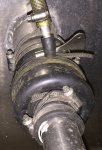
Dripless shaft seal - help please

Does anyone recognise the above shaft seal please? It’s weeping and I want to know how to adjust it. I think it might be an old Vetus model. Thanks
 
Deep sea seal. If it’s leaking you can clean up the brass face. Don’t think you can add much more pressure as it looks compressed enough already.

we had one on our boat and always had problems with it, swapped it for PSS seal and never had another issue, at least you got the emergency band on it

just to add, it has a fibre rotary face running on a bronze seat, we found that salt and crud build up on the bronze seat
 
Imho, DSS are only great if you keep the boat on the hard.
In fact, aside from being prone to collect dirt and consequently leak, it's their basic design that is flawed.
Just look at the two hose clamps on the rotating part in the above pic: they are supposed not only to withstand the water pressure from outside, but also the rotational force created by the friction of the sealing ring, while under way.
And all of this by fastening rubber against s/steel. Seriously?!? Such arrangement means that when (not IF) the rotating part slips forward, even by just a few millimiters, there's no seal anymore, and water can fill the e/r PDQ.
In fact, the producer also makes a metal collar, that should be placed on the shaft just in front of the rotating part of the seal, to hold it from slipping forward, with potentially catastrophic consequences. Which is what I would highly recommend the OP to install, if he doesn't want to replace the whole seal with a decent one, which would be by far the best idea.
 
Wise choice. The PSS that was already mentioned is a MUCH better alternative, for instance.
I could also recommend Fluiten seals, if it weren't that your shaft looks smaller than 60mm (which is as "small" as they go, being mostly oriented to very large vessels).
Or am I mistaken?
 
Shaft is 35mm. Not too sure of stern tube size until I get down to the boat at the W/end. Looks to be 80-90mm from the photo. So I may not be able to use the Radice.
 
If you can't get a Radice to fit (the diameter of tubes they fit is limited) then consider a Tides Marine, also a lip seal design
What do you mean by "also"?
All the seals mentioned so far, bar none, work with face, not lip seals: Radice, PSS, Fluiten - even the dreaded DSS.
Tides Marine went for lip seal instead, and personally I don't like the concept of seals relying on the shaft surface friction.
That said, Tides Marine seals do have a decent reputation, and are certainly a better choice compared to the DSS.
Then again, I'd rather have stuffing boxes (and I did, in fact - for 17 troublefree years!) than the DSS... :LOL:
 
Shaft is 35mm. Not too sure of stern tube size until I get down to the boat at the W/end. Looks to be 80-90mm from the photo. So I may not be able to use the Radice.
If you are sure that the shaft is 35mm, 80mm would be way too large for the stern tube, let alone 90.
Anyway, I can confirm you that PSS seals are available for 35mm shafts.
At that size, their length is 165mm and they can be supplied for stern tubes up to 2" 1/2.
That would be my choice, FWIW.
Zero personal involvement, mind - I just happen to have on the PC a catalogue with the available sizes.
 
I must admit to having gone traditional with a stuffing box after the DSS gave up the ghost after 2 years of seemingly abrasive Bristol Channel mud damaging the contact surfaces. Interestingly the DSS that happily gave service for seven years on a deep swinging mooring in Milford Haven lasted but two years when sitting in mud for twelve hours a day.
 
What do you mean by "also"?
All the seals mentioned so far, bar none, work with face, not lip seals: Radice, PSS, Fluiten - even the dreaded DSS.
Tides Marine went for lip seal instead, and personally I don't like the concept of seals relying on the shaft surface friction.
That said, Tides Marine seals do have a decent reputation, and are certainly a better choice compared to the DSS.
Then again, I'd rather have stuffing boxes (and I did, in fact - for 17 troublefree years!) than the DSS... :LOL:
Radice is a lip seal (2 in fact inside the moulded body). Personally i don't like face seals in this application. They are fine if the shaft does not move, but boat shafts do - fore and aft and side to side. There was an excellent article in PBO a couple of months ago describing failure of a PSS following an incident when the boat was put hard in reverse with the rudder over. The force of the water pushed the shaft enough to open the faces and water rushed in. They do not like being left without moving in the water as the faces can stick with deposits from saltwater. Cases in the states of boats sinking because the engine was used without checking that the faces were free and the force enough to rip the bellows. Note that the DSS you have is fitted with an emergency clamp for use when the bellows fail. Why would you need that?

In my view lip seals , particularly double ones are a far better solution, after all a traditional stuffing box seals in the same way although with packing rather than lips. They do not fail catastrophically like bellows mounted face seals, rather slowly wearing and dripping (if at all!).

My observations are based on being involved in the business 30+ years ago when face seals first came in and seeing the problems first hand. I know that PSS have a good reputation now and their product is now well engineered, but the fundamental drawbacks are still there and it is to my mind complicated and expensive compared with a Volvo/Radice type seal.
 
Radice is a lip seal
No, it isn't.
Radice has two types of shaft seals.
Their mainstream seal is pretty similar to the PSS in terms of design, and is available in the 45 to 105mm shaft size.
The one I think you are referring to is (according to the builder) strictly meant as a stuffing box replacement, it's only available for shafts up to 40mm, it's rated for 30kts max, and requires periodic greasing.
Which on top of being annoying, tells you a lot about how dependable the sealing actually is.
In short, there's no place for that in my boat, though if you're happy to have it on yours, that's fine with me of course! :)

Radice aside, ref. lip vs. face seals in general, well, let's have a look at what the industry has to offer.
After all, you would expect that in the superyacht league neither the builders nor the buyers would accept anything but the best components.
Now, the best lip seals I am aware of are those made by Tides, which are available for pretty large shafts - up to 160mm, according to their website.
But, PSS face seals are available for even larger shafts, up to 8" diameter.
And the Fluiten I previously mentioned (which you might have never heard of, because mostly meant for commercial vessels, but they are also face seals anyway) are available for shafts up to 300mm, no less.
They have no rubber bellows at all BTW, so the risk you mentioned for the PSS simply doesn't exist.
That's what I have on my current boat.
 
Manecraft seal. Probably quite old from the yellow print on the body as current units do not have this. May be time for a replacement (see below).

The butterfly screw is to seal to the shaft should you have a catastrophic failure, but MUST NOT turn the shaft afterwards. It does work as I tried it on the unit I took off my boat.

Manufacturer recommends change every five years, however, my current boat had one when purchased in 2009. I replaced it in 2019 for another Manecraft seal as I had to draw the shaft to replace the cutless bearing. I suspect it was around 15 to 20 years old and still had significant life in it.

From the photo it looks as if yours was not installed correctly. You should have a 'Y' connection and two tubes from the top. One is a breather to well above the waterline and the other should have a water flow from a 'T' just after your raw water pump outlet to lubricate and cool the sealing faces - it also lubricates the cutless bearing.

Where is it leaking? If from the sealing faces separating the two sections and cleaning may help. However it looks as if you have sealant on the shaft. If leaking there slide the shaft boot forward and check for damage to the neoprene body or shaft corrosion. Tightening the hose clips may resolve the problem afterwards. Obvously, not while in the water though you could dry out and check between tides.

After ten plus years (plus the previous owners time) of drip free use and quite a few thousand miles I confidently replaced with another Manecraft seal.
 
Last edited:
No, it isn't.
Radice has two types of shaft seals.
Their mainstream seal is pretty similar to the PSS in terms of design, and is available in the 45 to 105mm shaft size.
The one I think you are referring to is (according to the builder) strictly meant as a stuffing box replacement, it's only available for shafts up to 40mm, it's rated for 30kts max, and requires periodic greasing.
Which on top of being annoying, tells you a lot about how dependable the sealing actually is.
In short, there's no place for that in my boat, though if you're happy to have it on yours, that's fine with me of course! :)

Radice aside, ref. lip vs. face seals in general, well, let's have a look at what the industry has to offer.
After all, you would expect that in the superyacht league neither the builders nor the buyers would accept anything but the best components.
Now, the best lip seals I am aware of are those made by Tides, which are available for pretty large shafts - up to 160mm, according to their website.
But, PSS face seals are available for even larger shafts, up to 8" diameter.
And the Fluiten I previously mentioned (which you might have never heard of, because mostly meant for commercial vessels, but they are also face seals anyway) are available for shafts up to 300mm, no less.
They have no rubber bellows at all BTW, so the risk you mentioned for the PSS simply doesn't exist.
That's what I have on my current boat.
Sorry. we are at cross purposes here. I was referring to the Radice/Volvo lip seals, which are what is relevant to the OP's boat as a replacement for his Deep Sea Seal, not about seals for large shafts and high powered boats. In the sailing boat and small power market lip seals dominate in the relatively few new boats built with shaft drive rather than saildrives or sterndrives - at least in Europe. Fitted by the two major builders that still use shaft drives for yachts and smaller power boats

Straying into the type of seals you are talking about is irrelevant to the OP's problem. Different criteria and different solutions when you move to high power and bigger shaft sizes.
 
Top