not a dragonfly but I was very impressed by a Farrier and I gather the 2 sail very similarly. controllable speed - though like all small multis, I wouldnt like to be caught out in real bad weather in it.
pal has one and took it down to n spain, coast hopping. small inside. not wildly impressed by the outboard (Yam 9 hp) but sailed like *****.
ideal boat for a young man, with nubile girl friend, and fond of fast day sailing. for an old man, with old wife and a liking for comfortab;e cruising - forget it.
[ QUOTE ] ideal boat for a young man, with nubile girl friend, and fond of fast day sailing. for an old man, with old wife and a liking for comfortab;e cruising - forget it.
[/ QUOTE ]
Oi! Ageism! Moderator....!
What about an old man with a nubile girlfriend and a liking for......... No, I'm not going to forget it - that's what 'fanny magnets' like the D-920 are about!!
Reminds me of the one about the two rams - the young one and the old one - standing on a hilltop, 'appreciating' the herd of ewes down below.
"Why don't we charge right down there and 'ave our way with a couple of 'em?" said the young ram.
"Naw!" replied the old ram. "I'd rather just amble quietly down, and tup 'em all......."
There is mention of a dragonfly in this thread from earlier today together with a short video of the skipper making dinner whilst beating into the wind in a force 5 from earlier this year in the Irish Sea. The boat isn't going at max speed as I am on watch so the sail trim is bad and I am messing with the camera whilst operating the tiller with the cheeks of my arse.
Most of the detractors of the boat haven't actually sailed one.
It is an enjoyable boat to sail and despite people claiming only suitable for short coastal hops we managed a 650 nm cruise in 2 weeks in August when most people on the forum seemed to be moaning that the weather was too bad to go out.
We haven't managed to entice many nubiles onboard and I'm not sure it is relevant.
I'm sure Angus will give you some more details in the morning.
I sail a standard 920, but have never sailed a DF920 Extreme, but I know someone who has one. If you send me a PM I can put you in touch. Insurance can be difficult or expensive for the Extreme. It may be worth investigating first if you are considering buying one.
The main hulls of the standard 920 and the Extreme are almost identical, apart from the rig, which is significantly more powerful on the Extreme. The beams, bowsprit and floats are all longer on the Extreme.
One major advantage of the DFs compared to the Farrier designs is the folding system if you need to keep your tri in a standard marina berth. When a Farrier system tri is folded, the floats end up side on in the water, which is not a good long term solution, as the float sides become fouled. The DF system is much better here, with the floats swinging back, so no fouling problems. The Farrier system is better for trailing, because the DF system requires dismantling. The folding and unfolding of a DF920 takes about 2 minutes, and it is entirely feasible to do this every time you go sailing.
Dragonflies are made by the Quorning boatyard in Denmark. The quality of build, especially the woodwork, is similar to other Scandinavian boat builders. The incognati will say that the are stripped out empty fibreglass shells inside. Nothing could be further from the truth. The fitting out may be light and simple, but it is done very well. Quorning is a small family run business who value their customers highly, including second owners. You can talk directly to the DF designer Jens Quorning. On the downside, spares are often very expensive, but they go out of their way to help you.
One obvious disadvantage of DFs, and trimarans in general, is the amount of living space you get for your money. Quorning have not stuffed a silly number of berths in the 920. There are 4, 2 in the bow, and 2 long seats in the main cabin. However, there is really only space for 2 to be comfortable for any length of time. I regularly spend fortnights on trips with 2 people, and there is plenty of space for this. As said earlier in the thread, skipper plus nubile girlfriend is fine. Family or larger occupants will struggle. Despite the lack of space for bodies, there is excellent space for storage of bulky light items in the floats. Although the floats have limited load carrying capability (60kg), they are idea for voluminous light stuff. No living with fenders, boat hook and sails in the cabin. The optional cockpit tent is excellent, and most boats are bought with it.
All small tris are sensitive to weight. You must get into a mindset of keeping things light. The performance will soon drop if it's loaded heavily. Carrying a lot of 'just in case' items and spares is a bad idea. If that's the only way you are happy sailing, a tri is not for you. Similarly, lots of crew will slow you down!
DFs always gets criticism here for being outboard powered. All the DFs above the 920 are inboard powered, it's the 800 and 920 that have outboards. It's one of the trade-offs that has to be made to keep the weight down. Living with a well installed 4-stroke outboard is not the problem the detractors make out. The extra-long shaft 10hp Yamaha is deep enough not to cavitate, it will do 7 knots maximum in calm weather, and 20 miles per gallon at 6 knots. It is steerable, which really helps manoeuvring. Reversing is no problem. Fuel is obviously more expensive, but DFs are about sailing, and the total fuel cost is still a trivial part of the overall expense. Modern good quality 4-stroke outboards have good reliability. An outboard is cheaper to replace at the end of its life, but vulnerable to theft.
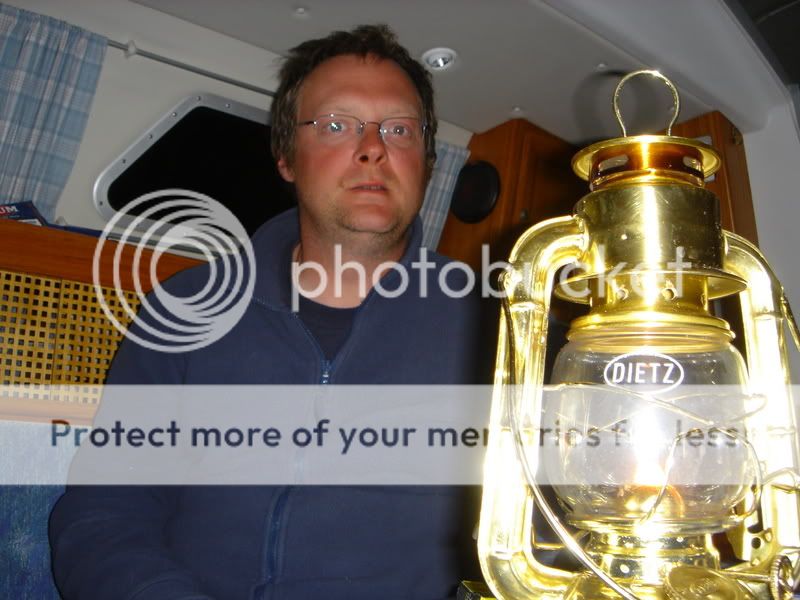
Being outboard powered, electrical power is more limited, but you can adapt. The Honda or Yamaha engines on the 920 have a 12 Amp alternator. Most 920s have a 30 Watt solar panel. If you only do extended trips in summer, the solar panel helps considerably. The boat I sail has this electrical installation: standard ST60 instruments, a chart plotter, LED nav lights, VHF, autopilot, Navtex, and a Waeco compressor coolbox. Interior lights are fitted, but rarely used when away from shore power. By careful electrical management, it is possible to stay away from shore power indefinitely in summer, and still keep the coolbox running. An extremely large oil lamp always helps...
Maintenance is more onerous for tris than a similar sized mono. There are obviously more moving parts to a folding tri, and these must all be kept in good condition. Your life could depend on it. The rig is more highly loaded than a mono, and the replacement schedules for rigging is more frequent than typical mono schedules. The water stays have a 3 year life, and cost £500 to replace. There is nothing particularly difficult about the maintenance. It can all be done by an amateur.
Seaworthiness is something that DFs always get a knocking over, usually by people who have never sailed one in a blow. The biggest risk is not the boat, it's the nut on the end of the tiller. They need to be sailed with a mature and sensible attitude, especially the Extreme. Also it needs to be recognised that the small DFs are not ocean going boats, and are not intended to be. They will not cope well with a F10 in Biscay, because they are not designed to operate in those conditions. The biggest risk is pushing them too hard. Only one 920 has ever capsized, and that was racing in a F7 with the asymmetric up. That is pushing it too hard. For the areas and conditions they are designed to sail in, they can always be slowed down by reducing sail area. Cruising tris like DFs and Farriers come to grief by diagonal pitch poling, not being blown over or knocked over by waves. A diagonal pitch pole is an avoidable accident by a prudent skipper.
Finally the sailing aspect. Nothing sails like a DF - except a Farrier! The sailing ability is what it's all about. Who needs an umpteen HP inboard when on a boat that sails like a DF anyway? The sailing speed is nothing special in light winds because of all the hulls to drag through the water, but once the wind gets going, the speed just goes on rising. A low F5 is best. A standard 920 is comfortable at 15 knots, and can be pushed to 20 with care. An Extreme can add 4 knots to those speeds. They do not sail at these speeds all the time, but obtain these speeds in favourable conditions. These are not instant wave surfing speeds. When you can reach a good speed, you can expect a good average. I have averaged 14 knots over 40 miles. The best speeds are on a close reach to a broad reach. Dead downwind sailing is usually not done, because the apparent wind drops off. Dead downwind is down in broad reach legs with gybing. The main boom cannot be extended beyond 60 degrees from the centreline because of the backstays, but this is not a problem as dead downwind is inefficient anyway.
Multis all get tarred with the same 'won't sail upwind' brush. Small tris have excellent upwind characteristics. Leeway is about the same as a similar sized mono. The centre board has good grip and is an efficient shape. A 920 will do 8-10 knots at 32 degrees to apparent wind. True tacking angle will always be poorer for a boat that has boat speed a higher proportion of true wind speed, but once the wind speed gets up and the boat speed/true wind speed ratio decreases, tacking angle improves.
A standard 920 is easy to sail. The rig is not complex, and the loads are not heavy. The tiller is always light because of the lack of heel. When pushing for speed, care must be taken and the crew must stay alert. However, on longer trips or at night it's always possible to reduce sail, slow down, and relax a bit. Single handed sailing is no problem with an autopilot, even using the asymmetric. An Extreme will be more onerous to sail, but as I've never sailed one, I cannot comment. There is bags of space on the tramps, which is great for preparing the asymmetric or parking the dinghy.
Single handed asymmetric...
As for being a fanny magnet, I never noticed, but on second thoughts, this one seems to have been magnetically attracted to one of the floats...
superb reply - I have considered f27/28 and 920 repeatedly but have never taken the plunge as swmbo is anti tri big time - she did come for a trial sail in an f28 and reluctantly accepted might be allright for just the 2 of us but not whilst we sail with 3 growing c's - perhaps I will get my chance some time!