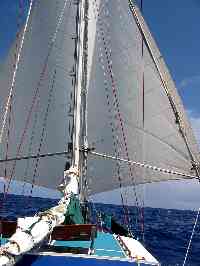
Downwind Rigs

merenpleine

Well-Known Member
Joined
3 Feb 2006
Messages
144
Location
Afloat
Visit site
I recently came across a diagram of a rig on the internet (But now cannot locate it again ..) it showed eg., port headsail boomed out the stbd headsail hanked on only at the head the foot secured and then a line running to a block on the boom and then back to cockpit...anyone know of this rig and what advantage if any it may have?
 
I don't know about having the second fore sail only held by head and foot. I've tried a few set ups and the best I found was on a boat with twind headsail grooves in the track for the roller furling. With this set up you can hoist two headsails on th esame roller, one sheeted via pole, the other sheeted via a block attached to the end of the boom and the boom held out all the way with a preventer. This works well as you can furl up both sails together progressively or quickly if a squal hits.

I posted some pictures here but we were more fore reaching than running so we weren't using the boom at the time, there are some more comments on downwind set ups here though.
http://www.ybw.com/forums/showflat.php?C...true#Post970601
 
[ QUOTE ]
I recently came across a diagram of a rig on the internet (But now cannot locate it again ..) it showed eg., port head-sail boomed out the stbd head-sail hanked on only at the head the foot secured and then a line running to a block on the boom and then back to cockpit...anyone know of this rig and what advantage if any it may have?

[/ QUOTE ]

That is the 'trades winds' rig I used all the time. the 2nd genoa hanked on at head and foot... onld difference is that I had just a spinnaker sheet attached at the clew..

The gap between the boomed out roller genoa and the 2nd boomed out genoa was only an inch or two at it's widest.. very little wind loss. So easy to set up and strike... When the winds got too strong for both sails it was easy and quick to drop the 2nd genoa - after that just progressively rolling the first boomed out genoa.

I would use this rig in preference to the spinnaker except in very light winds.

Michael
 
Howzabout this ?
kiteship.jpg
 
We used the same arrangement too, and it works very well from a broad reach all the way round to dead run.

If the rolling got too awful on or close to a run we put up a small staysail (cutter rig!) sheeted tightly in amidships. I know it's subjective, but it seemed to help with the rolling.
 
Yeah I saw that too I think its called a TWIZZLE RIG By some guy in US it needs a Gizmo where the poles connect should come up on "Google" if you type twizzle downwind rig: i reckon...
 
better if the second sail is supported in some way, e.g. either a boltrope, or a second channel in the foil.

Second channel in the foil is best, cause you can reef both sails at the same time!
 
Re: What\'s wrong with the kite?

twizzle rig is english. ive got this set up and i cant fault it. i use 2 130%s in the roller furling this allows me to reduce sail area easily and if i need to come ito the wind the sails sandwich together and roll up at the same time. we think its the perfect solution as its only two of us on the boat.
 
Re: What\'s wrong with the kite?

there is no gap if both are fed up the furling roller - also with some designs the 2nd halyard does not allow the furling gear to furl....

I never experienced any significant rolling with the 2nd Genoa just fixed head and foot - maybe that was due to the 'gap' ? I had not heard that theory before but from my own experience it could true.

Michael
 
Re: What\'s wrong with the kite?

[ QUOTE ]
if i need to come ito the wind the sails sandwich together and roll up at the same time.

[/ QUOTE ]

That is an excellent justification for the system. A recent experience brought this home to me - middle of the night with a bit of moon, 10 miles offshore, bowling along on a very broad reach with 20Kn wind and just a spinny. We glimpse in front of us the tiny floats of a net extending into the darkness either side. Desperate luff, boat stops sail flapping. Dare not start engines as we are now right on top of the net. We have to drop the spinny and unfurl headsail to sail out of the net. Almost miraculously this happened at a watch change so there were 3 on deck and it was just feasible. With doubled headsails we could have just sheeted in and sailed clear with no drama.
 
Re: What\'s wrong with the kite?

Michael, is the second genny hanked on above the top hank of the main (fully hanked) genny, is it just hoisted on the halyard unhanked to the forestay at the head and hanked just at the foot?

Does one need two forstays to set the second genny as you describe?

Thanks

Ste
 
You seem to have covered almost averything but a couple of ideas I have thought of (as destinct from tried!!)

If you can get a cheap second hand hanked genoa with wire luff + tackle at bottem you could wind it up tigh and effectively create a second forstay?

If you use hanked sails for both (ie those of us luddites still not conviced furling gears are worth it) you can interleave both sets of hanks and are still able to turn upwind and allow the sails to fold together - just not to reef
 
Re: What\'s wrong with the kite?

No.. The 2nd genny is not hanked on at all... I use the spinnaker halyard to haul it up and I placed a U bolt - with substantial backing plate on the deck very close to the fairlead and use a rope to adjust the height.

Actually I had two spare genoas which I could use like this... the smaller one of a heavier material which I would use running before stronger winds with the roller furler genao already reefed.

I have never found that the two sails had to be exactly the same size or cloth weight.. roughly but no where near exact - and that would be using a Hydrovane self steering gear almost all the time.....

Michael
 
I've done it with hanked sails as you suggest, and they would reef together with ties the same as the main.

Not so many fore sails seem to be made with reefing points though these days. They work well as the centre of effort drops as you reef. You may be able to get your sails altered to include eyelets and second/third clew/tack positions.
 
Top