Downwind Faster than the Wind - Successful Run by manned cart

Regarding your final try:
I wrote:
"As it passes windspeed the apparent wind starts to take over and starts to DRIVE the wheel(s). "

Now apart from addressing the issue of windspeed reducing to zero here, the situation where you are trying to START a wind powered vehicle on a calm day sounds a bit ludicrous to me - presumably not to you.

You're the one claiming that the apparent wind can drive the wheels when the cart moves faster than the wind. I'm the one asking you if your claim applies on a calm day.

You made the claim, sunbeam: you defend it.
 
Well Phil, from what I have read so far....... On a clam day ,all you do is give the cart a push start and then.... as if by magic the apparent wind drives the propellor and you accelerate away into the sunset.. obvious innit!!!!!!!
In other words it's just the same as when the cart reaches windspeed.
To demonstrate this you can attach a propeller to the roof of your car when there is a tailwind of 15mph and the propeller is spinning nicely. Off you go driving downwind, driving carefully until you reach a speed of 15mph and then as if by magic...... the propellor stops turning. Oooops!!!
Where did we go so wrong????
 
Last edited:
Wind no blow, cart no go...

This is consistent with our empirical results. :D

Well Phil, from what I have read so far....... On a clam day ,all you do is give the cart a push start and then.... as if by magic the apparent wind drives the propellor and you accelerate away into the sunset.. obvious innit!!!!!!!
In other words it's just the same as when the cart reaches windspeed.

Not so much. The cart exploits the energy available at the wind/surface interface. It slows the wind relative to the ground (it accelerates the wind relative to itself). So as tober said - wind no blow, cart no go.
 
Last edited:
If you go back many posts, you will see that my little model has a negative pitch to the air movement over the blades when pushed in still air, and will act as a reverse pitch airbrake.
No perpetual motion there, I'm afraid.
However, if I put it on a treadmill in still air.......
 
If you go back many posts, you will see that my little model has a negative pitch to the air movement over the blades when pushed in still air, and will act as a reverse pitch airbrake.
No perpetual motion there, I'm afraid.
However, if I put it on a treadmill in still air.......

As you probably worked out for yourself, it has to have a negative pitch in still air. If you give it a postive pitch in still air it will go directly UPWIND.
 
QUOTE SPORK
"The cart exploits the energy available at the wind/surface interface. It slows the wind relative to the ground (it accelerates the wind relative to itself)."

This is simply gobbledygook!!! Try and get that into "Nature"!!
I expect that the energy to accerate the wind comes from.....wait for it.....THE WIND
 
QUOTE SPORK
"The cart exploits the energy available at the wind/surface interface. It slows the wind relative to the ground (it accelerates the wind relative to itself)."

This is simply gobbledygook!!! Try and get that into "Nature"!!

I suspect it would not be "gobbledygook" to the folks at Nature. I'm sure some of them have studied some physics.

I expect that the energy to accerate the wind comes from.....wait for it.....THE WIND

Not so much. The energy that accelerates the wind comes from... wait for it... the SUN.
 
Didn't Neil Armstrong finally tire of people telling him the moon landings were faked and punch somebody?

I'm beginning to understand why. :D


Edited: It was Buzz Aldrin.
 
ThinAirDesigns:"Halfway" and "MikeMonty" Please do not confuse us. I, in no way, support MikeMonty assertions.

However, now we have you here, it would seem I also must declare that I do not support in anyway your work. Both because it is engineered based on incorrect theories, and because you have shown a complete lack of understanding about how to market and "prove" a concept. As for your safety stupidity, I am totally amazed.

The one main fact to show your ignorance it to use "streamers" on a moving "accelerating" vehicle. I "weather cock" or double pendulum, as described previously, is far better than a freeze framed turbulent-flow tell tail. In yachting, we use tell tails to show the turbulent flow events for a specific purpose, but we use a wind direction vane for relative wind.

On the safety issue your design is horrendous. But, by not actually using the correct theory you have also wrongly engineered the cart.

A blindingly simple issue is the difference between a yacht and your cart. Wind is produced by nature. It comes in gusts. In a yacht the gusts are catered for by a lateral heel that de-powers the system. This is not just a rubber band, or chain tensioner, taking up slack, it a serious reduction of air cross section and keel effectiveness. It takes excess energy and creates a potential energy store (righting moment) that smoothes out the gust energy without wasting it all. (Think about the relative wind while recovering). This is completely missing in your cart. You could have easily added the equivalent feature if you had designed the pylon and prop correctly.


As I have said the forward force to overcome the friction is the difference of two vectors. These forces are much larger than the force required to pull along the cart at the same speed, with say a tow rope. Put these large forces with the wind turbulence, and you will get peak loads that are beyond your carts ability. Then with the gear size, to wheel ratio, these forces are multiplied again. Even in basic testing you have been exploding every item and have slowly added "extras" to the design. Now in trials you have collapsed a sprocket. Whatever the excuse, that force was on the prop drive shaft.

Now just consider the front wheel. Nothing more than a normal bike wheel. Now hit one stone with that, and you will collapse it. We are talking about a small diameter wheel going 45mph. The next stage is the front digs in sharply. Then the tower breaks free, prop makes mincemeat of your driver! I do a lot of work with a certain type of cycling that destroys bikes easily. Nice touch having the quick release on the front wheel right next to the drivers feet. As for the complete lack of bracing in the rear section of the cart or the lower pylon, this will just help the collapse as both bow outwards (Seems to already be sprung that way). I know of one video on you tube of a wheel collapse and sadly I have had a few myself. (Rear wheel only, so I still have a face).


Other points noticed:
1. You have the weight of a body on a brush handle. If it, or its attachment (which seems to have been altered) was to fail the driver would be killed.
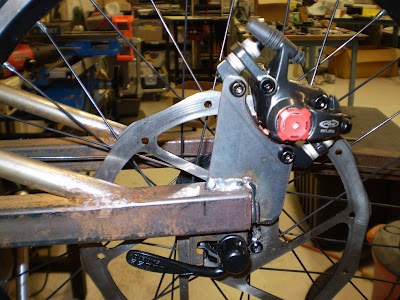
2. You have the front calliper attached to a "tacked" on thin sheet. The rotation is trying to compress the longest edge.
3. You seemed to learn late what bracing is used for, especially on the rear frame.
4. The pushing by a car. If a rear wheel was to collapse, the cart would fall under the pusher bar and the frame would hit the ground spinning the cart The reaction time of the driver would mean that they would have to walk backwards to see the carnage. Please PULL. More sensible even considering the wind direction at slow speeds.
5. You go to all the trouble to get disk brakes but why not go for hydraulic and then extend the tubes. Instead you put a 4:1 lever on a brake lever designed for finger pulling and instead allow the whole of a human arm muscles to though the 4:1 advantage to over load the lever.
6. Strange that you create such a meaty "pusher" bar but when designing the pylon top, that has many times the pusher force, it is created so weak.


Think about it, you are riding a big bike on a flat surface with a tail wind. So the apparent wind is not very high. So friction is not very high. Could a good cyclist make those speeds with just their legs. If so why do you need something the size of a 3KW wind turbine to make it go along. If you believe Mark Drela, and the energy balance, then the net energy can only be explained by inefficiencies in the prop model and so is small amount. This leads you to imagine targets of 1.25 times the wind. But actually if you use the correct theory the relative wind on the prop sails, at the exact wind speed, is the same as the actual wind speed. As you increase cart speed, the relative wind INCREASES in magnitude, only your ability to "collect" the wind decreases due to its resultant lift/apparent angle. So your wonderful success is actually evidence that your theory is wrong! Why does the cart accelerate so much? Every video you seem to be surprised as it takes off away from the car.

Is it not now time to consider that your success is not matching the theory? Since you see the result with your eyes why not question the theory?
Also is it not time to see that your basic design choices are as flawed as your theories. If you make such basic engineering mistakes why should anyone trust your ability to prove a theory. Your record of mechanical failure is also an indication that the theory is wrong.

Take some time off and do some hard soul searching. Please.
 
QUOTE SPORK
"The cart exploits the energy available at the wind/surface interface. It slows the wind relative to the ground (it accelerates the wind relative to itself)."

This is simply gobbledygook!!!

'gobbledygook' = 'it is too complicated for me to understand'

So let's just repeat one point you should be able to grasp - You can't sail a boat with wind alone, it has to be moving over the surface of the sea. If your boat is in a 5 knot current with the wind blowing in the same direction at 5 knots you can't sail, you can only drift.
 
ThinAirDesigns:"Halfway" and "MikeMonty" Please do not confuse us. I, in no way, support MikeMonty assertions.

However, now we have you here, it would seem I also must declare that I do not support in anyway your work. Both because it is engineered based on incorrect theories, and because you have shown a complete lack of understanding about how to market and "prove" a concept. As for your safety stupidity, I am totally amazed.

The one main fact to show your ignorance it to use "streamers" on a moving "accelerating" vehicle. I "weather cock" or double pendulum, as described previously, is far better than a freeze framed turbulent-flow tell tail. In yachting, we use tell tails to show the turbulent flow events for a specific purpose, but we use a wind direction vane for relative wind.

On the safety issue your design is horrendous. But, by not actually using the correct theory you have also wrongly engineered the cart.

A blindingly simple issue is the difference between a yacht and your cart. Wind is produced by nature. It comes in gusts. In a yacht the gusts are catered for by a lateral heel that de-powers the system. This is not just a rubber band, or chain tensioner, taking up slack, it a serious reduction of air cross section and keel effectiveness. It takes excess energy and creates a potential energy store (righting moment) that smoothes out the gust energy without wasting it all. (Think about the relative wind while recovering). This is completely missing in your cart. You could have easily added the equivalent feature if you had designed the pylon and prop correctly.


As I have said the forward force to overcome the friction is the difference of two vectors. These forces are much larger than the force required to pull along the cart at the same speed, with say a tow rope. Put these large forces with the wind turbulence, and you will get peak loads that are beyond your carts ability. Then with the gear size, to wheel ratio, these forces are multiplied again. Even in basic testing you have been exploding every item and have slowly added "extras" to the design. Now in trials you have collapsed a sprocket. Whatever the excuse, that force was on the prop drive shaft.

Now just consider the front wheel. Nothing more than a normal bike wheel. Now hit one stone with that, and you will collapse it. We are talking about a small diameter wheel going 45mph. The next stage is the front digs in sharply. Then the tower breaks free, prop makes mincemeat of your driver! I do a lot of work with a certain type of cycling that destroys bikes easily. Nice touch having the quick release on the front wheel right next to the drivers feet. As for the complete lack of bracing in the rear section of the cart or the lower pylon, this will just help the collapse as both bow outwards (Seems to already be sprung that way). I know of one video on you tube of a wheel collapse and sadly I have had a few myself. (Rear wheel only, so I still have a face).


Other points noticed:
1. You have the weight of a body on a brush handle. If it, or its attachment (which seems to have been altered) was to fail the driver would be killed.
2. You have the front calliper attached to a "tacked" on thin sheet. The rotation is trying to compress the longest edge.
3. You seemed to learn late what bracing is used for, especially on the rear frame.
4. The pushing by a car. If a rear wheel was to collapse, the cart would fall under the pusher bar and the frame would hit the ground spinning the cart The reaction time of the driver would mean that they would have to walk backwards to see the carnage. Please PULL. More sensible even considering the wind direction at slow speeds.
5. You go to all the trouble to get disk brakes but why not go for hydraulic and then extend the tubes. Instead you put a 4:1 lever on a brake lever designed for finger pulling and instead allow the whole of a human arm muscles to though the 4:1 advantage to over load the lever.
6. Strange that you create such a meaty "pusher" bar but when designing the pylon top, that has many times the pusher force, it is created so weak.


Think about it, you are riding a big bike on a flat surface with a tail wind. So the apparent wind is not very high. So friction is not very high. Could a good cyclist make those speeds with just their legs. If so why do you need something the size of a 3KW wind turbine to make it go along. If you believe Mark Drela, and the energy balance, then the net energy can only be explained by inefficiencies in the prop model and so is small amount. This leads you to imagine targets of 1.25 times the wind. But actually if you use the correct theory the relative wind on the prop sails, at the exact wind speed, is the same as the actual wind speed. As you increase cart speed, the relative wind INCREASES in magnitude, only your ability to "collect" the wind decreases due to its resultant lift/apparent angle. So your wonderful success is actually evidence that your theory is wrong! Why does the cart accelerate so much? Every video you seem to be surprised as it takes off away from the car.

Is it not now time to consider that your success is not matching the theory? Since you see the result with your eyes why not question the theory?
Also is it not time to see that your basic design choices are as flawed as your theories. If you make such basic engineering mistakes why should anyone trust your ability to prove a theory. Your record of mechanical failure is also an indication that the theory is wrong.

Take some time off and do some hard soul searching. Please.

It's always nice to meet more good folks that appreciate our work.
 
If so why do you need something the size of a 3KW wind turbine to make it go along. If you believe Mark Drela, and the energy balance, then the net energy can only be explained by inefficiencies in the prop model and so is small amount. This leads you to imagine targets of 1.25 times the wind. But actually if you use the correct theory the relative wind on the prop sails, at the exact wind speed, is the same as the actual wind speed. As you increase cart speed, the relative wind INCREASES in magnitude, only your ability to "collect" the wind decreases due to its resultant lift/apparent angle. So your wonderful success is actually evidence that your theory is wrong! Why does the cart accelerate so much? Every video you seem to be surprised as it takes off away from the car.

Is it not now time to consider that your success is not matching the theory? Since you see the result with your eyes why not question the theory?
Also is it not time to see that your basic design choices are as flawed as your theories. If you make such basic engineering mistakes why should anyone trust your ability to prove a theory. Your record of mechanical failure is also an indication that the theory is wrong.

Take some time off and do some hard soul searching. Please.

I'm a little confused by this mix of Health & safety and the assertion that 'the theory is wrong' as I don't see where you have explained what the theory should be.

The acceleration seems to be a difficult point so maybe I can elucidate here.

In this diagram:
foil3-1.jpg

We start with no motion so true and apparent wind are the same. The angle of attack of the foil is around 110° and the foil is stalled. As the vehicle begins to move and the prop spins, the apparent wind increases and moves anti-clockwise. The angle of attack steadily drops. Here is a plot of lift v angle of attack for a simple aerofoil (NACA 0012)

NACA-0012-CLvAOA-2DWING.gif


When the angle of attack is more than 16° the foil is stalled and producing little lift. As the angle of attack reaches 16°, laminar flow kicks in, the prop suddenly becomes efficient and the power comes in fast.

If a variable-pitch prop were used, starting at a pitch of -74° and increasing as speed builds up, there would be steady acceleration.
 
ThinAirDesigns:"Halfway" and "MikeMonty" Please do not confuse us. I, in no way, support MikeMonty assertions.

However, now we have you here, it would seem I also must declare that I do not support in anyway your work. Both because it is engineered based on incorrect theories, and because you have shown a complete lack of understanding about how to market and "prove" a concept. As for your safety stupidity, I am totally amazed.

The one main fact to show your ignorance it to use "streamers" on a moving "accelerating" vehicle. I "weather cock" or double pendulum, as described previously, is far better than a freeze framed turbulent-flow tell tail. In yachting, we use tell tails to show the turbulent flow events for a specific purpose, but we use a wind direction vane for relative wind.

On the safety issue your design is horrendous. But, by not actually using the correct theory you have also wrongly engineered the cart.

A blindingly simple issue is the difference between a yacht and your cart. Wind is produced by nature. It comes in gusts. In a yacht the gusts are catered for by a lateral heel that de-powers the system. This is not just a rubber band, or chain tensioner, taking up slack, it a serious reduction of air cross section and keel effectiveness. It takes excess energy and creates a potential energy store (righting moment) that smoothes out the gust energy without wasting it all. (Think about the relative wind while recovering). This is completely missing in your cart. You could have easily added the equivalent feature if you had designed the pylon and prop correctly.


As I have said the forward force to overcome the friction is the difference of two vectors. These forces are much larger than the force required to pull along the cart at the same speed, with say a tow rope. Put these large forces with the wind turbulence, and you will get peak loads that are beyond your carts ability. Then with the gear size, to wheel ratio, these forces are multiplied again. Even in basic testing you have been exploding every item and have slowly added "extras" to the design. Now in trials you have collapsed a sprocket. Whatever the excuse, that force was on the prop drive shaft.

Now just consider the front wheel. Nothing more than a normal bike wheel. Now hit one stone with that, and you will collapse it. We are talking about a small diameter wheel going 45mph. The next stage is the front digs in sharply. Then the tower breaks free, prop makes mincemeat of your driver! I do a lot of work with a certain type of cycling that destroys bikes easily. Nice touch having the quick release on the front wheel right next to the drivers feet. As for the complete lack of bracing in the rear section of the cart or the lower pylon, this will just help the collapse as both bow outwards (Seems to already be sprung that way). I know of one video on you tube of a wheel collapse and sadly I have had a few myself. (Rear wheel only, so I still have a face).


Other points noticed:
1. You have the weight of a body on a brush handle. If it, or its attachment (which seems to have been altered) was to fail the driver would be killed.
2. You have the front calliper attached to a "tacked" on thin sheet. The rotation is trying to compress the longest edge.
3. You seemed to learn late what bracing is used for, especially on the rear frame.
4. The pushing by a car. If a rear wheel was to collapse, the cart would fall under the pusher bar and the frame would hit the ground spinning the cart The reaction time of the driver would mean that they would have to walk backwards to see the carnage. Please PULL. More sensible even considering the wind direction at slow speeds.
5. You go to all the trouble to get disk brakes but why not go for hydraulic and then extend the tubes. Instead you put a 4:1 lever on a brake lever designed for finger pulling and instead allow the whole of a human arm muscles to though the 4:1 advantage to over load the lever.
6. Strange that you create such a meaty "pusher" bar but when designing the pylon top, that has many times the pusher force, it is created so weak.


Think about it, you are riding a big bike on a flat surface with a tail wind. So the apparent wind is not very high. So friction is not very high. Could a good cyclist make those speeds with just their legs. If so why do you need something the size of a 3KW wind turbine to make it go along. If you believe Mark Drela, and the energy balance, then the net energy can only be explained by inefficiencies in the prop model and so is small amount. This leads you to imagine targets of 1.25 times the wind. But actually if you use the correct theory the relative wind on the prop sails, at the exact wind speed, is the same as the actual wind speed. As you increase cart speed, the relative wind INCREASES in magnitude, only your ability to "collect" the wind decreases due to its resultant lift/apparent angle. So your wonderful success is actually evidence that your theory is wrong! Why does the cart accelerate so much? Every video you seem to be surprised as it takes off away from the car.

Is it not now time to consider that your success is not matching the theory? Since you see the result with your eyes why not question the theory?
Also is it not time to see that your basic design choices are as flawed as your theories. If you make such basic engineering mistakes why should anyone trust your ability to prove a theory. Your record of mechanical failure is also an indication that the theory is wrong.

Take some time off and do some hard soul searching. Please.

This thread seems relevant.... :D
 
This is simply gobbledygook!!! Try and get that into "Nature"!!

Well saltwater_gypsy, we'll just have to have a chat with them about that -- hardly much of a challenge since Nature Magazine just picked Spork and I to be two of the invited attendee/presenters at their annual and very exclusive Science Foo 'Unconference.'

http://www.nature.com/natureconferences/scifoo/index.html

Apparently the folks at Nature Magazine believe we understand this project a lot better than you do.

JB
 
Last edited:
ThinAirDesigns:"Halfway" and "MikeMonty" Please do not confuse us. I, in no way, support MikeMonty assertions.

Oh, I in no way confuse you two -- your wrongness is unique and clearly the product of your own creative mind and I would never attempt to steal any of that 'original work of wrongness' credit away from you and assign any portion of it to MikeMonty.

JB
 
snowleopard: "I'm a little confused by this mix of Health & safety and the assertion that 'the theory is wrong' as I don't see where you have explained what the theory should be."

I'm sorry SL but if you remember back to the time when I gave a partial proof (It was you who noticed I put the north and south the wrong way around) and you then kindly created the first diagram with the wind going up and down the page.

You then changed it to the second version that combined the two apparent winds into a single 45 degree apparent wind and produced the second diagram.

I thanked you at the time. So look back at where the diagram was first made and you will see the explanation. It also includes all the angles of attack and the suggestion for a variable pitch to enable starting.

It was "ThinAirDesigns" that stated quite clearly that my ideas where wrong, and from his past posts he is a supporter of the incorrect energy proof. Also seen by the fact they designed the wrong prop. But my biggest beef with him is his complete lack of engineering ability and safety. I do not mind anyone playing and investigating like "tobermoryphil" but you do not kill. His creation will kill. It is however nice to see that, while I have been away, a few posts have occurred on other threads supporting the more traditional sailing, difference of two forces explanation over the bogus Mark Drela explanation.

----

ThinAirDesigns: By all means go to conferences. It will hopefully distract you long enough to see sense. That is what they are for, so that ideas can be discussed and the cold light of the day can permeate some closed minds. In the time of the Wright brothers a lot of people where doing the same thing. But due to natural selection many of them were killed building gliders. Only the Wright brothers locked their machine up in a shed, for a year to avoid a similar outcome and concentrate on the marketing.
 
Halfway, since only so much "wrongness" can be addressed in one post (there is just a 'common sense' wrongness limit you see) I will just pick one point you made and address it's absolute wrongness.

2. You have the front calliper attached to a "tacked" on thin sheet.

In welding venacular to have a mig weld that is "tacked" means that you have only welded a small portion of the available interface:

http://www.ehow.com/video_2327761_do-mig-tack-welding.html

It's clear from the project blog picture that the front caliper mount is not "tacked" but fully welded:

P3160001.JPG


As a second note as to the wrongness of your statement, when considering its application and small size, most welders/designers would never call 1/4" thick steel plate a "thin sheet", nor doubt this hefty plate's ability to handle the rather moderate compressive loads expected of it.

JB
 
... the fact they designed the wrong prop.

Ohhh ... that's a nice little "wrongness" tidbit -- I think I'll grab that one.

A quick little lesson for you about how to compare design concepts with design results:

When you set out to design and build a propeller that will accelerate a vehicle DDW to a speed of at least 2x WS, and then you go out and find that the propeller you designed and built accelerates the vehicle DDW to a speed of at least 2x speed WS, you designed the right prop and not the "wrong prop".

Results matter. QED.

JB
 
Top