
Don't want to open a can of worms, but.. .

I'm on the South Coast UK. My harbour is shallow and almost drying, meaning nothing over 3ft draft. I'm looking for a 30ft ish cruiser for costal / Cross channel sailing. My choice is either lifting keel or bilge/twin keel.

In my situation, what would be your choice?

Thanks in advance

Lifting keel, so how about my favourite boat, the Portland Pudgey. Draught about 3ft board down, or 1 foot up.
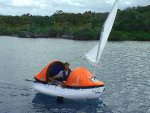
 

Attachments

  • Portland Pudgey Dingy.jpg
    Portland Pudgey Dingy.jpg
    304.6 KB · Views: 22
Another vote for the Parker 31 (later models known as 325 and 335). Draws 2’ with the keel up.

One listed for sale at pretty much your budget on the Parker Seal Sailing Association site, however it appears to be in France which will presumably create a VAT issue.

There’s also a Parker 275 on there (in Kent) if you could cope with something slightly smaller. Those will sail on a damp lawn.
 
Last edited:
TNL1: It might help to be specific as to which harbour. Local knowledge probably available on this forum.

And do you want the creek crawl along to other anchorages and harbours or do you want to go for day sail out to sea and back? Apart from going to France on ocassions
 
There are still stacks of options that your personal preferences can quickly decide, rather than asking for all our warped and wefted likes and dislikes...

...but it occurred to me (and Fred Russell and Mr Ming ahead of me with the similar Parker) that you could easily afford an excellent example of the Super Seal 26, a fine-performing centreboarder from last century, with pretty fair accommodation too.

51900258104_a3ec055314_o.jpg


Plenty of small catamarans have low enough draught. The Prout Sirocco (26ft) below is quite rare, nice if you can find one. Bigger catamarans would fit in your harbour, but possibly not in your wallet.

51900267909_669fab8d28_o.jpg


If your upper budget is a hard £30,000, you'll almost exclusively be looking at boats from 25+ years ago. In terms of styling, I call that a distinct advantage, but many here will tell you the opposite.

New bilge keelers are far fewer now than in the 70s/80s, but old doesn't have to mean decrepit or irrelevant - their popularity seems to have declined as the number of marinas (with deep-water berths) has increased, but a yacht with two legs will stand upright at low tide wherever you stop on your travels, unlike her fin-keeled sisters...but I reckon you know all that.

You aren't restricted to Westerly Centaurs by budget, so I won't include any photos of them here. The Sadler 29 bilge keeler (a shade over 3ft draught) is reckoned to sail much better than most boats with that keel design...nice saloon too...

51900622575_7446cd041e_o.jpg
51900625630_542e8f7a39_w.jpg


It interests me that the first Southerly, the 28, had shallow keels and a centreboard. The later bigger models went for minimal draft - no external keels, and a fully retracting plate, meaning that drying out might leave the hull pressed up against rocks or wreckage. The 28's triple keels meant the hull stood a foot or so above a hard bottom, although I seem to have found the only photo in existence, of one which hasn't dried out upright...

51899932656_0f9f4b662d_z.jpg


Coming from a motorboat background, be very sure what you're prepared to tolerate in terms of discomfort. If you're the type of person who enjoys a ramble through the hills in heavy rain and relishes the effort and determination (and extra clothing) it requires, then almost any 30ft yacht may suit...

...but if you want to enjoy the UK's good weather without being remotely obliged to endure it when it all goes grey and wet en route, look carefully at motorsailer options too. Not the prettiest designs, but by far the most practical, and likely to keep the average family much happier, because you and they can choose to steer outside or behind glass. I'd definitely prefer that choice. :)

51848649449_a58cec96af_z.jpg


That's an LM 27. There are various LMs, bigger and smaller, and several motorsailers from other manufacturers, although there are sadly far fewer to choose between, than if you prefer a 'steer in the rain' design.
 
Last edited:
A lot of the British Hunters (ask how I know) draw 1m or just over. You'd get some change out of £30,000 as well...
 
I'm on the South Coast UK. My harbour is shallow and almost drying, meaning nothing over 3ft draft. I'm looking for a 30ft ish cruiser for costal / Cross channel sailing. My choice is either lifting keel or bilge/twin keel.

In my situation, what would be your choice?

Thanks in advance

You might put up with the extra few inches draught and look for a Westerly Merlin or similar. Generally available, not expensive and easy to move on when you are ready. However, personally I would hold out for a good, clean Sadler 29.

.
 
A friend's lift keel boat went aground and sank in the recent storms. I'd go for a boat that can take the ground safely. You'll probably lose a bit of windward ability, but do you really want to flog to windward? An added bonus is that it opens up anchorages that other boats can't get to. There's a certain smug pleasure in sitting in the corner of an anchorage away from everyone and watching fins unable to find deep enough a bit of water.

A catamaran would fit the bill nicely as it won't fall over unless you're really doing something very wrong! (dishonourable exception made for the Iroquois, which I understand does have a tendency to capsize.)
 
… the Iroquois, which I understand does have a tendency to capsize.)

…But does sail to windward well I believe? To each their own, of course, but I’ve never understood those that don’t care if their boat is close-winded or not. I mean, that’s the best bit isn’t it? To (seemingly) defy physics and sail towards the wind, the balance between ballast and breeze - it’s a joy.
 
I’ve never understood those that don’t care if their boat is close-winded or not. I mean, that’s the best bit isn’t it?

It is when it is...in bright warm weather with a modest heel (rare in UK). When it isn't, it's often very discouraging.

Until lately I enjoyed thinking about the wonderful physics which allow even an indifferently-designed yacht to make progress into the wind that drives it...

...I've only realised in recent years that I'd much rather motor briskly to windward in a boat whose designer didn't treat its engine as an unloved burdensome necessity, than spend my free days sailing a crazy zigzag course as if I was paid to waste time.

As soon as I recognised that, I stopped wanting any boat whose design is concentrated on best-possible upwind sailing.

The prospect of boating (rather than strictly sailing) with virtually guaranteed arrival times and very little heeling, no elastic passage lengths, plus, critically, the avoidance of our variable climate's nasty tricks, is blissful.

Lots of weekends begin on a fine Friday evening with a downwind passage in glorious weather to a lovely anchorage. Then in dawn's first light there is the patter of rain, and at breakfast time you face a thankless drenching day either beating home against it, or just sitting in the cabin hoping for better on Sunday, and wondering if it would have been nicer sitting at home.


If the boat wasn't designed primarily to sail well to windward (in fact if yachtsmen weren't obsessed with that ability), there'd be a dry comfortable place (with good all-round visibility) to steer from. Happy, warm dry families laughing smugly at the water streaming across the glass, like they do on the road. Unheard of aboard pure sailing yachts, and sadly, rare aboard many deck-saloon designs which put the inside helm at so disadvantageous a position, it's a poor substitute for standing outside.

The best thing about turning the corner to proper motorsailers, is realising that going along under engine isn't second-rate, in a boat adroitly designed to make that experience a pleasure (I recognise that not all alleged motorsailers are in that group :rolleyes:). Embrace that, and you can enjoy longer seasons and (barring gales) rely on weatherproof passage-plans made months in advance.

51901776580_1e6175f960_z.jpg


I realise I bore for England and nobody wants to hear it, but the gent asking, deserves to know the truth.

I'll go, now. ;)
 
Last edited:
Hi. To clarify:

Very shallow harbour. Around 2ft if water at LWS Around 5ft of water at mid tide so anything over 3ft draft is quite restricted. Virtually all of the sailing boats in the harbour are lifting keel or bilge as the chances are you'll be taking the ground at some point.

I know, not ideal yacht territory but we are where we are. Thanks for the replies so far.
Just look at boats that all the others in the Harbour use. That will dictate the type / model of boat. Its then your preference for either bilge or lifting keel.

Which harbour is it ?
 
2ft of water at low water springs sounds quite generous to boats with keels, though as he says, it'll mean hitting bottom in most yachts.

I reckon a vast proportion of Poole's or Chichester's mud is 2ft or more above the water at LWS.
 
2ft of water at low water springs sounds quite generous to boats with keels, though as he says, it'll mean hitting bottom in most yachts.

I reckon a vast proportion of Poole's or Chichester's mud is 2ft or more above the water at LWS.

But not in the channels or where mooring are. Don't think there are any drying moorings in Poole - all deep water or marinas.
 
Top