Don't drag your anchor!

Just to add to my last posting to make my point Dulls .We are anchored on the south of France , every day these day power cabin cruisers boats come out of the marina for the day , they turn up around 10sh drop a load of chain and jump in and swim / sun bath have lunch , around early after noon the wind start to pick up a bit every day boat dragging , you think they would learn but the next day the same boat do the same again and they drag again ,
There only one way to anchor , set the anchor .
Sorry when did i say dont set the anchor? Read post properly
Dulls, I think you are describing a situation similar to that pictured below. In this case even though the Rocna is facing the wrong way it still providing the majority of the holding power. It takes a reasonable amount of force on the anchor before it starts rotating:
FjJPWbt.jpg


There are some times such as the photo below where the chain is providing all the holding power, but unless the chain is stuck under a rock or in heavy weed this will only occur if the wind is light:
24tPLQ4.jpg


The chain on its own only has very slight holding power. The chain does assist the anchors holding ability in some circumstances primarily by modifying the direction of pull, and helping the initial setting of the anchor, but this it is still the anchor probiding the holding power even when this occurs.
Bottom photo shows no tension on the anchor which appears not to be set either.
 
Bottom photo shows no tension on the anchor which appears not to be set either.

Yes, agreed. The owner obviously dropped some of the chain in a heap and never applied any setting force to the Kobra. Not a recommended technique, although in the vast majority of cases any increase wind force will straighten out the chain and set the anchor quite nicely.

The photo was taken some time after the anchor was dropped, and shows that the chain is indeed holding the boat as the chain has not even moved enough to straighten out and start applying any force to the anchor.

However, this situation will only be seen in light winds/currents.
 
Sorry when did i say dont set the anchor? Read post properly

Bottom photo shows no tension on the anchor which appears not to be set either.
You need to read what I said , NO WHERE did I say you suggest not to set a anchor , what I said was ( There only one way to anchor , set the anchor .)
Your first posting make it clear that you always dig your anchor in slowly so why would I say other wise
It also said ( If you ever get the chance, lay out your chain on a concrete surface and then try to drag it. I have a feeling that most of the time you are at anchor it is the chain holding you and not the anchor.)
Well I done that a few times , ever time I re mark the chain and I have not problem pulling the chain .

as I said in my first reply to you , I totally disagree with your feeling that most of the time it's the chain that holding you and not the anchor .

Come to think of it I could be wrong , if your one of these people who only anchor in no or very light , in which case your feeling in your case right .


Now if you want to carry on quoting what I said to carry this on then do so , but I have no intention of answering too busy watching a yacht dragging in 16 kts of wind , maybe he been reading YBW ?
 
Last edited:
You need to read what I said , NO WHERE did I say you suggest not to set a anchor , what I said was ( There only one way to anchor , set the anchor .)
Your first posting make it clear that you always dig your anchor in slowly so why would I say other wise
It also said ( If you ever get the chance, lay out your chain on a concrete surface and then try to drag it. I have a feeling that most of the time you are at anchor it is the chain holding you and not the anchor.)
Well I done that a few times , ever time I re mark the chain and I have not problem pulling the chain .

as I said in my first reply to you , I totally disagree with your feeling that most of the time it's the chain that holding you and not the anchor .

Come to think of it I could be wrong , if your one of these people who only anchor in no or very light , in which case your feeling in your case right .


Now if you want to carry on quoting what I said to carry this on then do so , but I have no intention of answering too busy watching a yacht dragging in 16 kts of wind , maybe he been reading YBW ?
so we agree....
 
Well after my last post we had some Acton here in Golfe Juan


Why writing the last post there been some shouting going on ,
Call from another boat was trying to get the attention of the yacht that was dragging and heading for a cat .
Now soon I posted I jumped into the dinghy to warn the cat , while the other guy headed for the yacht ,
found them having dinner down below the guy who was shouting now in his dinghy banging on the Ben hull ,
sod law no one on board , lucky both the cat skipper and the other guy French spoke good English and quickly we decided the guy in the rib would push the Ben away from the cat and I would climb onto the Ben with a rope from the cat and we would tie it along side the Cat .


All went to plain , except the cat skipper wanted to haul in the Ben anchor , as he didn't know what time the people would be back and didn't want to be messing about in the dark if it was caught on his , to be honesty I wasn't very please in hauling the Ben anchor and wouldn't get involved , between him and the other guy they hauled around 25 mt of chain and on the end a 15 kg Rocna .
I think the people on the Ben are in for a shock when they return .
75 kg of chain and anchor in 16 kts and it still moved .

It's very weedy here I had have two Go at anchoring as I wasn't convinced it was set the first time , I didn't see the Ben anchor so no idea if he tried to set it or not .
What ever the case it wasn't set .
 
Well done, Vic. Often people do nothing to help dragging boats, which is sad.
One of the problems is that the insurance can come after you if something happens to the boat after you left. I know this is the case in Australia .
 
One of the problems is that the insurance can come after you if something happens to the boat after you left. I know this is the case in Australia .

Unfortunately, you do take some risk.

Sometimes you just have to trust your judgement and do your best, as you hope others would do for you.
 
Unfortunately, you do take some risk. Sometimes you just have to trust your judgement and do your best, as you hope others would do for you.

Isn't that what we're about.... or should be?

As for anchoring without setting, the above recalls drifting in on the last remnants of a dying breeze to just south of Duntrune Castle/Loch Crinan, ina Rival 34 with a dead engine. Yes, the anchor went down and yes, so did 40 metres of chain on top of it. There was only Hobsons' Chioce. The argument was that if any breeze got up in the night, the chain would 'grumble' enought to wake us, and we could sail off.... or just watch to see if the chain straightened and the anchor bit.

Came the dawn - we hadn't budged. But.... there were hints on the water of the beginnings of a breeze, so we 'got' the anchor and worked every cat's paw out through the Dorus Mhor. The tide streams started to run and that gave us enough movement to 'belly' the mainsail, and one of us held the genoa clew in the right position - as a human 'Barber Hauler. That was enough to get us up towards Fladda and the Dubh Sgeir light...... and the tidestream carried us on towards Oban

Dinghy stuff..... ;)
 
Here is some data, which I've actually measured.

At a 5:1 scope with 30m of 8mm chain deployed and with a tension of 70kg all of the chain will be off the seabed. 70kg tension is about the same as a reasonably fit and healthy man can 'hold'. 70kg of tension is about the same as the tension developed on a 45' yacht in 17/18 knots of wind.

Now to me - having all the chain off the seabed means there is no friction, between chain and seabed, adding to the hold of the rode. In lighter winds there will be more chain on the seabed - and of course you could deploy more chain and have more on the seabed (But when I did these measurements I was restricted by space).

Now if you take this 30m and lay it on the beach and try to pull it the scope is 30:1 (roughly) it is all on the seabed, whereas with the yacht there is lots of chain dangling in the water. So the idea you can equate what a man can pull on a beach to what happens beyond the bow of your yacht lacks any logic.

Obviously if you have 100m of 8mm chain on a 30'; yacht then that 100m will hold the yacht steady - up to a point. But as most owners persist in having 8mm chain, and some 10mm chain, that 100m of chain will do nothing for sailing ability.

Because the cult of catenary is flawed - we don't use 8mm chain - but have replaced it with high tensile 6mm chain - but then we rely on our anchor (and 2 anchors set in a 'V' if the forecast will result in our enjoying 35knot winds in our sheltered anchorage).

At about 30 knots of the 8mm x 30m chain it 'looks' straight and the tension is of the order of 250kg. Lets not get pedantic - I said 'looks' straight - and it is at this point you need to think of deploying more chain (if you have the space) and being grateful you have a decent 10m undernourished nylon snubber (and that you power set the anchor). Power setting at about 75% of full revs will develop a tension in the rode (same conditions as previous) of about 250kg - so about the same tension developed from 30knots of wind. Beyond the 30 knots your anchor is setting more deeply, than you can achieve by power setting, and if there is an old beer can or towel, fell off a yacht, buried in the sand 1cm in front of the toe of your previously securely power set anchor - it will drag.

If your snubber is too short and/or too beefy - it will not be very elastic and not much use - better than nothing but a thinner and longer piece of nylon will cost the same - and make your anchoring more pleasant. We are comfortably using 12mm x 30m nylon, as a bridle - though I wish now it was 10mm.

Don't be complacent! No matter what your anchor - they don't work when they have impailed a towel, beer can, bit of kelp stalk or oyster shell.

This idea of power setting, constantly repeated, is guaranteed to engender complacency - yet when you need it most - beyond those 30 knots - you are relying on nature (and your anchor alarm). Power setting is not the panacea implied.

Now the data I quote can be scaled up or down for a smaller of larger yacht. I am more than happy to extend the data - just lend me your yacht for a few days....... Think of it as 'order of magnitude'.

If you are in weed the problems increases as the weed can get caught round the base of the shank, the crown (and this restricts or stops the anchor digging more deeply) and the weed can clog the fluke (possibly the issue Vic describes, above). Weed round the shank has nothing to do with design and choice of anchor - it will happen to any anchor - as they all have a crown. The only answer is, anchor somewhere else or look for the weed free patches and drop the anchor into one of them.

So....if you think your chain contributes to hold - do the experiment again, have 10m of that 30m of chain on the seabed, maybe this equates to a benign wind of 12 knots - try pulling the 10m across the seabed - that's the contribution your chain makes - in benign conditions. And please don't suggest that there is some resistance of the water on the chain......

Jonathan
 
First let me say , it's sadden me to think anyone would stand by and watch a boat drift off in case someone may try and sue them ,
This is not the first time I had to help to sort out a boat that's dragging and I guess it won't be the last .
It doesn't enter my mind , we live in a world where any thing we do some tosser low life could try and sue you .
Has a human being it wouldn't stop me given someone CPR in case that person dies and I got sue , this is why we have insurances in the end let the court decide . That's is what their are there for.

I got two nice bottle of wine last night for the French owner shame my partner not here to help me drink them, there won't be much left but the time she gets back.
He explain that he made several attempts to set the anchor but couldn't get through the weed , in the end it felt the anchor was holding so he decided not to put too much pressure on it . the forecaster was for very light wind for the next 24 hours .
He said he anchored here a few times and he alway had the same problem but the boat as never moved before,
I asked how much chain he drop cos the skipper of the cat said there was 25 mts he said he dropped 35 mts and he depth of 5 mts .
The children grandmother lived a mile down the road and it was her birthday and he felt it be ok to leave the boat as it wouldn't take long to get back if he needed .
He set an anchor alarms that would send him a SMS if the boat moved but by the time he got the alarm and got back he notice the boat was next to the cat .
He said it was just unlucky the boat got that far with so much weed he tho if the boat should move it would had just got caught on more weed given him enough time to get back .
That wouldn't be my logic of thinking . Just show how people think and how little valve they put on there boat let alone the boat they may hit .

This whole area is very weedy with very long grass right along the French coast they have swimming buoys so you are limited how close you can anchor .
I can't comment on what happen to the boat but I had to anchor twice , the first time we held at 1000 rpm once I increased the rpm to 1200 which is were I normally set my anchor at it just didn't feel right and for sure there was a very slightly movement not that you notice but I know my boat.
I guessing the anchor hadn't cut through the weed and was holding on roots or the weed it self,
I could had done what so many people do and left it as there no sign of bad weather for the next few days but my experience tells me the one time you leave it is the time you will wish you never had plus as I am on own and if we should get a thunder storm which can happen here this time of year over night and I start to move it be a pain especially as my windlass as a mind of its own and decide to stop at the most inconvenient time .
 
Obviously if you have 100m of 8mm chain on a 30'; yacht then that 100m will hold the yacht steady - up to a point. But as most owners persist in having 8mm chain, and some 10mm chain, that 100m of chain will do nothing for sailing ability.

Because the cult of catenary is flawed - we don't use 8mm chain - but have replaced it with high tensile 6mm chain - but then we rely on our anchor (and 2 anchors set in a 'V' if the forecast will result in our enjoying 35knot winds in our sheltered anchorage).

Johnathan, some interesting data, thanks. The problem with changing the chain and the reason most don't is the cost of the new chain plus the windlass together. Locating G40 isn't too difficult, anything like G70 in a 6mm form, more difficult. I guess the demand for 6mm chain is mainly little day fishing boats who don't really care about quality and price is the determining factor. So most will stay with 8mm as the easier and cheaper option.

If you know of a European supplier it would be interesting to do some sums. There is a business opportunity for you, import G70, 6mm chain into the UK for us. Just make sure the quality is accurate, we don't want another bendy anchor shank malarkey.

Pete
 
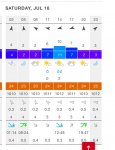
This was the forecaster for yesterday it ended up topping 18kts , I wonder how many people with the view that there chain will hold them in light winds would had not bother try and set their anchor with that forecaster and go off ashore for some time believing their boat was safe ?
 

Attachments

  • IMG_1714.jpg
    IMG_1714.jpg
    100.9 KB · Views: 4
If you know of a European supplier it would be interesting to do some sums. There is a business opportunity for you, import G70, 6mm chain into the UK for us. Just make sure the quality is accurate, we don't want another bendy anchor shank malarkey.

Pete

I developed the 6mm HT chain for our own use. The ambition was to make a chain that replaced the 8mm G30, for strength - noting that most G30 is nearly G40 quality. The focus was on having a rode with all the components matching, connectors (like shackles), chain hooks and anchor righters (replacement for swivels) - matching for strength and fit. All of this was achieved - the downside was - we needed a new gypsy.

Gypsies are extortionate and as our windlass was 16 years old - we bought a new one. Windlass have developed in 16 years - and the new one is refreshing - so fast. You don't need a chain hook (for the snubber) you could use a soft shackle - but 6mm chain is small and threading a soft shackle through a 6mm link is fiddly (at 2am in the rain) hooks are easier.

Since I made our rode I helped make another, 8mm, as replacement for a 10mm, for a 50' cat and I managed to increase the strength.

I'm in the middle of helping make two more rodes, 130m each - one of 6mm, for a tri, the other 8mm for an Ovni 43. The extreme length is so that they can have 100m rodes and 30m for a mixed second rode.

My involvement in these rodes are non financial - I learn and abstract the data.

When I made our rode I tested the finished product for strength, did the same with the 8mm and plan to do the same for the 6mm and 8mm. You can have a certificate of strength - and I suppose a Youtube if you wanted. The other perameter was gal coating thickness and I have a way to check the coating through the length of the rode - and the happy new owner has samples taken from along the length that he can have tested himself (I have ours on keyrings). Another idea was to have the rode marked at 10m intervals - the owner of the Ovni wants to do this himself.

Advantages - its lighter, takes up less room, the windlass can be smaller, uses less power to retrieve, polishes to look like black stainless (less towering, less mud clinging), has harder and thicker coating than HDG (and hardness and coating thickness determine life - tested this) and it costs less (if you live in The Lucky Country, Oz for anyone else). Downside - that gypsy and you lose catenary (which you must replace with a snubber)

Coincidentally I looked, today, at shipping costs from Oz to the UK - possible but (based on a quick look) the freight destroys the major advantage here - my rode is dirt cheap. But it should be possible to make in Europe (and even in the UK) - I'm thinking along those lines - watch this space - but the current environment is not conducive to anything new :(

If anyone is interested - send me an email address and I'll send an article defining chapter and verse. Sorry I don't have a link - its behind a paywall - but I do have a pdf. Knowledge is not of much value unless it is shared.

But I've hi-jacked a thread - again - apologies

Jonathan
 
Unfortunately, you do take some risk.

Sometimes you just have to trust your judgement and do your best, as you hope others would do for you.
I agree with you but insurance companies are about making a profit. If you do do anything to help dont broadcast it. One of the marine rescue units about 15 years ago was involved with the insurance coming after them. You also have to remember there are nasty boat owners out there as well. We left the gentle age of politeness and helping ones fellow man 50 odd years ago. I have helped in situations like that but it leaves me wondering about future litigation. If you were the last person to say reset their anchor and then the boat goes onto do further damage you may wish you had never bothered.
 
Haha no we don't agree unless as I said you only anchor in very light winds and even then it's not worth considering.
I anchor in all weathers but more often than not it is in good weather and not bad. Strongest winds i have ever faced at anchor were in Australia. Pre thunderstorm gusts but only short lived.
 
You also have to remember there are nasty boat owners out there as well.
Your warning is important to take into account, but I am not as pessimistic about human nature.

I have been full time cruising for a long time so I have rescued quite a few boats. Here are a couple of tips:

1. Have some safety gear for yourself, such as a lifejacket, hand held VHF, phone, knife. Even some apparently straightforward situations have become more serious and hazardous. Some simple tools and a kedge anchor, diving mask etc depending on the circumstances can be invaluable.

2. If possible first visit other boats in the anchorage for extra help. More hands and opinions are invaluable and it helps remove the suggestion that you may have a nefarious intent.

When leaving your own boat at anchor consider leaving a sign with your mobile number.
 
Top