Don't drag your anchor!

Hard sand can certainly be a difficult substrate for anchors, but it is true that you are not likely to find this in Australia.


An anchor’s performance in hard sand also seems to equate to its performance in thick weed. This is not surprising. Strong penetration force on the toe is required to dig below hard sand, and also to penetrate below weed roots. An anchor that is good in hard sand is very likely to be good in weed in my experience.

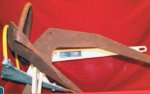
I encourage others to look at my underwater photos and draw their own conclusions, but to talk about effective fluke angle you really need to understand how anchors work. One poster on this forum has, in my view, drawn some very weird and inaccurate conclusions. This photo published in Practical Sailor showing the reported difference of the Mantus fluke angle compared to the Rocna is just so wrong it is embarrassing.


This photo below was published in the Practical Sailor Febuary 2017:


Fluke angles for many large commercial oil rig anchors are adjusted following an analysis of the seabed. This allows the setting of the largest possible angle consistent with the seabed composition, but if the fluke angle becomes too large the anchor becomes totally unstable and will not work at all. On the other hand, a lower angle will still work and provide reasonable holding.


If you use multiple small anchors, I can see trying to duplicate this approach using a range of anchors for different seabed types, but I suspect most users want an anchor that will work well on a large range of seabeds.


I have owned a Rocna and an identically sized Mantus. The Rocna is excellent, but the Mantus is just a bit better. I included the Rocna in the sale of my old boat and kept the Mantus. I am sure better anchors will come along in the future (I hope so), but the Mantus is very hard to beat, at least compared to all the anchors I have seen performing underwater (there are some new models I have not had the chance to evaluate).


A Google search will show many positive user reports from happy customers of the Mantus.


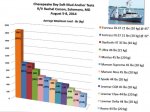
The Fortress Chesapeake Bay tests were conducted in very soupy thin mud where if the conclusions about the performance of the Mantus were accurate, the effect should have been the most pronounced. The Mantus was one of the best non “fluke” anchors (ie non Fortress and Danforth style). The holding power of the Mantus was almost double that achieved by the Rocna and 25% more than the Spade. It was also arguably the most consistent of the anchor models, including the Fortress. No anchor was as good as the “fluke” anchors, which is why Fortress chose this extremely soft substrate, but the Mantus did much better than most alternatives. The results are posted below.


Anyway, I just wanted to set record straight. I am not going to be drawn into a long series of bickering posts on the forum. I dont think this is productive, of interest to many readers, or good for the forum. I do not understand why anchors cannot be discussed in a civil manner.


If there are any questions about my experience with the Mantus, my underwater photos or anything else, I am more than happy to post an answer to any questions from any polite members on this great forum.
 

Attachments

  • C893CCAD-C8DB-4A3C-851E-02C9095E6A4A.jpeg
    C893CCAD-C8DB-4A3C-851E-02C9095E6A4A.jpeg
    825.6 KB · Views: 32
  • CC66D98B-9494-432C-A0B2-4B11701178AD.jpeg
    CC66D98B-9494-432C-A0B2-4B11701178AD.jpeg
    103 KB · Views: 30
  • Like
Reactions: GHA
Noelex,

You cannot make this up!

I draw your attention to this thread and separately video

Photos of Anchors Setting - Page 10 - Cruisers & Sailing Forums

To make it easy for you, and anyone else.

Specifically look at images in posts numbered 61, 83, 131, 132 and 147. These are simply examples, I got bored and could not be bothered with the hundreds of similar examples.

Now look at the long of the shank (these are of Mantus - the long of the shank is horizontal). If you look at the image in your post that has been lifted from Practical Sailor the long of the fluke of the Mantus is also horizontal and the fluke thus lies at 16 degrees. It is not surprising that the the images on the thread and the image of the Mantus are similar - one is a mock up of the other.

If you recall a fluke at 16 degrees has 50% of the hold of a similar sized anchor with its fluke at 30 degrees.

If you look at Post 74 there is a picture of a Bugel. The shank is also horizontal - and as the shank is at an angle of 30 degrees to the fluke the fluke is thus at 30 degrees to the seabed. 30 degrees is the common aspect of the fluke of a Rocna, Supreme, Ultra, Excel, Spade etc to the seabed when set and the shank still visible.

Now if you look at this video and compare the various setting orientation of the Rocna - low and behold the angles reflect the mock up of the Practical Sailor article - with the fluke at 30 degrees.


Now these images are not mine they are taken by you and very independent of me the vid is from 'Distant Shores'

If you want another view of a Rocna setting, or set - simply go to the Rocna website and Smith has a vid, in damp mud, showing the anchor setting - and surprise surprise - the orientation is the same as I illustrate for Distant Shores etc in the PS article. What I have found is that Mantus is pretty consistent with a 16 degree fluke angle - other anchors average about 30 degrees - but do vary between about 25 and 35 degrees - and I don't know why.

I have obviously not been able to doctor anything - I simply looked at images of a Rocna and a Mantus set underwater and copied the way they are set.

Interestingly in the first 150 images I did not find a Rocna. As I said I became bored. If someone wishes to trawl through the thread and finds some images of a Rocna - feel free to post. I thought the vid was sufficient.

In the first 150 images there are a number of pictures of a Spade that has been set. because it has a smooth curved fluke it is much more difficult to analyse the angle of the fluke to the seabed. I do have some images where an analysis is possible - the fluke lies at 30 degrees.

Now exactly what is embarrassing? with the PS image


I have also noted your repeated claims that a large anchor is reliable at short scope. Yours is a big anchor, here is an image of your anchor at short scope

see post 99 on the Images of Anchors thread (link above).

The shank is skying - my guess at near 16 degrees, which means the fluke is horizontal - offering virtually no hold. Precisely why is this indicative that a large anchor at short scope can be relied on? Not only is the fluke horizontal but shallow and in soft sand (which I thought you said only occurred in Australia).


Now the question must be - would the forum members swap their anchor for one optimised to work in a hard seabed and sacrifice 50% of hold? Secondly what is the reaction to someone spruikking an anchor that optimises a hard seabed, was the reason for choosing the anchor - but this was left unsaid.

Finally you claim optimisation for a hard seabed results in an ability to set better in weed - any evidence. Most of your assertions are 'gut feel and lack any evidence, like the short scope mantra. Your analysis of your own anchor is seriously flawed - how can anyone consider your comments on other anchors and different conditions with any credibility.

Keep digging - the hole only gets deeper.


I am upset and passionate. I believe much of the conclusions previously expressed by Noelex of Mantus and his comments on other anchors are dangerous (and nonsense). People have bought a Mantus thinking its as good as Rocna. This, to me, is blatantly untrue - and if someone buys a Mantus, on the basis of Noelex 'recommendations' of the same weight as recommended for a Rocna - they may be truly embarrassed. I try to provide an alternate analysis.

Noelex has a reputation to defend, I don't care for my reputation - I just want people to be safe and enjoy being at anchor.


Jonathan

Edit

Of course Noelex might have an usual anchor


Look at the first section of this video - note it is a promotional video showing the Mantus in good light. Two factors to note - when the Mantus is being 'set' the shanks skies slightly - and as illustrated if the shank is above the horizontal then the fluke is addressing the seabed at less than 16 degrees. Secondly if you look carefully the Mantus never locks up, where the video is edited, in the early part, in 2 sections the anchor is still moving - it never sets

Mantusa undoubtedly engages with the seabed quickly - but setting distances can be very long - and in some cases tha anchor simply does not set nor drag.

I reiterate this is a promotional video showing the anchor in the best light?
 
Last edited:
My anchor has been defeated by hard ground. Croic Harbour in the Monach Isles, is not actually a harbour, but a wide sandy bay, but part of it is just thin sand over smooth rock.
I wouldn’t count that - no anchor of any design would work then - like you I’ve encountered that and use that experience to explain why you need to to test the seabed with full reverse. A few inches of sand above rock will hold in a few knots of wind.
 
@ NORMAN...
It wasnt a anchor survey but if I was going to so one it be more likely in a marina then diving under boats at anchor and digging up their anchor :)

I tend to find that a larger population of a specific anchor design is indicative of easy access to a retail outlet.

If the chandler stocks Spade then you find lots of Spades in the nearby marinas. There is also a national bias, which may also reflect availability of stock in a chandler - you see a higher proportion of Britany and Spade in France (and the French Pacific) than anywhere else. You see more Excels in Australia, New Zealand and the Pacific North West - than anywhere else. This latter is actually odd as New Zealand and the Pacific NW are the home of Rocna (and Manson). You will find (and this is subjective), if you probe, a higher proportion of Mantus owners are members of Cruisers Forum. Fortress adorn bow rollers on yachts in the US and are almost unseen anywhere else.

An implication is that 'marketing' is a strong influence in anchor sales - not excellence. I find it difficult to believe that Spade works well in France bot no-where else, or that an Excel has been optimised only for Australia and will not perform as well in a seabed 5000nm away. In fact I cannot think of a bigger difference than the Pacific North West and Australian waters - yet both are a focus for Excel sales - in the face of fierce completion from Rocna.

When people want an new anchor - they want it NOW - not some indeterminate time in the future.

Our Spade took weeks to deliver to Oz, we had to driver miles to a freight forwarder to pick it up - who needs that when you can buy a Rocna 100m from your yacht?

Jonathan
 
A Google search will show many positive user reports from happy customers of the Mantus.


The Fortress Chesapeake Bay tests were conducted in very soupy thin mud where if the conclusions about the performance of the Mantus were accurate, the effect should have been the most pronounced. The Mantus was one of the best non “fluke” anchors (ie non Fortress and Danforth style). The holding power of the Mantus was almost double that achieved by the Rocna and 25% more than the Spade. It was also arguably the most consistent of the anchor models, including the Fortress. No anchor was as good as the “fluke” anchors, which is why Fortress chose this extremely soft substrate, but the Mantus did much better than most alternatives. The results are posted below.


Of course there are many happy customers for Mantus - it has the hold of a similarly sized Delta but engages much more quickly and reliably. Many members here have openly stated they used a Delta for years - they simply now know there are anchors that offer a better performance - quick to engage, reliable and additional hold. Whether you need additional hold - is debatable - but having it - is reassuring. Reassurance adds to a relaxed night in a berth.

The US Navy believe that for anchors of similar design characteristics and similar fluke areas then the effect of fluke seabed angle can be roughly determined by the ratio of the sines of the respective fluke/seabed angles. I have repeatedly said that a Mantus is an unballasted fluke anchor (with its crown in a disadvantageous location) like a Fortress, Danforth, Bugel, Bruce and Knox etc.

The sine of

16 degrees is 0.28
30 degrees 0.50
45 degrees 0,71

If a Fortress FX 37 of similar fluke area as a Mantus are compared then as was conducted at the Chesapeake tests then if the Fortress, set at 30 degrees were to achieve a hold of 995lb then a Mantus would be predicted to develop a hold (based on that 16 degree angle) of 548lb - it actually achieved a better result of 680lbs. A Danforth of similar size to the Fortress would be expected to achieve a hold similar to the Fortress, it averaged at 990lb. A Fortress set at 45 degrees would be predicted to achieve a hold of 1,989lbs the actual result achieved was 1,862 lbs. There are variations from the predictions.

The Mantus returns a better result than anticipated but the roll bar adds hold - it has surface area and offers resistance to dragging - and this may offer a reason for the better performance.

To me the Mantus was slightly better than expected - but for a test with many variables, such as the seabed, it performed well within predictions. The roll bar has a surface area, measured on a 15kg model, adding 14% to the fluke area. If we increase the predicted hold after adding in the surface area of the roll bar the prediction increases from 548lb to 625lbs - much closer to the actual achieved of 680lbs. Maybe the US Navy know a thing or two about anchors?

Rocna etc are ballasted anchors like a Spade and are simply not comparable to a Mantus nor Fortress in a seabed specifically chosen to show an unballasted fluke anchor in best light. Ballasted anchors rely on being able to roll over and this may not have occurred in the chosen substrate. A Mantus is hydro-dynamic and always aligns correctly if the vessel setting the anchor is moving aft (which would be normal for setting an anchor) and though it has a roll bar it is unnecessary if the anchor is free hanging (and falling, being deployed) - as it is correctly addressing the seabed when it arrives there.

Noelex - just keep digging

Noelex - I am like you I cannot understand why anchor threads are uncivil - but then I cannot understand why someone can spruik an anchor and completely omit to mention one of the key reasons they think it is a good anchor.

I feel a responsibility to support my contentions to demonstrate I have not plucked them out of the air. I am sure, Noelex, that people who bought a Mantus based on your expertise would like some reassurance that counters my comments. I am open minded and very willing to learn and disseminate what I have learnt - so that people an make their own decisions based on a cross section of information. I hope you will do the same so that I can be corrected and Mantus owners offered comfort.

Jonathan
 
Last edited:
I tend to find that a larger population of a specific anchor design is indicative of easy access to a retail outlet.

If the chandler stocks Spade then you find lots of Spades in the nearby marinas. There is also a national bias, which may also reflect availability of stock in a chandler - you see a higher proportion of Britany and Spade in France (and the French Pacific) than anywhere else. You see more Excels in Australia, New Zealand and the Pacific North West - than anywhere else. This latter is actually odd as New Zealand and the Pacific NW are the home of Rocna (and Manson). You will find (and this is subjective), if you probe, a higher proportion of Mantus owners are members of Cruisers Forum. Fortress adorn bow rollers on yachts in the US and are almost unseen anywhere else.

An implication is that 'marketing' is a strong influence in anchor sales - not excellence. I find it difficult to believe that Spade works well in France bot no-where else, or that an Excel has been optimised only for Australia and will not perform as well in a seabed 5000nm away. In fact I cannot think of a bigger difference than the Pacific North West and Australian waters - yet both are a focus for Excel sales - in the face of fierce completion from Rocna.

When people want an new anchor - they want it NOW - not some indeterminate time in the future.

Our Spade took weeks to deliver to Oz, we had to driver miles to a freight forwarder to pick it up - who needs that when you can buy a Rocna 100m from your yacht?

Jonathan
I would had agree with you Jonathan but only for one thing all the marinas we use to winter out have a large amount of boats from all over the world , so their anchors have been brought any where but local , there three boats here from oz , two have Rocna .( took a walk and had a look ) the third I not sure what it is , look like it been made by a unknown
most of the local boat specially if they happen to be an old type weekend uses will have non NG anchors .
 
Vic,

Those of you living aboard were the pioneers and (though you were not conscious), part of the global marketing for , lets call them, NG anchors. But you guys are not the market. There are not enough of you to keep the plethora of anchor makers in the manner to which they wish to become accustomed. The market is those who have those older non - NG anchors, the boatbuilders (who the ambitious want to adorn their bow rollers) and the windlass companies (who might bundle windlass/anchor and chain in one neat package.

You might think that after 15 years (since the 2006 articles) the market would have settled down - but we still await Lewmar's response and there are other wannabe's chomping at the bit. I'd not dare to forecast the future as a a few years ago I would have said Rocna was dead in the water - we all make mistakes and I was so very wrong (and credit to CMP for looking through the fog - prescient comes to mind.

In 2006 I would have said that CQR, Bruce and Delta were the most common anchors - I'd have to say - the NG anchor makers still have an enormous opportunity. Interestingly the CQR and Danforth will soon be 100 years old - and still in use (not quite like the originals) - but hanging in there. Imposing change is slow - and cannot be rushed.

But forget, temporarily at least, anchors - how has your windlass saga developed?

And remiss of me - Best wishes for 2020

Jonathan
 
Vic,

Those of you living aboard were the pioneers and (though you were not conscious), part of the global marketing for , lets call them, NG anchors. But you guys are not the market. There are not enough of you to keep the plethora of anchor makers in the manner to which they wish to become accustomed. The market is those who have those older non - NG anchors, the boatbuilders (who the ambitious want to adorn their bow rollers) and the windlass companies (who might bundle windlass/anchor and chain in one neat package.

You might think that after 15 years (since the 2006 articles) the market would have settled down - but we still await Lewmar's response and there are other wannabe's chomping at the bit. I'd not dare to forecast the future as a a few years ago I would have said Rocna was dead in the water - we all make mistakes and I was so very wrong (and credit to CMP for looking through the fog - prescient comes to mind.

In 2006 I would have said that CQR, Bruce and Delta were the most common anchors - I'd have to say - the NG anchor makers still have an enormous opportunity. Interestingly the CQR and Danforth will soon be 100 years old - and still in use (not quite like the originals) - but hanging in there. Imposing change is slow - and cannot be rushed.

But forget, temporarily at least, anchors - how has your windlass saga developed?

And remiss of me - Best wishes for 2020

Jonathan
best wishes to you too for 2020 and may we all on this forum have safe and quite night sleep at anchor , although I think that wish full thinking for us who live on our hook .
windlass , well as I said last summer I got around to stripping it down and check the bearing and Gears and all was well , remove the motor and check armature and bushes and run a bit of emery paper over .
so all in all I didn't find anything wrong .

I lost count how many times the breaker trip last season but guessing 7 or so times , that's in nine months of anchoring .
and most of that when it was just hauling up the last bit of chain , so really hardly any weight.

in about six weeks we start a new season , not finding any thing wrong I guess the problem will return at some point,
I still have to option of putting on a bigger breaker which I not keen to do has I already got a 100A when they suggest an 80A tho the three engineer I had out to check it in the past have suggest 120A breaker or maybe they suggested a bigger breaker because they couldn't find a problem , who knows . like all of us on boats a fire is my biggest concern .
the other option is to rip everything out re wire the whole lot and put a bigger windlass on , i got as much chance of doing that then winner the lotto specially as I don't do it .
 
Richard,

What a refreshing surprise.

Go to this link

Photos of Anchors Setting - Cruisers & Sailing Forums

Start at the beginning and then work your way through to the end.

Recall that Noelex has said that his reason for choosing the Mantus over a Rocna is that Mantus has an ability to succeed in very hard seabeds. Take note of the idea that 'maybe' he had no idea of how his anchor actually performed - until a few days ago and also note his critical comment of other anchors. Take particular note of the individuals who thank Noelex for his efforts (and his and his wife's photographs are invaluable).

Now maybe start reading and cogitating

When you get to the end it would be interesting if you can comment - as this will all be new to you.

Good luck,

Jonathan

Edit

And Richard

I you find a few images of a Rocna set take a look at the representation of the comparison I made of the setting attitude of Mantus and Rocna, copied in post 42, and tell me if I should be embarrassed - and whether it is fairly typical or a dishonest attempt to deceive, or gild the lily.

Thanks

J
 
Last edited:
I don't understand? What reputation does Noelex have to defend? I've never heard of him apart from on this forum. :unsure:

Richard
Thanks, Richard.

It is unfortunate that anchor threads are so often focused on people. I think they should be focused on anchors, techniques etc. I do my best to prevent these anchor threads dissolving into mindless bickering.

I do also post on Cruisers Forum and there you will find a long thread where I photographed the underwater performance of every anchor I saw for a couple years. That’s a lot of anchors. Others have also contributed some great images. When looking underwater, the differences in performance between good and not so good anchors are I think very obvious, and importantly users can judge for themselves although there have been some very strange interpretations of these photos expressed on this forum so perhaps you do need to have looked at anchors underwater to gain a proper perspective.

I should probably have also posted these photo on YBW, so apologies. The internet connection in remote anchorages can be very frustrating especially dealing with images.

In terms of anchor recommendations, there are a range of excellent models from several manufacturers, but the Mantus anchor is an exceptionally good primary anchor. My only reservation is that with its long fluke and large rollbar it does not fit many boats well, so check first.

I anchor over 300 days a year and have done so for over a decade and use an admittedly large Mantus anchor myself in some challenging conditions. For example, Storm Brendan just a few weeks ago, delivered some gusts in the high sixties. I really cannot afford to be sentimental about anchor designs with my cruising style and will always use (and recommend) what I consider to be the best equipment.

To maintain complete independence from any manufacturer, I paid for my Mantus anchor in full even though I was offered this anchor at no charge. Large anchors are expensive, but this leaves me free to comment on the pluses and minuses of this and other anchor designs without even any subtle obligation.


Now back to anchors.
 

Attachments

  • EFF0DFC4-81EF-4C8E-9B37-3E1D8570C1CE.jpeg
    EFF0DFC4-81EF-4C8E-9B37-3E1D8570C1CE.jpeg
    133.7 KB · Views: 5
No thread on anchoring should be without the excellent research carried out by SV Panope.

My general thoughts on anchors are for most boats in benign conditions any old boot will do and frequently does! Personally I use a Spade. If you watch Skip Novak's video on storm anchoring you will see him use a CQR!

Many well known YouTubers use a Mantus. Mantus surface area is impressive and so is the pointy end. The best known YouTuber uses a Spade because that is what their yard / builder recommends.

I thank the OP for his excellent short film. As stated above - his effort may well help others from going aground.
 
A question for Neeves
On your commentary on the Knox, you express concern that trapped mud can change the balance of the anchor?
How does that work, surely the weight of wet mud can not be that different from the water it displaces?

Not often I question your statements but since you usually seem to make sense I would like to try to understand this one.
 
A question for Neeves
On your commentary on the Knox, you express concern that trapped mud can change the balance of the anchor?
How does that work, surely the weight of wet mud can not be that different from the water it displaces?

Not often I question your statements but since you usually seem to make sense I would like to try to understand this one.

If I may, having just taken delivery of a 9kg Knox I've also been thinking about this some. The trapped mud will have effectively become part of the anchor, slightly increasing it's overall weight but more crucially, slightly altering it's balance which in turn could affect performance. All the water does is flow freely around the anchor without any effect on it's weight or balance so doesn't have the potential to alter it's performance in the same way that mud attached to it could have, if that makes sense.

I will certainly grease the inside of the fluke pockets but I think finding a way to close the pockets would be preferable. One idea I've had is to fill them with CT1 or similar but then we're back to whether that relatively small quantity of material would affect balance/performance remotely significantly. My instinct is probably not but who knows, you'd have to test & even then controlling all the variables sufficiently to give a definitive answer would be impossible. So I will see how I go & if mud in the fluke pockets becomes a bugbear I might just find a way to close them off or even fill 'em in!
 
Re Knox anchors, and anchors in marinas: -
Walking down a pontoon, a couple of years ago, I noticed that a yacht had a Knox anchor, so I asked the owner what he thought of it.. "I've never had it in the water" was the answer. ?
 
A question for Neeves
On your commentary on the Knox, you express concern that trapped mud can change the balance of the anchor?
How does that work, surely the weight of wet mud can not be that different from the water it displaces?

Not often I question your statements but since you usually seem to make sense I would like to try to understand this one.

I think V1701 gives the answer.

I don't know how impacted mud in the pocket would alter the performance - it might make it better or worse. I'd guess - worse. Most anchor makers are tinkerers and play around with their design, Rocna has changed, little by little over the years - a tweak here another there. If John Knox had wanted more or less weight in the toe he would have used thinner/thicker steel.

I took a Mantus, I was given a 15kg version, and drilled new bolt holes in the fluke plate and moved the shank back a short distance, not as far as I would have liked but as far as was feasible. It looked closer to a Bugel when it was bolted up in the new position. The change altered the fluke seabed angle from 16 degrees to 26 degrees and achieved a commensurate increase in holding capacity (tested it before and after). Viking when it started out looked very like the Mantus the owner of the business read my article in PS. he said so on a post on CF, and moved the shank back (again not as far as I would have done). He altered the fluke/seabed angle and derived an increase in holding capacity. Viking and my changes were small but we both achieved a disproportional increase in performance. I don't have the detail of Viking - but he has left the crown, (the connection of fluke to shank) in the new position for some time now - so he must be happy with the improevment. Because he followed my advise, with success, I follow his (very slow) developments. I was obviously quite chuffed to see someone had taken notice and achieved the result I predicted. It makes it all worthwhile.

So the member here, I wonder who has a strong interest in and would want to defend Mantus? bizarre. who had the Mods give me the third degree when I started a Viking thread - had no idea. The anchor does not resemble a Mantus - as with most anchors it picks up good points (and some bad points) - anchor development is and always has been incremental. I thought the mods had been taken advantage of, for personal motives - but fortunately they left the thread in place - hopefully for the benefit of the members.

Another difference between Mantus and Viking is that the Mantus fluke, in common with (I think) all other steel flukes is made from a mild steel. Viking are using a high tensile steel. This allows the fluke to be thinner and lighter. I have never understood why this has never been done before. You might need 'weight' like a Rocna, a ballasted anchor, but the rest of the fluke could be so much thinner - and a Danforth could be so much lighter.

Curtailing debate, removing threads, banning members because they do not agree - its a bit like burning books. It does not work - the truth comes out eventually.

If you look at a Bruce the crown sticks out behind the heel - Peter Bruce knew what he was doing. Interesting most unaballasted fluke anchors have the weight in the heel (so mud in the toe of the Knox would be the opposite). Danforth and Fortress have the crown and stock in the heel. Bruce has those dihedral wings, at the heel, large commercial anchors have the weight in the heel - but they also all have the crown in the heel.

If you think of a Danforth the flukes narrows toward the toe - so the toe is really light - adding weight there - seems contradictory (unless you also move the crown forward, slightly.

The problem with my moving the crown aft is that I finish up with a perforated fluke (and this was never intended). I was conscious that if I moved the crown as far back as I wanted I might compromise the strength of the fluke and it fold up on me - and if it had folded up I would be unable to measure hold. I compromised. Viking is worse as he brings the shank up through a slot on the fluke - he would need a big design change.

The other issues with mud in the Knox is corrosion. The pockets will sit open to the rain, the mud will block the drain holes, wet mud is the worst thing to have in contact with gal - I'd expect to see corrosion in the fullness of time. Greasing the inside of the pockets seems a good idea - I'd prefer bigger drain holes. If I was buying one I'd talk to Geoff and if there was no technical reason why it should not be done I'd request that my model had larger drains holes and was subsequently galvanised. If I already had one I would pay particular attention to cleaning it out after each use (and larger drain holes would make this easier.

Some muds are anaerobic and organisms live in the mud in the absence of oxygen. They exude sulphur based products that convert to sulphuric acid, hence the bad egg smell. The mud will corrode gal. Its a big issue in sewage works, old harbours, slow moving rivers with lots of high nutrient run off and inshore muds that are not aerated. It also turns the gal black. If you leave gal wet but clean (nice aerated 'clean' mud) you can find the gal is damaged, slowly. You can find white rust - that's your gal dissolving (google 'white rust')


Quandary - a rambling and drifting answer to your query - I simply think if the anchor would have benefitted from extra weight it would have been there already, a small change in anchor design can makes a disproportionate change in performance coupled with the issue of corrosion. Having said that I think some anchors makers have no idea (but John Knox, usually, did his homework).

Jonathan
 
Last edited:
I have subsequently measured my Mantus

The fluke is 490mm long (heel to toe). I moved the centre of the crown aft 135mm and almost doubled hold. What I consider not a large modification having a very significant impact on performance. It will still address hard seabeds better than a Rocna (especially as it has a sharp toe). I'm not sure how long the toe will stay sharp (its only mild steel) and the fluke is not very robust (weakened by the weld across the toe - which has been shown to be a weak part).n

Mud has an SG of about 1.75, it will alter balance - but not by much (depends on how much mud!) a slight change in balance might alter performance more than you would guess, see the impact of moving the shank.

Jonathan
 
Top