Domestic water pump won't prime....

I must be getting careless? Have you stated what sort of pump it is? Some types of pumps won't self prime e.g. a bilge pump. (centrifugal pumps won't self prime)

A positive displacement pump (Jabsco, diaphragm, piston ) will normally self prime.

Now where am I going wrong!! :confused:
The OP says that it's his domestic fresh water pump and that he has replaced the pump valves so surely it can't be centrifugal?

Richard
 
The OP says that it's his domestic fresh water pump and that he has replaced the pump valves so surely it can't be centrifugal?

Richard

No: centrifugal pumps have valves

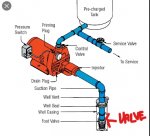
Last week my well pump for garden reticulation stopped working after 15 years. I thought I was up or a new pump but when I went down the well I discovered a PVC joint on the suction side had parted. I glued it back together and before I started the pump I had to prime pump as I knew it would be full of air. I unscrewed a nylon plug, filled the pump up with water, screwed the plug back in and then started the pump. Had I not primed the pump it would never have started pumping water even though the check valve had maintained the water at surface level.

InkedScreenshot_2020-10-22 where to install check valve on water pump - Google Search_LI.jpg

Some systems have valves to maintain a pressure. As soon as you turn a tap on in the galley or bathroom the pressure drops which actuates a switch to start the pump motor.
 
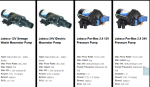
The pump is a Jabsco Par Max and is supposed to self prime up to 1.8m - that seems like a strong 'suck' so air _must_ be getting in somewhere. Once primed, there's never an issue - no lag or random re-pressurising.
 
No: centrifugal pumps have valves

View attachment 101232

Some systems have valves to maintain a pressure. As soon as you turn a tap on in the galley or bathroom the pressure drops which actuates a switch to start the pump motor.
Errrrr ..... that's a simple NRV and not a pump valve. It's used in many flow situations and is nothing at all to do with the pump itself.

Richard
 
Errrrr ..... that's a simple NRV and not a pump valve. It's used in many flow situations and is nothing at all to do with the pump itself.

Richard
Richard the normal centrifugal pump will not self prime so it is necessary to have a check valve otherwise it would start pumping air.
 
The pump is a Jabsco Par Max and is supposed to self prime up to 1.8m - that seems like a strong 'suck' so air _must_ be getting in somewhere. Once primed, there's never an issue - no lag or random re-pressurising.

I agree 1.8 m is a long way to suck. With a bit of wear an tear maybe less?

I notice some jabscos can only lift 1.2 m. I have read that some jabsco type pumps are sold as "self priming" but are not so after about two years.

Screenshot_2020-10-22 Marine Pumps Boat Pumps - Free Shipping - Water Pumps Now - Free Shipping.png


I suppose you've checked this out already.

Leaks on the pump's intake line as well as around the shaft seal of the pump housing itself can cause your pump to lose its prime. ... Obstruction-One possible reason your pump may be losing its prime is an obstruction or blockage in a line. Debris blocking the suction strainer or foot valve is the most common cause.
 
Last edited:
I suppose you've checked this out already.

Leaks on the pump's intake line as well as around the shaft seal of the pump housing itself can cause your pump to lose its prime. ... Obstruction-One possible reason your pump may be losing its prime is an obstruction or blockage in a line. Debris blocking the suction strainer or foot valve is the most common cause.

No. Where did you find that (although there are similar statements on the Q/A for some pumps)? However, the valve has been replaced and the suction strainer looks clear. I may eliminate it temporarily (actually, I may eliminate the whole tank select manifold) to check.
 
I should have given you the link. But if you google some of the text (say) "Leaks on the pump's intake line as well as around the shaft seal of the pump housing itself " you will get the link.

But my browser (Mozilla Firefox) warned me about the link as being a possible danger

Warning: Potential Security Risk Ahead

Firefox detected a potential security threat and did not continue to wplawinc.com. If you visit this site, attackers could try to steal information like your passwords, emails, or credit card details.

What can you do about it?

The issue is most likely with the website, and there is nothing you can do to resolve it. You can notify the website’s administrator about the problem.


Learn more…

Here is another (safe) link
6 Reasons Your Self-Priming Pump Won’t Prime
 
No. Where did you find that (although there are similar statements on the Q/A for some pumps)? However, the valve has been replaced and the suction strainer looks clear. I may eliminate it temporarily (actually, I may eliminate the whole tank select manifold) to check.
This clip may be helpful as your pump is a Jabsco par max diaphragm pump.


If your pump was a Jabsco impeller pump this would help


How a diaphragm pump works

 
Last edited:
My guess is your problem is on the other side of the circuit.

When the pump won‘t prime disconnect the out pipe and switch on. If it then pumps you will know that there is a restriction in the pipe after the pump. The pump can’t pump air against water in the system the back pressure can be too great. If this is the problem you will need a breather valve after the pump to allow the air an easy exit.
 
My guess is your problem is on the other side of the circuit.

When the pump won‘t prime disconnect the out pipe and switch on. If it then pumps you will know that there is a restriction in the pipe after the pump. The pump can’t pump air against water in the system the back pressure can be too great. If this is the problem you will need a breather valve after the pump to allow the air an easy exit.

Then it will blow water out of the "breather valve"
 
No you need a value that lets air out but not water like those used to vent central heating systems.

As I say disconnect the flow side of the pump and see if the pump can suddenly work if that is the case it is simply that the pump can’t pump against the pressure of water.
 
No you need a value that lets air out but not water like those used to vent central heating systems.

As I say disconnect the flow side of the pump and see if the pump can suddenly work if that is the case it is simply that the pump can’t pump against the pressure of water.
That sounds like a float valve. I'm sure that would work in principle but, in practice, there is probably not a high point on the output side where the air might collect and where the valve could be installed. As the pump should not get air into it once it is initially primed, and as it should be easy to prime initially if it is installed below the level of the full water tank, I'm not sure that the additional complication, and potential of water leaks from a sticking float, is really justified.

Richard
 
When we switch tanks we usually find we have to open a tap to ensure water comes through as the pump has been pumping air instead of water when it runs out. After a few sputters it all works fine, but otherwise the pump goes on and on.
 
I have a very old brass manual pump serving my washbasin. It's reluctant to prime initially, but pouring a little water down from the tap end of the pump usually helps create enough suction to get it going.

If you have an electric pump, particularly a modern plastic one. it's possible that wear around the impeller is the cause of your problems. I've replaced a couple of electric bilge pumps simply because they were "sealed for life" and despite the motor running audibly, stubbornly refused to pump out my sump.
 
I have a very old brass manual pump serving my washbasin. It's reluctant to prime initially, but pouring a little water down from the tap end of the pump usually helps create enough suction to get it going.

If you have an electric pump, particularly a modern plastic one. it's possible that wear around the impeller is the cause of your problems. I've replaced a couple of electric bilge pumps simply because they were "sealed for life" and despite the motor running audibly, stubbornly refused to pump out my sump.
The OP has a Jabsco Par Max, which is a diaphragm pump. No impeller. After very long term duty the cam can wear out but that is many hundreds of hours in my fidge coolant duty.
 
My guess is your problem is on the other side of the circuit.

When the pump won‘t prime disconnect the out pipe and switch on. If it then pumps you will know that there is a restriction in the pipe after the pump. The pump can’t pump air against water in the system the back pressure can be too great. If this is the problem you will need a breather valve after the pump to allow the air an easy exit.
That is an interesting thought. Easy enough to check too - I'll have a look next time I'm on the boat.
 
That is an interesting thought. Easy enough to check too - I'll have a look next time I'm on the boat.
I have the same problem on rare occasions and disconnecting the output side of the pump until water flows fixes it. It is an easily accessible quick connection so I haven’t needed to modify the system. Definitely worth a try.
 
Top