domestic solar

riverliver

Well-Known Member
Joined
20 Mar 2011
Messages
93
Visit site
Hi

I have learnt an awful lot from this forum about solar for boats and in a modest way implemented what I have learnt on my boat.
I would like to explore the pros and cons of solar for the house. Can anyone recommend a decent forum/website similar to the quality here. There is obviously a lot out there on reddit and utube but ploughing through all the rubbish is daunting so pointers to good locations would be welcome
TIA
 
Solar is a bit more black and white than boats. And I found that no forum is really gong to do your leg work for you. There are a number of sites for your hard facts of course. Having been through this process relatively recently, and fairly successfully, we are very pleased with our outcomes, your process is:-
1 Decide on how many panels you can fit on which of your roof elevations, or elsewhere if you’ve got the space. This involves measuring the space and seeing what size panels optimise max output against price.. they’re almost all 1134mm wide. Output increases with length, you want to cover as much roof as practical.
2 Roof angles and your geographic location, once you’ve decided on point 1, you can crunch your numbers with direction, angle and location to determine likely output.
3 Inverter, battery. What is your household fuse rated at. That’s how much your inverter needs to handle. Where is it gojng to be, where can you fit a battery. There are building recommendations for batteries, it’s not actually regulated by law, but you’d be silly not to follow that. Size, as big as you can afford, but power for 24 hrs + 20% (don’t deep discharge) is a good guide.
4 cable routes and sizes. Cable sizing calculators are easily accessible.
5 find an installer. We bought our own kit, and installed it, but got a local guy to do the mains side and check my work.
6 Start saving money. We will be off grid today and tomorrow. Still on 90% charge now.
 
There are lots of questions to answer first.

Do you want "offgrid" capability and can you afford it. In terms of "offgrid" it's either power outages ie disconnected physically from the grid or daily when you generate sufficient electricity so as not to require electricity from the grid which if you wish to extend to hours when there is no sun then you require batteries

How much will you be allowed to export if that is going to be part of your system and is it worth it.

How much electricity do you normally consume and when.

Is your location suitable

Are you practical and minded to complete part or all of the installation yourself or do you want someone to do it.

Start by answering those questions then you can move onto reviewing what is available and then onto the practicalities.
 
thanks for the prompt response. I thought the installer had to be certified or is that just to sell excess back?

Also do you have to tell your house insurer you are installing?
 
thanks for the prompt response. I thought the installer had to be certified or is that just to sell excess back?

Also do you have to tell your house insurer you are installing?
You’re going to be breaking into the main supply, so unless you’re qualified, you’ll need that signed off regardless of feeding back. Home insurance, tell them if you’re nervous. Certified electrical work isn’t usually something they are interested in though.
 
thanks for the prompt response. I thought the installer had to be certified or is that just to sell excess back?

Also do you have to tell your house insurer you are installing?
Yes for connection to the grid it is a requirement and when you consider building and wiring regulations, insurance etc it is also more than just advisable. For insurance the obvious answer is that you should ask.
 
FJH

thanks Its pondering those questions I want to explore - if you like from a desk top perspective before next stage hence input from folk like C slave a good start.

In an ideal world i would put panels on a fairly long garage roof rather than on the house (for aesthetic reasons) but shading/orientation questions arise.

What i would quite like to do is a desk top evaluation with the possible layout. I played with suncalc last year which seemed like a possible tool to get going
 
FJH

thanks Its pondering those questions I want to explore - if you like from a desk top perspective before next stage hence input from folk like C slave a good start.

In an ideal world i would put panels on a fairly long garage roof rather than on the house (for aesthetic reasons) but shading/orientation questions arise.

What i would quite like to do is a desk top evaluation with the possible layout. I played with suncalc last year which seemed like a possible tool to get going
Location is probably the first question you have to answer with regards to angle and shading. I would suggest that to make it worthwhile in the UK, certainly anywhere north of the UKs southern parts it's critical that those two items are optimal.
 
FJH

thanks Its pondering those questions I want to explore - if you like from a desk top perspective before next stage hence input from folk like C slave a good start.

In an ideal world i would put panels on a fairly long garage roof rather than on the house (for aesthetic reasons) but shading/orientation questions arise.

What i would quite like to do is a desk top evaluation with the possible layout. I played with suncalc last year which seemed like a possible tool to get going
You’re on the right lines then. Mine is on my workshop, as it would spoil the look of the house. We are lucky to have low shade E/W orientation, so 2 arrays. 5 x 600w panels on each. I drew the roof on graph paper and made paper panels in scale to get optimum fit, then threw that away and just bought the biggest, most efficient panels I could get, it looks neat, vertically aligned. Simple is good. DC cables underground to our back porch which happens to be next to the meter. I had to size up the DC cables for that run, but it did make the AC side much easier. I made the mistake of buying a cheap inverter. It works fine but the remote access is poor, so in winter I have tp press physical buttons every day. We charge overnight on cheap rate and run on the battery when there's not enough solar for charging. It has shaved nearly £80 off our winter power bills. Summer, it’s just standing charges. We charge our own cars and the neighbours too in the right weather.
 
I can't help with advice for domestic PV in UK because weather is so different to here. I can rattle on about the situation here in West Australia. (sunny 37 degrees max today)
About 12 years ago I was sold a 1500W system. The government were giving rebates on installation costs and giving 40 cents credit per unit (Kwhr) exported for 10 years. This arrangement meant we paid little for electricity and system though expensive at the time soon paid for itself.
Time has passed now a huge 80 percentage of domestic houses have solar PV. The credit for export is now only 9 cents per unit compared to 30 cents per unit you take from the grid. Systems are now so much cheaper with 6Kw array being normal. Not so much bigger because panels are so much more efficient.
Now companies and government are pushing solar plus battery. Contrary to older rules new battery instalations can provide power when grid supply fails. Older solar only installations relied on grid power to time the generation (50hertz) and to avert power in to a grid that is being worked on.
Now I fancied a battery added to my old PV array. The company advise that the old system is too old and must be replaced. Which put me right off a battery.
So to the OP just do your research. All above comments re siting direction and angel are valid. ol'will
 
Look at other houses near you that have solar panels fitted and knock on their doors to ask about their system and any problems with the installer. That is what I did and one local company kept being mentioned. I did get a couple of other quotes, and they turned out to be more expensive. The owner came to discuss the system he could fit and gave us lots of detailed information. When we decided to proceed, they did an accurate roof survey to see how many panels they could fit. The original quote was for 16 panels. but this could be increased to 20 panels. He wanted to have an 8Kw inverter to sell to the grid under the Micro Generation Scheme. They came back and said they would only allow a 4Kw inverter that was restricted to 2Kw only. The installer then made some changes and reduced the system back to 16 panels and used a different inverter rated to 3.65Kw that could be fully used. Not exactly what we wanted but that was the best we could obtain.

We have a 9Kw battery that we charge on cheap rate electricity (8.5p) and is usually sufficient for daytime needs during the winter as we tend to use the washing machine, tumble drier and dishwasher overnight. We also run 2 electric cars on cheap rate electricity. The system was operational on 1 October and we cannot believe how good it has been so far. We have exported a limited amount electricity at 15p. The bill for the current months electricity compared to last year, before we got electric cars, was about £110 to £120 per month and this has dropped to £70 to £80. These figures include the standing charge and VAT. We also do not have to buy any petrol or diesel for the cars. In the summer we expect to generate more electricity than the standing charge. I cannot provide that information but we are highly delighted with the performance so far.

We may change from a fixed export tariff to a variable tariff that is AI governed. The battery will still be charged by the cheap rate, but can be discharged during the day when demand is highest and the feed in tariff can be as high as 35p. So technically we can buy electricity overnight at 8.5p and sell it back, along with any solar produced, for up to 35p - making a profit. If this works, then we shall increase our battery storage to take advantage of this. During the summer we expect to use excess solar power to top up the electric cars for free, rather than use cheap rate electricity.

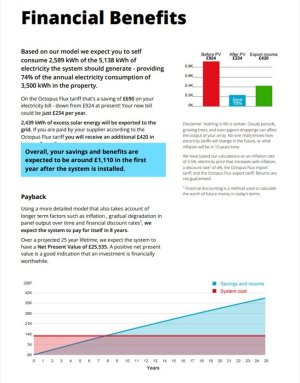
Hopefully riverliver, you can see why talking with an expert is better than finding web sites. I can remember about 15 years ago investigating solar power and was shocked that the system would cost about £30,000 after government grants. Our system cost £12750 and expect it to be fully paid back in 7 to 7½ years. The inverter will probably need replacing at about 10 years and the solar panels should last 25 years. I doubt if I shall still be alive in 25 years, so from 7½ years we shall return a huge profit on our investment, besides making large savings during that period.
 
Our numbers correspond with yours, Concerto, though the savings are achieved slightly differently, we do not export. Our system, being in large part DIY, cost £4k. It’d be useful to know what power your panels are rated at, and angle and direction, as a real world comparison.
 
I'm not going to get time to fit it before we head back to the boat, but I am hoping to install about 4kw of panels and a diverter unit which will heat my hot water tank. This is a DIY system without MCS approval or export payments. I'm using secondhand equipment where possible and should come in under £1000.
I estimate that it should pay for itself in 2-3yrs.
 
Our numbers correspond with yours, Concerto, though the savings are achieved slightly differently, we do not export. Our system, being in large part DIY, cost £4k. It’d be useful to know what power your panels are rated at, and angle and direction, as a real world comparison.
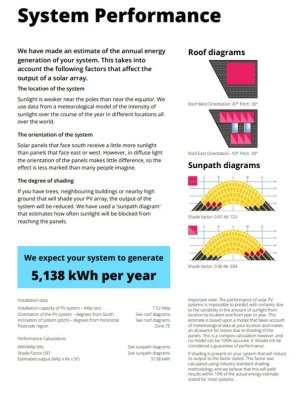
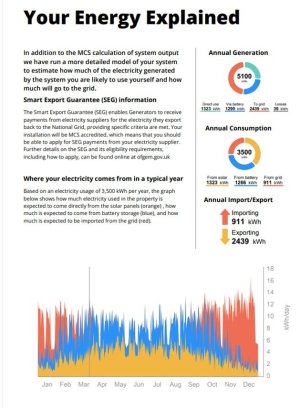
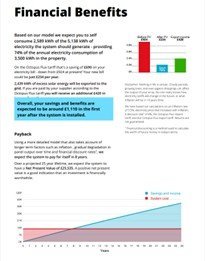
We have 16 Aiko Neostar 3S 470W panels. We have 8 panels facing East and 8 facing West. The roof pitch is 30 degrees. The system is expected to generate 5138 kWh per year. The battery is rated at 8.8 kWh, but charges to 9.03. The whole system is run via an app and I can see exactly how much energy is being generated and used and from which source. Our home is in Cheshire, not the sunny south.

These photos are from the quote document and show the calculations used for our property.

Solar 1.jpg

Solar 2.jpg

Solar 3.jpg
Hope you all find this interesting.
 

Attachments

  • Solar 2.jpg
    Solar 2.jpg
    14.1 KB · Views: 1
  • Solar 3.jpg
    Solar 3.jpg
    13.3 KB · Views: 0
Last edited:
I did some sums last year and it seemed the lions share of the savings could be made by using night rate electricity to charge batteries (payback less than a decade) but once you added the cost of solar panels, the payback time was extended dramatically even with them generating decent levels. It's a shame I can't store the summer gains through to the winter when the ASHP is gobbling up all the power.

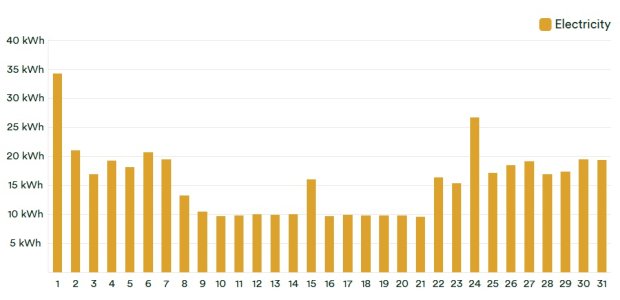
JULY 2025 - 483 kWh

jun_elec.jpg

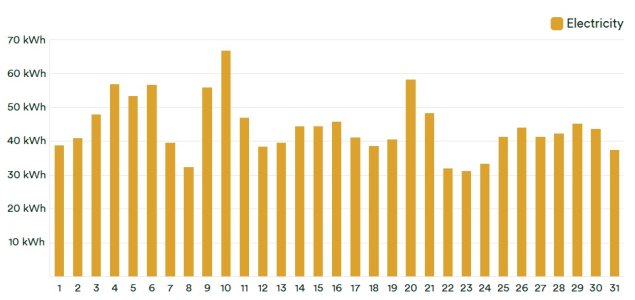
JAN 2026 - 1,365kWh

jan_elec.jpg
 
Some of the better tariffs are phasing out now unfortunately. We've had eon next drive, which didn't require an electric car bit now does, for the last year.

5kwp facing SSW at 30degrees in Edinburgh with 5kw solar inverter and 4kwh AC coupled battery with 2.6kw inverter.

Panels produce about 4500kwh but very season dependent, December usually 60kwh and may/June 700kwh. Worst winter day 0.6kwh, best summer 35kwh.

Eon next drive was 6.4pkwh 0-7am, 24.3 the rest of the time. Export 16.50pkwh. The approach and been to fill the battery, plus time the washing machine, dishwasher etc to run the same time. Then the battery is full for and you're exporting almost immediately for far more than the import cost. Then use the battery in the evenings before dumping what's left back to the grid before midnight.

We used 1800kwh in the house 750 from solar direct, 700 from battery and 350 from the grid. This would have cost £490 on standard tariff at 27.1pkwh.

Our average unit cost was 8.5p for the 2000kwh we imported, 1650 of that going to the battery. So £170 import cost. Then we exported 3150kwh of solar and 1000kwh from the battery making £685. Net £515 profit or almost exactly £1000 vs standard.

Panels and battery were £11000 so 10-15 years payback depending on future trends, and assuming no residual value in the house valuation for them at that point. Probably not great vs £23k for 15 years compounded at 5% if we'd just invested it, but it feels good to have done it either way.

Prices for batteries especially have come down significantly recently so the economics will have improved. It had also been an opportunity to play around with homeassistant on the raspberry pi to run the battery based on octopus agile prices - we did that two years ago but agile prices were too high last year. May go back to it this year.
 
Just a few added comments to above. Yes all installations connected to the grid must be done by licensed electrician.
My sytem was fitted with fuses near the panels on the roof in pos and neg wires. 5amp high voltage tubular. Twice they have "blown" I didn't know for a while. I do not understand the need for fuses as PV max capability is about 3.5 amps.
I did have to pay at the time for a new power meter to accommodate feeding power in to the grid.
Regarding electric hot water . They are pushing heat pump (to air) water heaters which are crazy expensive compared to heating element types. You can buy a lot of solar PV for the price difference. Again more applicable in my climate.
Timed electricity prices have turned around with cheapest elecricity by far between 9 AM and 4PM reflecting huge community solar input. Expensive is 4pm to 10 pm and 6AM to 9AM reflecting demand not filled by solar and middle of the night being mid priced reflecting need for coal power generation. (virtual;ly no hydro power and not so much wind power.) but recently they announced reached 50% renewables. ol'will
 
Thanks for the great info all.

Concerto. interested in what you say as i restarted thinking about this when someone claimed that even without the solar panels you could operate with a battery installed and "collect" electricity to store when v cheap - overnight etc and then sell it back to the electricity company at high demand time for a fair bit more. Then add on solar panels as cherry on the cake so to speak. Seemed unlikely at the time but what you describe isn't far off.

Ciara: it seems you didn't go for a battery in your scheme but I am guessing you could add one in the future?
 
Top