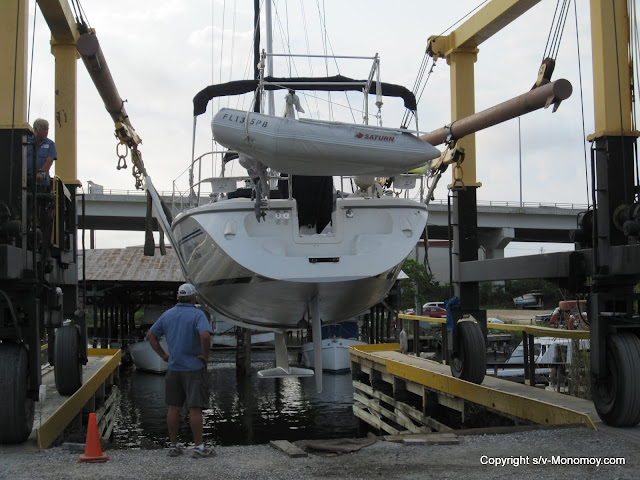
Does your boat hull "squash" when on the hard?

Yachts with long keels flex very little. Boats with short fins will flex noticeably. I used to have a long wooden boat which flexed alarmingly. (No ballast keel). Mind you, she used to flex in a seaway.:(
 
Yachts with long keels flex very little. Boats with short fins will flex noticeably. I used to have a long wooden boat which flexed alarmingly. (No ballast keel). Mind you, she used to flex in a seaway.:(

Yes, ours is long-keeled and doesn't flex much, but it is noticeable. The heads door just starts to stick slightly, the washboards go a bit tight as the hatch slides over them too. Slackening the rigging changes it again.
 
My Fulmar flexes slightly aft of the keel even after the very thick reinforcing floors I've added to it.Nothing ever broke and the hull layup in that area is very thick.The area is very flat and the floors have to be shallow so it's not easy to make them stiff enough to stop flexing entirely.Not impossible though.
 
I was involved with a fin-keel Konsort with this problem. It flexed a bit when resting on the keel but not normally a problem. Then one year they insisted on having the mast down and that made a colossal difference - the rig had been holding the hull up! We carefully put her back in the water and sold her.
 
Interestingly the only time I've had a problem with distortion has been when the boat has been in slings and the door to the forepeak (approx above where the forward sling would be) has refused to close. Sitting on its keel it's fine (oceanlord)
 
From observation of lightweight kayak hulls when a student I would be concerned if your hull flex is significant. The resin in GRP is hard and brittle, the glass strands are flexible.
We used to carry people on the aft decks of the college's kayaks while out paddling on a river. After a while the decks would flex a bit and pop up again. Each week the decks became noticable softer and by the end of the summer they just sagged and stayed sagged. I suspect that the GRP aft decks had become a mass of granular resin held together by embedded glass mat strands.
If GRP is flexed beyond the limited elasticity of the resin then that resin must have failed to allow the movement.
It all depends on the elasticity of your cured resin. My example dates back to the late 70's and resin chemistry has no doubt changed since then. Hopefully, it is more flexible in your boat.
 
Pretty certain the deflections are nowhere near what you were seeing on your canoe. It's just that the vessels are much bigger so over (say) 30 feet you'd get a lot more movement, even though the fibreglass isn't deflecting much a any one point. Certainly hasn't bothered Avocet in the last 40-odd years.
 
Having spent quite a bit of time repairing yachts i have seen more than a bit of flexing of hulls. The modern style of flat floored yacht is often prone to this.
So are yachts like UFO 31's & similar designs that have highly stressed keels.
If you are concerned pull the floorboards up & have a look, check there are no broken bonds on grp tabbing to floors & check the insde of the keel area for cracking particularly at the frd & aft end of the ballast keel.
If there are cracks you have a problem.
 
My Vancouver does not seem to squash when being lifted, or when resting on a steel cradle when on the hard. All internal cupboard and saloon doors open and close without sticking.
If I measure the tension of the rig when floating and again on the hard there is no measurable difference.

The downside of having no hull flex, (if you can call it that), is when its on the steel cradle in a winter gale the whole boat including the cradle will shake/vibrate slightly.
If the wind is strong enough on the side of the hull/mast with the cradle on firm ground, it will "walk" slightly. At the end of one winter the cradle had moved forward about 30mm.
 
I believe that the hull form probably has more effect on the degree of flex than most other influences. A relatively flat bottomed boat will be inclined to oil drum when the loading is reversed, whereas the type of hull typical of the transition period from long keel to "modern" designs has a wineglass section around the keel and tumblehome to the topsides, both of which will resist deformation. These features also give the hull a seakindly motion and no slamming - win win.

Rob.
 
Last edited:
rob2, here is a view of the identical boat (not mine) - does that fit with your theory?

014.JPG


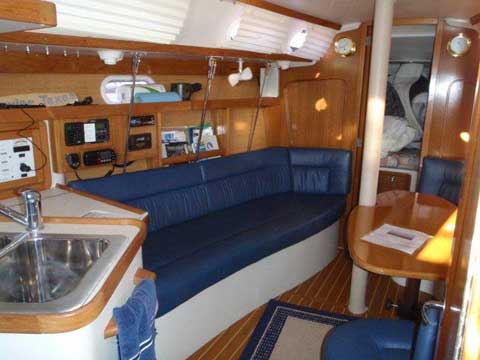
By the way there are - inside - three steel tie rods that go from underneath the chain plates on deck to a point on the side of the hull about where his head is. These are factory tensioned with turnbuckle type arrangements (no idea if this is standard for other makes). Quite visible in following interior photo. That is going to have an effect on hull shape I guess?

piccatalina320108c.jpg
 
Last edited:
Our club had a Dheller 29 on a trailer & one could rock the transom up & down by a good 150mm
My own Hanse 311 was badly chocked in Inverness for 3 weeks whilst they replaced the rudder, The floor panel sprung up 12mm & the gell coat cracked just aft of the keel but a surveyor later assured me that it was just minor gel crazing seen on many boats
He also made the comment that in his experience some Jeneau designs were the worse
I did hear of a yard that is reputed not to like lifting Bavarias because they are so bad for this. I know at my own marina they tell me they have to be careful how they chock Bavs

There was an early one off 3/4 toner (Dingo, owned by father of Rob Stuart another boat designer)whose designer, soon after launching, strung a line right through the boat from bow to stern.
They then really tensioned up the rig & the distance from keel bolt to line increased by something like 1.25 inches as the boat did its impression of a banana
Apparently the designer was pleased that it was so little
I am sure that a lot of modern designs would flex just as much if the same test was repeated on them
 
Last edited:
All boats flex to a certain extent, the older the grp boat the less.
It's very much more noticeable on modern, light, form-stable hulls.
Don't know of any cases where the boats have been irretrievably damaged - though I have been told, by a reputable designer, that it is thoroughly bad practice to have a boat stored on hard standing with all the weight being taken through the keel.
Unfortunately many yards apparently don't understand this and the reported incidents seem to bear this out.
Fortunately my boat doesn't need a cradle or the maladministration of yard workers.
 
Rob and Mojo (10).jpg
rob2, here is a view of the identical boat (not mine) - does that fit with your theory?


Well yes, the hull is a simple curve in crosssection with flared sides so the chainplate loads cannot be simply transferred into the topsides, hence the tie-rods below decks. The keel is effectively a point loading onto a simple curved surface, so it can deform it when the loading is reveresed on coming ashore. By contrast here is my Weston (Varne 27) with a far more voluptuous shape!


Rob
 
Top