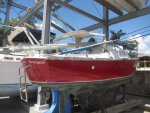
Does this look like mast compression (Hurley 22)?

billy pilgrim

New Member
Joined
21 Mar 2015
Messages
2
Visit site
Hello,

I am in the market for a small sailboat for day cruising and have found a Hurley 22 for sale near me. I live on an island, and, unfortunately, there is not much of a market for used sailboats under 30'.

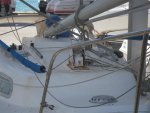
I have read several useful threads on this forum about the Hurley 22 and have learned about the frequent problem of mast compression. Before I go further and request a survey of this particular Hurley 22, I wanted to see if some of the more experienced forum members could tell me if they see a major problem from the photos, especially the photos of the base of the mast, which does show some corrosion and damage.

Thank you!
IMG_2780.jpgIMG_2778.jpgIMG_2779.jpgIMG_2774.jpg
 
As no-one else has pitched in, here is my take.
The crack in the deck forward of the tabernacle indicates compression, but it would be useful to take a good look at the underside.
The bulkhead separating the forecabin from the saloon takes the compression forced of the mast. Later boats suffered more because of the bulkhead (ply) being cut away to make the interior more "open plan". Even the earlier boats occasionally went bad because of owner mods or water penetration rotting the top part of the bulkhead.
It is fixable by taking off the tabernacle, rebuilding the fiberglass underneath and reinforcing the bulkhead but the cost of the work should be factored into the offer price. The variable will be the extent of work needed to the bulkhead.
 
I agree with Gordonmc. I suffered a similar issue on my last boat and the obvious signs were inside the boat. There is normally a way to beef up and spread the deck loads but without a photograph it is difficult to advise. I discovered that there was a gap between deck and bulkhead so that there was 3/4 inch of deck compression even before the bulkhead had chance to do anything, just getting a piece of hardwood epoxied into the gap was a good start and I then used a through bolted piece of box steel to provide vurther support together with some load spreading 'legs' onto the box section. All done in a day and not that difficult.

Yoda
 
billy pilgrim,

might be compression but doesn't look like it to me, surely there would be a ' squashing ' effect rather than a gap ?

My vote would be the mast has put a levering force on the tabernacle when being lowered; this can happen if there's a mast securing bolt upwards from the pivot position and someone forgets to change the bolt to the pivot hole.

Just a thought, but compression is worth checking for too, have a look at the bulkhead edges in the cabin to ensure they are still attached.
 
I was going to suggest that you get Nick Vass to have a look at it until I noticed the palm trees in the background which suggests that you're not in the UK. However he may be able to give you a heads up from the photos.
If it is mast compression, it should be a relatively easy matter to beef it up and you can probably find some good ideas on the Hurley owners club site. Here again Nick is a contact for the site.
 
I take it that the mast load is on a bulkhead rather than a post? If it's on a bulkhead, is the load centred on the bulkhead? and if it is, can the mast base rock forward, pivoting on the bulkhead? Possibly when lowering?
 
Join the Hurley Owners' Association, about a tenner online, there is a vast amount of info, photos, solutions to mast compression, but in the end, it's probably been like that for decades anyway...they are tough little boats!
 
I find it strange that the mast base seems to be set up for pivoting the mast foreward for lowering. I would be rotating the base around so that the mast can pivot backwards. So much easier to catch the mast in a post at the transom. Then easier to lift the mast from the base forward and onto the deck.
The rust marks around the base should not be a problem to clean up and repaint.
I don't know the boat type but from comments it relies on a bulkhead to support the mast from underneath. This should give a firm support under the deck. Additional piece of wood post bonded to the bulkhead would give stronger support if that seemed necessary. A bit difficult when looking to buy but basically you measure the clearance deck to floor then put the mast up and tension. Then check for any change in this dimension. Should not be much compression.
I would suggest that the rest of the boat condition might be more significant and of course the price than concern about mast compression. good luck olewill
 
Don't think so - and, as already pointed out, more easily guaged inside.
I suspect it's rust on the tabernacle base-plate forcing off the hastily-applied gel coat.
I'd be taking the whole tabernacle off, probably replacing it in SS, at least re-galvanising the old one.
 
As others have said, look at the owners association www.hurleyownersassociation.co.uk
You can join for £10 and get into the technical library where there is loads of information. Most 22's suffered from mast compression at some stage but it is easy to fix and usually there is no damage to the boat.
There is also a yahoo group for Hurleys that is very active. Can't remember the link but I'm sure it's easy to find if you do a search. All the owners are very willing to help with advice from experience.
Where is your island?
 
Thank you all for the information and advice. The island is the Dominican Republic. I'm going to do some reading on the Hurley site, visit the boat again, and take a more detailed look inside and at any other problems.

Anyone happen to know a good boat surveyor in this country:D?
 
Top