does engine oil deteriorate with time or just use?

I agree that old marinised automotive engines prob do run cold more modern fresh water cooled units run very similar temps

I have 34 years of engine design development and repair so I think I am better placed than most care for my own but like most things in life familuarity breeds contempt so I prob push it longer than i should. /forums/images/graemlins/tongue.gif /forums/images/graemlins/grin.gif
 
[ QUOTE ]
Oils are developed for today's driving in today's cars, which means high revs, high temperatures, high power outputs. Yacht engines run slowly, cold, low power. They also run for long periods at constant revs, a difficult situation to lubricate. Very few manufacturers make oils for this kind of duty now - indeed, Shell dropped their Rimula C between me writing the article and YM printing it.

If you buy the 'best quality oil' for your yacht auxiliary engine you will certainly not be giving it the best treatment. And changing it 'when I feel it's time' sounds like a recipe for trouble - how and what are you going to measure?

[/ QUOTE ]

Not especially to you, Vyv, (I haven't seen the YM article, but will have a look next time I'm in Smiths /forums/images/graemlins/wink.gif )

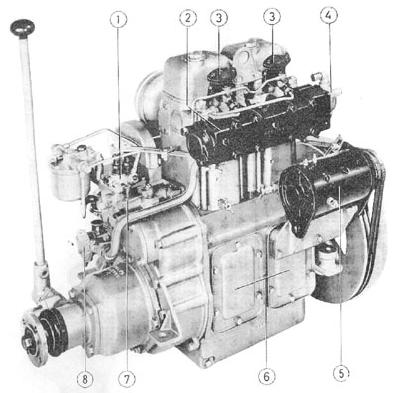
This thread seems to be going down the arguments for sailing boat auxiliaries, but the OP doesn't have one of those weedy cast iron dumper truck or taxi engines that've been designed to tolerate being run on a freshly squeezed dinosaur. eg:

7311.jpg


has *TWO* of these turbo-charged, 6 litre monsters:

perkins_sabre_m225ti.jpg


£50k's worth total (??) vs £3k ? 38 bhp/litre vs about 15....?

Surely these are nearer "modern" engines needing "modern oil", and one either needs to stick to the manufacturer's calendar based recommendations, or go for condition monitoring and change the oil when this dictates it.

To make up any 'third way' based on cash-flow, phases of the moon, or what that bloke from the club says must be madness /forums/images/graemlins/smile.gif


Andy
 
"I think you should have kept this post for April 1st !!"
---------------------------------------------------------
It sounds crazy but you only believe it after your experienced it.
A real case, nothing changed apart from fresh engine oil and the power just come back.
It was on a 15 yr old Yanmar 1GM10 without oil changed for 1 yr.
 
Post hoc ergo propter hoc - a common logical error. Just because something happens immediately after something else does not mean that the first thing must have caused the second. (Everyone dies after their last meal.)

If I have been fiddling with something and it then stops working it is a reasonable hypothesis that my fiddling has caused the change, but it is only a hypothesis and there may be another explanation.
 
[ QUOTE ]
Vyv, I am glad this has come up because it made me wonder when I read your article. Many boat engines are marinised car engines, eg Thornycrofts were BMC, now Mitsubishi. My Volvo M22 is a Perkins engine used in a Montego (yuk!)

So to think of car engines one way, and boat engines another is slightly confusing. Are you saying the above examples are older generation not suited to modern oils, as opposed to current engines, such as a VW TDi ?

[/ QUOTE ]

Let me say this ... Vyv is not wrong. But there is a bit missing. There are base lub oils out there - I've shipped enough of it !! But it tends to be single grade. sae 10, sae 20, sae 30 etc. There are also base multi-grades and usually they are the cheaper of the brand names on the forecourt shelf.

High performance oils are usually marked as such and IMHO avoided unless you have a high performance MOBO etc.

Marine engines nowadays I would suggest are divided between old hangers on like me with their vintage Perkins / old Volvo's ...... and later more modern Beta's, Yanmars, Kubota's etc. which have lighter blocks, construction and dare I say it tighter tolerances. So to lump all marine engines into the base oil market I think is a little too simple.

If I had a new modern engine .. same HP but a lot smaller and less kg's - I would be using middle road possibly mineral or semi-synthetic oils of good quality. Plenty oils are marked Diesel use etc. That's the crux ... whether it can handle combustion products of the fuel produced. As I and many others continue to use agricutural 'donks' - the it's el cheapo oil for diesels.
 
I think you need to read the article in YM. There's far more to it than the base oil but I'm not going to repeat it all again.

Many of the more modern engines that are installed in yachts were designed a long time ago, although some are more recent. Marinised automotive versions, and those designed from day one to be yacht auxiliaries, specify lubricants that take the duty into account. Hence recent Yanmars, Bukhs, maybe others, call for API CD, which became obsolete in 1991. This spec recognises that the engine will run cool, for relatively brief periods at constant speeds.

If anyone doubts that this is the case, look back through, say the past two months of forum, for posts about coking of exhausts. There will be quite a few. Then talk to automotive mechanics, forums, etc for the same thing. I've never even heard of a car exhaust manifold coking up. Coking occurs because combustion is incomplete, because the engine is being used lightly, at low revs, running cool.

Modern oils are designed for high-speed blasts in high-output turbocharged engines, where combustion acid loading will be high, oxidation is a big problem and cam/tappet acceleration is severe. These are completely unsuitable for our engines.

I'm not attempting to discuss mobo turbocharged engines. I apologise to the OP for the thread drift, although I gave him my opinion earlier. Advice as ever is to use the oil specified, for the period specified. However, when it has been obsolete for more than 15 years it is difficult to do so.

To Nick, as I hope I have said, it's not so much the engine but the duty. A turbocharged VW engine on the road will require a higher spec oil, maybe API CH or CI? (just guessing) The same engine without a turbocharger in a yacht would not take at all kindly to the same oil, being far better served by an API CD, if it was available. Unfortunately we are just too small a market for these low base number oils to warrant production.
 
I don't have access to YM and TBH - Ym is way above my boating circle !!

As to base oils - they are available, just not on most shelves. We were shipping base oils to UK for years till last year when a competitor took over - we had argument with supplier about his moisture content increasing to unnacceptable levels.
There are trade outlets for these - based mainly on Trucking / haulage contractors. One of the biggest users of the oils we inspected for our Client went to a Midlands based company who supplied a large part of UK's public transport network.

I cannot go into commercial data as I'm not allowed to. Client confidentiality and all that.
 
[ QUOTE ]
[ QUOTE ]
Oils are developed for today's driving in today's cars, which means high revs, high temperatures, high power outputs. Yacht engines run slowly, cold, low power. They also run for long periods at constant revs, a difficult situation to lubricate. Very few manufacturers make oils for this kind of duty now - indeed, Shell dropped their Rimula C between me writing the article and YM printing it.

If you buy the 'best quality oil' for your yacht auxiliary engine you will certainly not be giving it the best treatment. And changing it 'when I feel it's time' sounds like a recipe for trouble - how and what are you going to measure?

[/ QUOTE ]

Not especially to you, Vyv, (I haven't seen the YM article, but will have a look next time I'm in Smiths /forums/images/graemlins/wink.gif )

This thread seems to be going down the arguments for sailing boat auxiliaries, but the OP doesn't have one of those weedy cast iron dumper truck or taxi engines that've been designed to tolerate being run on a freshly squeezed dinosaur. eg:

7311.jpg


has *TWO* of these turbo-charged, 6 litre monsters:

perkins_sabre_m225ti.jpg


£50k's worth total (??) vs £3k ? 38 bhp/litre vs about 15....?

Surely these are nearer "modern" engines needing "modern oil", and one either needs to stick to the manufacturer's calendar based recommendations, or go for condition monitoring and change the oil when this dictates it.

To make up any 'third way' based on cash-flow, phases of the moon, or what that bloke from the club says must be madness /forums/images/graemlins/smile.gif


Andy

[/ QUOTE ]

Totally true and fair comment ... unfortunately - I got sidetracked into the 'dumper-truck' saga !
 
Top