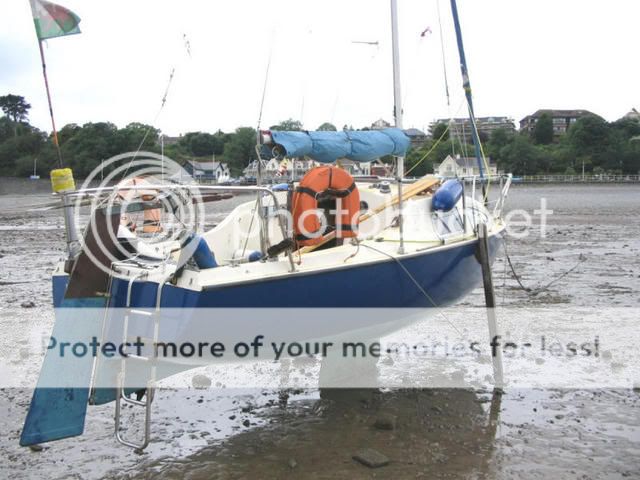
DIY legs for small long keeler?

maxcampbell

Well-Known Member
Joined
3 Nov 2008
Messages
476
Location
Me - village in south cambs. Boat - Brightlingsea
www.youtube.com
Have been thinking about making legs for 20' / 650 Kg long keeler (as avatar) with 3' / 1m draft.

What about hanging the boat from the legs with a tackle about a foot above the sidedeck to the chainplates, and the leg extending up the shrouds a couple of feet with a loose u-bolt?

Have been thinking about some oak, maybe 50mm x 30mm ish, probably laminated, with, what, 200mm square feet on flexible couplings??

It would be nice to plan to dry out, and I've left enough grooves through the east coast mud that I reckon it's only a matter of time before one of them ends up one way. I've never dried the boat out to see what happens, but it would be a heck of an angle.

Bought aluminium legs are just far too big (and expensive).

Am I missing something? Is this idea fatally flawed, or if not, what details do I need to think about?

Apologies about mixed units, I'm at that awkward age.
 
Had a 26' Invicta for 18 years. Layed her up on a beach in winter on legs. Used home made aluminium, then scaffold poles, but they can bend with twisting motion when stern bashed by waves. Ended up with tanalised fence posts with hull shaped wooden curve glued on to match hull shape with carpet protection. Bolted through hull pads. Important to tie fore & aft tightly to lewg bases to stop 'walking'. Also legs an inch or so shorter than keel depth.
 
You need to arrange your legs so that the load is under the gunwhale and possibly stabilised around the turn of the bilge. Then braced fore and aft so that they do not move. Have a close look at the Yachtlegs as there is nothing unusual about the design and no reason why you could not reproduce in wood. However, they are likely to be heavier, more difficult to stow and not as easily made adjustable as the aluminium ones can be.

Look in any drying harour in Western France and you will see small keel boats on home made legs.
 
You need to arrange your legs so that the load is under the gunwhale and possibly stabilised around the turn of the bilge. Then braced fore and aft so that they do not move. Have a close look at the Yachtlegs as there is nothing unusual about the design and no reason why you could not reproduce in wood. However, they are likely to be heavier, more difficult to stow and not as easily made adjustable as the aluminium ones can be.

NO! You do not want the load under the gunwhale - in fact you don't want the load on the legs themsleves anywhere. The load goes on the keel - the legs simply prop the boat up (hence them being a couple of inches shorter than the keel) - on a hard seabead likely one will be airborne, or even both if boat is well balanced!

But they need to be securely fixed to the boat (to save tucking under) - traditionally it was a large bolt through a hole in a the planking, likely with a bronze / brass? tube insert and with a large butterly nut on the inside (hole plugged with a bung when on passage, otherwise boat insides get wet :p). The modern alumunium Yachtlegs version dispenses with the hole and instead has a fiiting on the outside that the leg attaches to.

The draft (or length) of a boat is not the decider on whether legs are doable it's the shape of the keel and the balance of the boat - basically if the boat would point down bow first (past being comfortable to be on!) without legs (i.e. when against a wall) then that's the angle she would be with legs fitted - it you try and make the boat level instead the load goes on the legs, and that always ends badly!

Solid Wooden legs are heavy! - so bear that in mind - might want to compromise between Aluminium (£££) and solid wood by going for a box construction as will save a lot of weight. Also want to bear in mind that on a 20 foot with 3' draft that will have around 4 - 4 1/2 foot of leg (2 of them!) to stow! Always a PITA, even when kept on the sidedecks.

And at the risk of stating the obvious, legs don't suddenly make the boat capable of drying out anywhere - better than a fin (obviously!) but not so good as B/k's etc.
 
Last edited:
Lean against a wall..if there is a wall.
I did that often so i trust it.
Legs are only good if the ground is good [flat sand ideal]..no good if the leg lands in a hole!
 
Grounding

From a mere spectator from far away where there are virtually no tides. I really think that I would go for a catamaran rather than a bilge keel boat or setting up legs for a drying mooring. While I started with cats and love my little monohull for its windward sailing ability and its resilience to gusts and self righting, cats are good boats. They take a new mindset regarding reefing and sail reduction and may not go to windward so well but they are a lot faster sail level and sit on the bottom easily. These advantages would lean me towards a cat for a drying mooring. olewill
 
A page of my website is devoted to the fitting and installation of legs. See here. most of it is about Yacht Legs but a link at the bottom of the page will take you to a site detailing their DIY manufacture. I would recommend going the way of the Yacht Legs attachment sockets if you have the means of making them. There are many alternatives but these seem the best to me.

Despite the prejudice of many, legs work fine on all types of bottom. They are a very worthwhile addition to the boat, although I agree the comment above about keel configuration. If your boat has a swept, narrow keel you will need to think carefully about the attachment point and maybe conduct trials with a temporary arrangement.
 
The previous owner of my old 25' Folksong made wooden legs. They were shaped around the hull but did have the usual bolt through the top sides. Quite heavy but he did tie them to the pushpit when not being used. I'm not sure what wood they were but not oak, maybe ash which I think would be better choice.

IMG_2306.jpg
 
Just a note of caution; not strictly legs but it could be relevant.

Years ago I had to send a young relatively light crew up the mast of my 22' boat, an awkward size for this sort of thing as lowering the mast is a bit of a pain if avoidable - I forget why we were doing it, maybe a lost halliard - but the boat heels a lot with a body up the mast.

So I lashed her quite tightly from a chainplate sideways to a pontoon.

The chainplates are inverted 'U' bolts with large wood & stainless backing pads.

All went well, but the next season that same chainplate sheared clean off in a light breeze when I grabbed the shroud to go on deck; it seems I had stressed the U bolt sideways, though it may well have had a metallurgical fault.

We got away with a quick tack then sailing in with the main reefed and spare halliard wrapped around the mast - it was a lower which failed - then naturally replaced all the U bolts with rather oversized Wichard jobs.

It strikes me one could easily make the same mistake when making up ones' own legs for a similar boat.
 
Have been thinking about making legs for 20' / 650 Kg long keeler (as avatar) with 3' / 1m draft.

What about hanging the boat from the legs with a tackle about a foot above the sidedeck to the chainplates, and the leg extending up the shrouds a couple of feet with a loose u-bolt?

Have been thinking about some oak, maybe 50mm x 30mm ish, probably laminated, with, what, 200mm square feet on flexible couplings??

It would be nice to plan to dry out, and I've left enough grooves through the east coast mud that I reckon it's only a matter of time before one of them ends up one way. I've never dried the boat out to see what happens, but it would be a heck of an angle.

Bought aluminium legs are just far too big (and expensive).

Am I missing something? Is this idea fatally flawed, or if not, what details do I need to think about?

Apologies about mixed units, I'm at that awkward age.

I wouldnt use the chainplates but think about installing a seperate fixing point.You will be pulling the chainplate away from the hull which could cause water to start leaking in around its fastenings leading to possible rot problems developing, also as sea jet says it could lead to metal fatigue in the chainplate itself.

Why not fit them in the more traditional way of a bolt through the planking with a large backing pad inside to spread the weight?

On a grp boat I had legs that clipped to a ubolt through the deck .

The sizes you mentioned seem much thinner than legs I have seen which seem to be more usually about 100mm square for small boats but laminated ones would be stronger than solid timber so I dont know if thats an issue or not.

VLP.jpg
 
NO! You do not want the load under the gunwhale - in fact you don't want the load on the legs themsleves anywhere. The load goes on the keel - the legs simply prop the boat up (hence them being a couple of inches shorter than the keel) - on a hard seabead likely one will be airborne, or even both if boat is well balanced!

I was intending to differentiate from the OPs proposal to have the upper attachment above the deck on the chainplates rather than in the hull under the gunwhale. At some point the load comes on this attachment as the boat heels sightly when it dries out. Most of the load is of course on the keel, but if there was never any load on the leg you would not need it!
 
I think you need to think about the process of the boat taking the ground.
Even the slightest chop or swell could put a lot of force on a leg.
It's probably different if you are aboard and actively grounding the boat, from the boat taking the ground unattended as the tide goes out.
I think the legs would want to be pretty much full length, as the load on them will increase dramatically as the boat is allowed to heel. It does not take much breeze on the rig to put some weight on one leg.

It is obviously surmountable as people have been using legs for years.
Usually designed in on trad boats though?
 
I agree, it's not difficult to get into situations - or seabeds - where very nasty side loads act on a leg and its' mountings.

The Anderson 26 has / had the bright idea of internally mounted legs in sealed tubes from bilge to deckhead, let down and locked from on deck; there is a small footpad which fairs in with the hull.

This always struck me as ' a good idea in the pub ' but I'd be very wary, as if one got into a nasty sideload situation the worst case scenario is tearing a big chunk out of the hull; I don't know anyone who uses these legs now.

I know it is done, but there's no way I'd leave a boat on legs on a mooring unless it was extremely sheltered, as even in the unlikely event of drying on a flat regular seabed one can still get crosswinds; at my drying moorings it's absolutely standard for the wind to change direction markedly as the tide ebbs, in strong winds pushing hard on the beam.
 
Just some points to conisder. I would advocate a sturdier mounting such as a through bolt with backing pad - but... It used to be common practice in our club for shallow, long-keel boats beaching to be lifted ashore to use just such a set-up with a tackle as a temporary shoring as the tide dropped. I wouldn't be keen on using such a tackle if the boat were to be left unattended or for any length of time.

The choice of wood for the construction of legs will also depend on how they are to be used. For regular use, they should be made from a wood with good rot resistance but it is best to keep them well painted anyway. For irregular use and if given good maintenance to the paint a substantial softwood leg should be OK. Keeping them in a bag to protect the finish is good so long as they don't sit in the bottom of a locker - salty and damp.

Rob.
 
I agree with this too, I think the average grp boat will require reinforcing to use legs.

Anderson 22's are pretty strongly built to start with, but an owner of a transatlantic racing one - already with a 2oz extra all over beefed up hull - had a firm come aboard and conduct a survey of the area concerned, reinforce it internally then supply the legs, which sounds about right to me; ( the A22 will be a lot lower than traditional legs as she'll be sitting on the ballast bulb with keel retracted, but the principle surely applies to all ).

That was in the Weymouth area, I can find out the firm if anyone wants to know.
 
I use them every day, 12 tons 32ft. They are 5x5in Douglas fir with a cheek to run under the turn of the bilge, 6ft long bolted through the hull about 1ft down. Points to consider:
The bolt needs to be low enough to keep the leg tight to the hull.
Mine are 2in short so if the boat is ranging about the keel lands first and movement stops before the leg lands.
There is only one bolt, so it can move a bit (fore and aft lines).
If you put a foot on the leg, will the leg hold up on a soft surface when the keel sinks in? Could overstress the mounting.
If you don't put a foot on, will the leg drive down and list the boat, holdiing it down so she fills on the next flood? (Seen it happen to a 34ft fishing boat).

If you can't get the bolt below deck, it could be through a small 90deg bracket on the deck: to stabilise it can you make the leg, say, 18in above deck level, with a triangular bracket that sits on the deck (athwartships)?
 
Thanks for the interest everyone, but would appreciate more comment on my proposed method. I know graham addressed it directly, and thanks for that.

The boat is plywood, strongly built, there are 2 shrouds each side, which attach to ss strap chainplates each bolted through 15mm of ply with 4 m8 bolts. The chainplates are on the outside of the hull, and go over the outboard side of the gunwhales.

I don't want to make more holes in the hull (and I've only got about 18" freeboard, and it would be difficult to access inside), and I don't really like the idea of the legs bearing on the underneath of the gunwhales - I imagine the jolts/shocks of wood against wood (when settling down or re-floating in choppy conditions, especially) doing the structure no good at all, even if padded with carpet/w.h.y.. That's why I thought putting the load through the chainplates, at the same angle and direction as the rig puts loads when sailing, and snubbing the jolts with the cord in a tackle, would answer.

The tackle would also allow adjustment in the case of an uneven bottom, or resting on the edge of a channel, for example. Graham, I don't think I would be pulling the chainplate away from the hull - the leg extending up the shroud and held to it with a loose U-bolt would send the load in the same direction as the loads when sailing, wouldn't it?

She does sit happily and level on her keel (in a garden, for example!), which is also long enough to not worry about tipping forrard or back.

I've never seen it done, but even if you haven't, can you see anything wrong with the idea?

Rob2 just re-read your post - this would only be if I'm aboard (or maybe at the pub if the mud isn't too deep) - any more details of what you've seen appreciated - distance from chainplate to leg connection - how leg was held to shroud, was it a tackle or single line, etc etc - thanks.
 
Last edited:
I don't want to make more holes in the hull (and I've only got about 18" freeboard, and it would be difficult to access inside), and I don't really like the idea of the legs bearing on the underneath of the gunwhales - I imagine the jolts/shocks of wood against wood (when settling down or re-floating in choppy conditions, especially) doing the structure no good at all, even if padded with carpet/w.h.y.. That's why I thought putting the load through the chainplates, at the same angle and direction as the rig puts loads when sailing, and snubbing the jolts with the cord in a tackle, would answer.

The legs don't bear on the gunwhale. They are bolted trhough the topsides with a pad internally and/or externally. Have a look at the blocks Yachtlegs use. These are just aluminium versions of the same principle normally used on wooden legs. They don't take much load - as already mentioned most of the load is directly on the keel and the leg is just there to stop the boat falling over, Shape around the bilge (as in the photo zagato posted and located for and aft by the pin, plus lines from foot fore and aft to stop twisting and you will have a very secure system.
 
They are bolted trhough the topsides with a pad internally and/or externally.

Yes, thanks, I have seen the usual way of doing this, but I'd prefer to not put a hole in my 18" deep topsides, if there's a viable alternative, so given that, and in the search for such a viable alternative, what's the fatal flaw in hanging the boat off the chainplates?
 
Max,

I get what you're saying about a purchase with an upward load on the chainplates, I have seen this ( don't recall where or details I'm afraid ) and think that part would be OK.

However, without an attachment around topsides level, how is the leg going to stay positioned laterally ?

I'd think the 'loose U bolt around the shroud' would result in a lot of undesirable movement, and the whole set-up you describe sounds like it would have a lot of slack and not be positively located enough, I know the hope is this will reduce shocks but I suspect this might be too much of a good thing !
 
Top