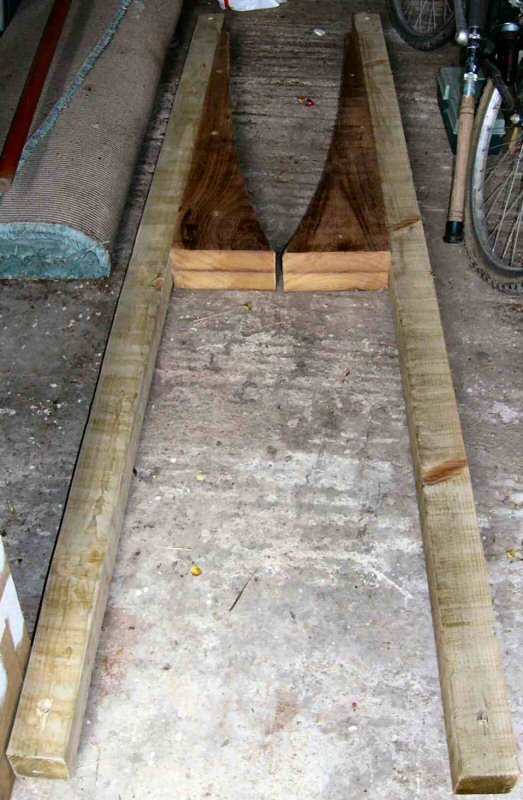
DIY legs for small long keeler?

Max,


However, without an attachment around topsides level, how is the leg going to stay positioned laterally ?

How about lines F&A (as per "Yachtlegs"), and maybe a notch in the gunwhales or pair of wooden blocks (or a combination of the 2) that the leg runs between. The F&A lines would also put in some inward pull.
 
How about changing the pin that holds the shroud to the chain plate with a longer one that the legs could go over like the bolts through the hull design but higher.

I use pre stretched lines for and aft to hold the legs I use on my boat in position vertically.
 
(cont.) Legs came in all shapes and sizes - from wooden fence posts to scaffold poles. Generally they stood about a foot above the gunwhale or maybe a little more to improve the angle to the chainplate. Footlines were used to stop them swinging fore and aft, but the only other constraint I have seen was to lash across to the handrail on the coachroof. It is this lack of security that makes the whole system unsuitable for anything other than short-term use with the leg positioned very carefully as the load comes to bear!

The only time I have used these legs, I hopped in and put some shores under the hull as soon as they would stay rather than float. The intention was simply to stay upright long enough to get the boat lifter into position.

I appreciate the difficulty that can be involved in getting at just the right spot to drill a hole! 18 inches of freeboard would be fine, though so long as you put a bolt through with an o-ring under the head when sailing. Some older boats had fittings which were threaded and had a cap which screwed down onto a gasket to close them off.

Rob.
 
Yes, thanks, I have seen the usual way of doing this, but I'd prefer to not put a hole in my 18" deep topsides, if there's a viable alternative, so given that, and in the search for such a viable alternative, what's the fatal flaw in hanging the boat off the chainplates?

The "hole" does not have to go right through permanently. You could bond a pad inside and out, with the inside one having a captive nut lined up with a hole through the planking. Machine a bolt to the right length and the leg can be attached from the outside. Without seeing the underwater profile of your boat difficult to say whether the chain plates are in the right location for and aft, but probabaly not critical if it has a long flat keel base.. Using the chain plates will put the same load through the topsides (if they are attached there) as through a block.
 
Thanks, all. It has got me thinking whether a bolt may be a possibility after all. The topsides are only 15mm thick in the 500mm space between bulkheads where the chainplates attach, the rest is 6mm, so without a lot of work in inaccessible lockers the bolt would have to be pretty close to the chainplates anyway. I don't think F&A position is critical - I've chocked the hull in various places and she's seemed pretty stable.

I'll sleep on it some more - thanks again.
 
I have hesitated from replying to this thread because I have only made legs which were used to keep the boat upright on a level slipway whilst waiting to be craned. I made them from ordinary wooden fence posts, added shaped bearers to fit the turn of the topsides and padded with carpet. They were attached to the hull by lashing to a suitably beefed up centre cleat, the leg was shaped at the top to ensure the leg could not slip through the lashing. The normal fore and aft lines stopped them tilting but I also added lines from the bottom of the leg that passed under the keel and up the opposite side to hold the leg close to the hull. They were a faff to fit but it was a once a year thing, they worked perfectly well for what was required. This was on a 28ft yacht that draws 3ft with a long, flat keel base.
If a suitable lashing point can be found it should be adequately strong and even add that tiny bit of flexibility to pevent topsides damage should there be a marginal bit of pounding. Didn't Wharram lash his cats together for that very reason?
legs.jpg
 
Thanks, all. It has got me thinking whether a bolt may be a possibility after all. The topsides are only 15mm thick in the 500mm space between bulkheads where the chainplates attach, the rest is 6mm, so without a lot of work in inaccessible lockers the bolt would have to be pretty close to the chainplates anyway. I don't think F&A position is critical - I've chocked the hull in various places and she's seemed pretty stable.

Sounds to me like you have most of the necesary backing in place already - just locate the legs midway between the chainpales on their 15mm backing (assuming that's continuous between them). I'd add another layer of ply on the inside between the chainplates, so creating further thickness and a gradual (albeit stepped) thinning from the bolting point to the 6mm hull.

I used to have legs like those shown in Zagato's photos on a long fin Hurley 22, but only ever used them for lifting in and out annually and winter storage. They fixed on with a captive bolt in the leg, through a hole in the GRP hull, through a glassed on (surprisingly small) ply backing pad with a captive nut. Fore and aft lines led from the small feet. (Main irritation when fitting them was the wooden legs wanted to float up and not stay still when I was trying to locate and screw in the bolt - metal feet might have helped weigh them down.) When the legs were not in use the hole in the hull was filled by a shorter screw of same thread onto the same captive nut. This stainless steel 'blanking screw' had a countersunk slot head, and was sealed against water ingress only by the remains of sealant on the back of the countersink that was on it when I bought the boat and seemed to seal perfectly until I sold it.
 
Top