DIY fit Volvo shaft seal

eddystone

Well-Known Member
Joined
18 Aug 2013
Messages
1,936
Location
North West Devon
Visit site
Getting extremely frustrated waiting to relaunch because of continued failure of engineer to do promised work, i.e. fit owner supplied shaft seal and investigate suspected faulty head gasket. Can't do anything about the latter but how difficult is it to do the volvo seal? Looking for explanation in ikea self assembly rather than engineer speak; level of skill? I'm Ok at undoing nuts and bolts and putting them back in reverse order but if it involves anything fancy to check shaft alignment I'm out. Also lack skills to diagnose why there is some reason it is spraying after less than 3 years (lips damaged when cutless bearing replaced becuase said engineer failed to use lips protector/crustacean action etc)
 
Replacing the shaft seal is easy. You may find the bolts holding the shaft onto the gearbox really tight though. If they're allen key screws, buy and use a hex socket, or you will risk graunching-up the screwheads.

When you remove the old seal, give the shaft a clean with metal polish and check it for damage and wear. If it is damaged or worn, you will either need to replace the shaft, or sometimes you can get away will not putting the shaft quite as far back into the clamp as it was before, so that the lips are bearing on a clean surface.

When putting the new seal in, don't remove the lip protector until everything is in and bolted-up (it can be a bugger to get it out thought, and you might need to use pliers on the tab to pull with).

Why is the head gasket suspect? What's the symptoms?
 
It's a fairly easy job, but it involves removing the shaft from the gearbox coupling. This can sometimes be tricky, but if your existing seal is only 3 years old the fixings should still be OK to undo. Once you've removed the old seal, offer the shaft back up to the coupling - this will help you to confirm that the shaft is central in the stern tube. If it isn't, you need to adjust the engine mounts to get it as central in the tube as possible, otherwise you'll put stress on the new seal and possibly reduce its life. It's worth checking that the area of the shaft on which the lip seals sit is as smooth as possible; any roughness will lead to premature wear of the lip seals. After fitting the new seal, remember to grease the lip seals.
 
Replacing the shaft seal is easy. You may find the bolts holding the shaft onto the gearbox really tight though. If they're allen key screws, buy and use a hex socket, or you will risk graunching-up the screwheads.

When you remove the old seal, give the shaft a clean with metal polish and check it for damage and wear. If it is damaged or worn, you will either need to replace the shaft, or sometimes you can get away will not putting the shaft quite as far back into the clamp as it was before, so that the lips are bearing on a clean surface.

When putting the new seal in, don't remove the lip protector until everything is in and bolted-up (it can be a bugger to get it out thought, and you might need to use pliers on the tab to pull with).

Why is the head gasket suspect? What's the symptoms?

Couldn't decide whether dampness on rear of engine was from gasket or leaking seal e.g. elbow connection so dried it all off, gave the engine a work out down S'Ton Water came back and checked - wet all around area of head gasket. Said engineer says he has ultra violet thingy to help detect. BTW no contamination of engine oil and no signs of overheating.
 
Just to add to the comment on the seal. Just do it, the more jobs that you can tackle (with the good advice from ) the less you will have to rely on expensive engineers. In an emergency you wil also have more chance of sorting things out as well.
 
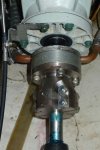
Sorry couple of questions arising from helpful responses above. Any idea which of the bolts in this photo need to be undone to release the shaft? Torque settings or just go by feel? If I put a vernier gauge on the shaft where the lips have been, what constitutes "worn needing replacement" from the original 25.4mm. I think my gauge can only read tenths of a millimetre.
 
Any idea which of the bolts in this photo need to be undone to release the shaft? Torque settings or just go by feel? If I put a vernier gauge on the shaft where the lips have been, what constitutes "worn needing replacement" from the original 25.4mm. I think my gauge can only read tenths of a millimetre.

You'd undo the bolts with the blue nyloc nuts to free the shaft. There may also be a pin securing it, which you'd need to drift out. It looks like you have an Ambassador Stripper fitted; remember to ensure that the cutter guide is properly located in the static part when you slide the propshaft back into position.
 
Sorry couple of questions arising from helpful responses above. Any idea which of the bolts in this photo need to be undone to release the shaft? Torque settings or just go by feel? If I put a vernier gauge on the shaft where the lips have been, what constitutes "worn needing replacement" from the original 25.4mm. I think my gauge can only read tenths of a millimetre.

To address your questions in turn that haven't already been answered:

1. When tightening the bolts you can just go by feel if you're reasonably experienced. By that I mean, if you're the type who regularly shears off or strips the thread off bolts because you have muscles like mountains and no feel for when it's tight, use a torque wrench. In reality and especially with nyloc nuts they shouldn't come undone in any forseeable circumstances so when it's tight it's fine. Try to make sure they're evenly tight if you can.

2. In terms of checking the shaft for wear. I would suggest you don't need a Vernier, you can check by eye. If the shaft has a groove any deeper than about 0.25-0.5mm that's considered worn. There may be a patch rather than just a groove where there is some wear, but you can polish it up to improve the surface with good metal polish and elbow grease (time, effort and patience). If there is a worn groove beyond the limits I've stated above, don't despair. Just make sure the shaft is inserted further or shallower into the coupling a little bit, so that the new seal sits on a slightly different part of the shaft and not the existing groove. That only needs to be a few mm different, so it's not going to have any effect on any other driveline components.
The main thing to ensure is that the new lip seal (where the groove is) sits on a fresh clean part of the shaft when you reassemble.
3. Make sure you apply plenty of proper Volvo grease before, during and after assembly. Don't wait until afterwards before greasing.
4. Make sure you re-grease every year. Did you do this previously? It could be one of the reasons why it hasn't lasted. The other reason could be, did you burp it on relaunching or on refloating each time after drying out? This is essential because the seal is water cooled. Unless you burp the air out it can get too hot and fail prematurely.
 
To address your questions in turn that haven't already been answered:

1. When tightening the bolts you can just go by feel if you're reasonably experienced. By that I mean, if you're the type who regularly shears off or strips the thread off bolts because you have muscles like mountains and no feel for when it's tight, use a torque wrench. In reality and especially with nyloc nuts they shouldn't come undone in any forseeable circumstances so when it's tight it's fine. Try to make sure they're evenly tight if you can.

2. In terms of checking the shaft for wear. I would suggest you don't need a Vernier, you can check by eye. If the shaft has a groove any deeper than about 0.25-0.5mm that's considered worn. There may be a patch rather than just a groove where there is some wear, but you can polish it up to improve the surface with good metal polish and elbow grease (time, effort and patience). If there is a worn groove beyond the limits I've stated above, don't despair. Just make sure the shaft is inserted further or shallower into the coupling a little bit, so that the new seal sits on a slightly different part of the shaft and not the existing groove. That only needs to be a few mm different, so it's not going to have any effect on any other driveline components.
The main thing to ensure is that the new lip seal (where the groove is) sits on a fresh clean part of the shaft when you reassemble.
3. Make sure you apply plenty of proper Volvo grease before, during and after assembly. Don't wait until afterwards before greasing.
4. Make sure you re-grease every year. Did you do this previously? It could be one of the reasons why it hasn't lasted. The other reason could be, did you burp it on relaunching or on refloating each time after drying out? This is essential because the seal is water cooled. Unless you burp the air out it can get too hot and fail prematurely.

May i just add something to your point number 1. As this type of coupling relies on friction between the coupling and the shaft for drive and thrust, the nuts and bolts you refer to do need to be tight enough to prevent shaft slip. Difficult to describe tightness in words.

Www.solocoastalsailing.co.uk
 
Agreed! Good point. As you say difficult to describe in words. I think most reasonably handy people can get the right feel for it, especially with experience. But as I said there are some who just shear or strip everything, because they keep tightening long after the fastener says it's had enough. Not putting a 4ft tommy bar on the socket and leaning with all one's strength helps to prevent damage...

Generally speaking for most nuts & bolts of 14-19mm size, arm tight with a standard 1/2" drive 200-250mm long ratchet handle is acceptable and you won't go far wrong.
 
You'd undo the bolts with the blue nyloc nuts to free the shaft. There may also be a pin securing it, which you'd need to drift out. It looks like you have an Ambassador Stripper fitted; remember to ensure that the cutter guide is properly located in the static part when you slide the propshaft back into position.

Gosh how can you tell the shaft has a Stripper from that photo? That's a complication I hadn't thought of.
 
As far as wear is concerned, as long as the shaft is smooth and round, it will be fine. If there are any hard edges or any nicks, then it's knackered.
 
Brilliant response - thanks; I've had a chat with Ambassador and not a big complication - just a question of aligning it when re-inserting shaft. If I can find torque settings for coupler I do have access t a torque wrench but probably difficult to find room to swing it.
 
Finally got round to this but bit stumped by the allen key screws going through the two flanges and thick spacer in between (with no nuts the other side - however they've stayed attached so far). My 8 mm allen key seemed to fit but I don't think there is any chance I got get enough leverage with that - it would probably just bend or even snap - do I understand you can get socket bits to use with a half inch ratchet handle? Are they Allen keys or are they called something else?

A more fundamental problem is is that the free movement of the shaft prevents any leverage being applied. Do you think it would damage the gearbox if I locked it in gear? Or is it better to somehow wedge the coupling?
 
Finally got round to this but bit stumped by the allen key screws going through the two flanges and thick spacer in between (with no nuts the other side - however they've stayed attached so far). My 8 mm allen key seemed to fit but I don't think there is any chance I got get enough leverage with that - it would probably just bend or even snap - do I understand you can get socket bits to use with a half inch ratchet handle? Are they Allen keys or are they called something else?

A more fundamental problem is is that the free movement of the shaft prevents any leverage being applied. Do you think it would damage the gearbox if I locked it in gear? Or is it better to somehow wedge the coupling?

Did previous install use loctite or similar and does the Allen key need longer handle? Or a medium size encourager

I did this job for the first time at the beginning of last season - went well and saved a load of money and had the satisfaction of knowing what was involved and seeing the shaft and so on for myself.

Also replaced the not totally satisfactory Volvo seal with a Radice seal, but a personal choice.

Good luck with the change.
 
Top