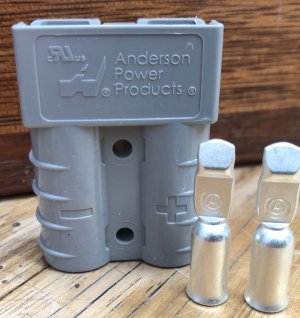
Dis-assembling Anderson plugs

Neeves

Well-Known Member
Joined
20 Nov 2011
Messages
14,231
Location
Sydney, Australia.
Visit site
Non Marine - but has marine implications

I have Anderson plugs on solar panels and the waterproof covers have deteriorated in the UV. I can buy new covers, different design, they seem to be silicone sleeves, but I need to disassemble the plugs to fit the covers. How do I free up the connectors in the plugs, without destroying the connectors nor the plugs.

When I wired the connectors I melted solder in the little cups and inserted the cables into the molten solder in the cups (a technique recommended here on PBO). This appears to be robust and shows no evidence of corrosion. If I could remove the connectors, easily, I should be able to add the protective covers and simply reinsert the connectors (on the end of the cables).

The connectors on the ends of the cable seem to be secured in the plug with a little spring clip. I suspect the spring clip needs 'lifted' to release the connector - just checking that its that simple. There is not much room in the plug to manipulate a small screwdriver and there may be a trick I'm missing.

Jonathan
 
It is that simple to release the connectors.

It is worth buying the genuine Anderson connectors; all the generic copies I have tried are rubbish. It is often not clear what you are purchasing.
 
Thank you

Confession time

I don't know that I have ever seen a genuine Anderson plug or I don't know that the ones I've used are genuine or not. I've used from different suppliers and they look indistinguishable from each other - and have never failed.

What makes a clone stand out?

They are desperately simple and simultaneously very clever.

Jonathan
 
The quality of the plastic and the thickness of the lugs is immediately obvious if you compare the genuine product with a generic copy. Unfortunately, all the products I have ordered from eBay or Amazon have been non-genuine.

My suggestion is to order a genuine Anderson connector from an authorised dealer so at least you know the difference.

The non-genuine products are much cheaper and may be worth consideration for non-critical applications, especially when the current draw is well below the specifications, but the housings are easily cracked if you accidentally step on them. Overall for marine applications I would only use the genuine products.
 
Last edited:
I've always just cut the connectors off and crimped them to long extensions. The mean time between services is 15-25 years, and there are junctions below deck. Fewer worries on-deck IME.
My panels came with Anderson plugs attached, I only had to make up the extension cables but the cables on the panels were stupidly short, maybe 15cm long. I need to have some form of water proof connector at the panel. I've found what look to be silicone sleeves, moulded to fit a 'male' and 'female' connector. The 'waterproof' facility is designed on the basis that one of the devices fits tightly into the other and the cable entry to each is a tight squeeze. The waterproof connectors 'look' to be what I need - but I need to take the Anderson plugs off the cables - hence the query about releasing the connectors (I've never had this specific need previously).

An alternative is a different means to make the Anderson plugs water proof.

I looked at Noelex link but weather proofing was not on the website

And I don't like Thinwater's crimp connector idea - melting solder in the little cup, small blow torch, and inserting the wires works a treat. However I could look at adding a longer cable to the solar panels but that means opening the waterproof junction box on each panel which may make the junction box on the back of the panel the weak link. It just moves the questionable connection rather than makes the connections water proof.

Jonathan
 
Maybe you didn't understand. Just cut the connector off and splice on more cable (crimp + heat shrink). Now you have a longer cable that will last as long as the panel. On my current boat, that meant I could feed the cable through the deck with a tiny pass-through instead of a hole large enough for the connector. The splice is below decks. I have also spliced above the deck, though.

I have also added the extensions from the panel box (last boat), but only if the box was fully amenable to that (rare these days).
 
The pins push in just look for the flat on the pin and the corresponding flat inside the plug. Then give a bid shove with a suitable sized screwdriver .
There a proper waterproof cconnectors for solar panels that are easy to get apart with a pair of long nosed pliers.
 

Other threads that may be of interest

Top