
Dinghy life-raft

pmagowan

Well-Known Member
Joined
7 Sep 2009
Messages
11,838
Location
Northern Ireland
sites.google.com
Could you make a tender into an effective life-raft? The threads on the standard type failing as in the case of the most recent tragedy make me wonder about their effectiveness. They appear vulnerable, uncomfortable, unable to be steered or propelled. They fail to 'go off' or do so upside down. Why could you not modify a tender for a circa 45' yacht to do everything and more. A tender can be rowed, sailed and motor propelled. You could have a small compartment on board containing tent poles, cover, drogue, flares etc. You could have a grab bag containing much more than a standard life raft. It could be towed or stored on deck in the standard fashion so that it is always available. A solid bottom would make it much more comfortable.
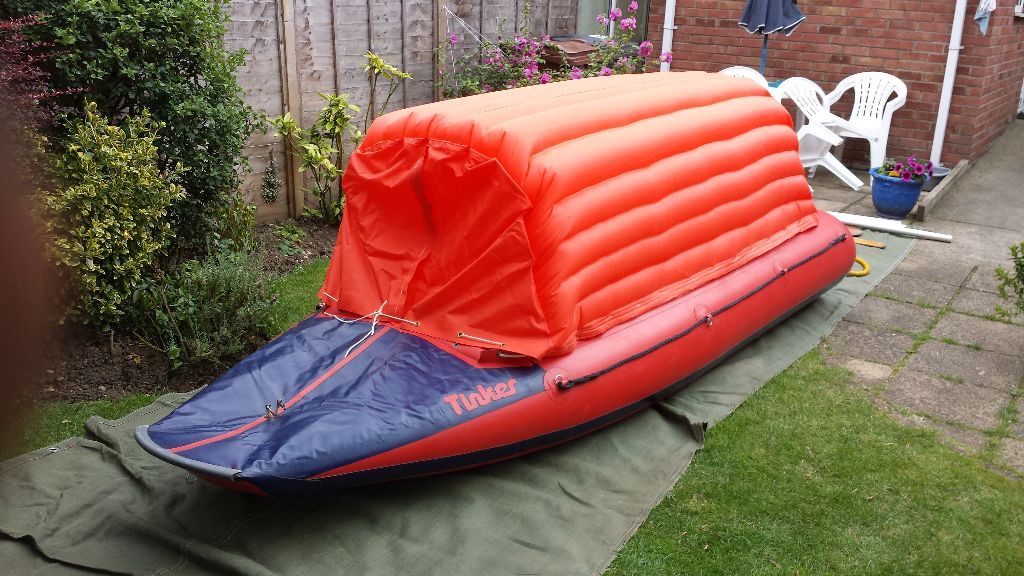
 
Henshaw inflatables used to make the Tinker range of inflatable dinghies. These could be configured to be life rafts. They were quite expensive and are no longer made. I guess this is what you call the market.
 
Could you make a tender into an effective life-raft? The threads on the standard type failing as in the case of the most recent tragedy make me wonder about their effectiveness. They appear vulnerable, uncomfortable, unable to be steered or propelled. They fail to 'go off' or do so upside down. Why could you not modify a tender for a circa 45' yacht to do everything and more. A tender can be rowed, sailed and motor propelled. You could have a small compartment on board containing tent poles, cover, drogue, flares etc. You could have a grab bag containing much more than a standard life raft. It could be towed or stored on deck in the standard fashion so that it is always available. A solid bottom would make it much more comfortable.

I have a rigid tender that has several compartments that I made sealed and added PET bottles as flotation at the bow and stern with a sealed center seat to store items into. I have now fitted a water proof cover with support hoops to allow water to run off.

Not designed to replace my like raft but by adding some fenders to the side and increase the height of the cover support hoops could be made suitable in and emergency together with a proper life raft that I have to have by law.

I often wondered is a "modified" wind surfing sail could be used from a life raft to allow some movement and direction control.
 
The two most obvious examples are the old Tinker canopy kit...

$_86.JPG


...and the current Portland Pudgie:

Portland-Pudgy-lifeboat-sailing.jpg


The Pardeys also regarded their dinghy as their lifeboat, with a home-made canopy and survival kit.

Pete
 
For fire or inundating water sinking then a regular un modified dinghy with grab bag is a major help, for a storm induced sinking then you're probably dead but a liferaft would keep you alive if you could get into it, even a modified dinghy would be utterly useless.
 
As others have said - Henshaw used to be able to adapt their (very capable) inflatables to act as a liferaft with self-inflation and a canopy. I looked into this, but eventually decided it was a compromise too far. The self-inflation and canopy kit would rather get in the way when used as a tender, and it is much bulkier and heavier than a liferaft, making it potentially harder to deploy.

On top of that the cost was as great as a dedicated liferaft.
 
An Avon with a surprisingly small amount of water in it is very stable. But I agree it would only be a short term solution for one or two.
Circa 1975 I had a fire on my Stella mid Nieuport to Burnham & the speed at which my 2 crew pumped up the Avon ( stowed 50% inflated on the cabin roof)had to be seen to be believed. Fortunately the third fire extinguisher put the fire out so I was able to persuade them to get back on board. But they insisted we towed the dinghy rather than deflate & stow.
 
Many people have tried it but never very satisfactory as the compromise to get enough buoyancy, capable of surviving inversion, hold people and emergency rations and, most importantly fire instantly is just to much. Many of the failures are in deployment, not failure once in use (at least for short periods) and if you want instant deployment you need the same systems that are dodgy on conventional liferafts. Stowing the thing where it can be easily deployed is also problematic.

What has been useful in some circumstances is taking an Avon (or even a rigid dinghy) with you as well. However this only works if you have time and relatively benign conditions whereas most deployments are in extreme conditions such as weather or collision when it would be difficult to launch anything other than a liferaft.

BTW the Henshaw product which was arguably the best attempt failed because it was a lousy liferaft (could not meet the basic standard) a poor dinghy and more expensive than a good dinghy and a raft.
 
The point about a survival is exposure, which killed many of the 35000 or so merchant seamen in WW2. Theory says that after twenty minutes in a closed raft the atmosphere is saturated and you stop losing heat through evaporation. Nothing to stop you cobbling something together as above suggestions, but choose your survival situation carefully.
 
I recall in that Avon inflatables used to offer inflation cylinders as an option for emergency inflation which we carried for many years and provided an alternative in event of fire to frantic pumping
 
Was the OP thinking hard boat or inflatable? Still needs to be rightable. Needs to be able to float swamped. If you can crack that and get into from the water... The shelter becomes the easy bit, as you say fibreglass tent poles and some lightweight fabric...infact on a mountain side in a survival situation you don't need poles and in 15mins will want to remove the shelter as you get too hot!
 
I recall in that Avon inflatables used to offer inflation cylinders as an option for emergency inflation which we carried for many years and provided an alternative in event of fire to frantic pumping
I had one of these, Redstart IIRC, but it was ancient and I wouldn't want to rely on it inflating in dire need. You also had to connect/ disconnect the cylinders after dinghy use.
 
The reasons for carrying a life raft vary. For many it is a mandatory requirement but for those who think they need an LR for safety (as an option) then the situation changes. Unlike the example of WW2 sinking victims the most likely need for abandoning ship is fire. This can happen in benign conditions or in a storm. In any other emergency conditions staying with the boat might be the best option. Generally a LR has more people capacity for its size as well as providing shelter and hopefully resistant to capsize or rightable. An inflatable dinghy might be useful for dual purpose. I expect better than nothing in a fire. Somewhat popular around here some time back was a hard plastic injection moulded dinghy with hand hold ropes all around. Unsinkable but with quite limited capacity for people. I don't know if it was given credit as a lifesaving device (float) for commercial purposes. Quite heavy as a dinghy. Came in various sizes.
Anyway bottom line is you buy a life raft if it is mandatory. You make your own choice if it is not. olewill
 
I recall in that Avon inflatables used to offer inflation cylinders as an option for emergency inflation which we carried for many years and provided an alternative in event of fire to frantic pumping

A bit of googling suggests that an Avon Redstart at 8'2" probably has a 6m x 0.3m tude around it. That's about 1.7cu m of volume or 1700 litres. The pressure required above atmosphere pressure probably another couple of PSI so 1.25 bar. Add a fudge factor for the air that will be lost during the inflation and you are talking a 10 litre diving cylinder charged to 232 bar, so 2300 litres of air. That is quite a large object to store on board and will weigh about 11 kgs. We keep a smaller 5L dive cylinder on board for emergencies if I have to go for a dive but a larger cylinder would get in the way.
 
I was thinking of perhaps a hard tender. It could be unsinkable in that it would have perhaps a foam core and floatation chambers. It could certainly beat a life raft on being controllable. The only concern would be how it handles very rough conditions. From my research life rafts do this quite poorly but you are at least in something akin to a zorb inflatable ball.

I am thinking about this because I have become more and more convinced that a life raft is an unnecessary temptation to abandon ship. Survivability seems to be poor in them and in most cases the reason for abandoning ship could have been foreseen and prevented. The reasons for needing to abandon ship seem to fall into two categories;
1) Sinking
2) Fire

Sinking further divides into two categories;
1) holes that already exist (through-hulls etc)
2) holes caused by collision

I think holes that already exist can be designed in such a way as to give virtually no risk of sinking. They can be contained in watertight compartments, bilge alarms, bungs, etc
Collision can be mitigated by watertight bulkheads, crash bulkheads, double skin under waterline, strong construction, floatation chambers.

Fire can be mitigated by good detection systems and extinguishers, not to mention reducing the risks by having good electrics etc.

With each of these things the need for a life raft is reduced but some reasonable method of abandoning ship may be required which makes me think the tender might be a good solution once modified.
 
A bit of googling suggests that an Avon Redstart at 8'2" probably has a 6m x 0.3m tude around it. That's about 1.7cu m of volume or 1700 litres. The pressure required above atmosphere pressure probably another couple of PSI so 1.25 bar. Add a fudge factor for the air that will be lost during the inflation and you are talking a 10 litre diving cylinder charged to 232 bar, so 2300 litres of air. That is quite a large object to store on board and will weigh about 11 kgs. We keep a smaller 5L dive cylinder on board for emergencies if I have to go for a dive but a larger cylinder would get in the way.

I suggest that you have over calculated the volume -but putting that aside -how does that volume compare with a 4 man liferaft.
An Avon is only inflated to a max 3PSI & one assumes a liferaft is similar
 
Last edited:
Many people have tried it but never very satisfactory as the compromise to get enough buoyancy, capable of surviving inversion, hold people and emergency rations and, most importantly fire instantly is just to much. Many of the failures are in deployment, not failure once in use (at least for short periods) and if you want instant deployment you need the same systems that are dodgy on conventional liferafts. Stowing the thing where it can be easily deployed is also problematic.

What has been useful in some circumstances is taking an Avon (or even a rigid dinghy) with you as well. However this only works if you have time and relatively benign conditions whereas most deployments are in extreme conditions such as weather or collision when it would be difficult to launch anything other than a liferaft.

BTW the Henshaw product which was arguably the best attempt failed because it was a lousy liferaft (could not meet the basic standard) a poor dinghy and more expensive than a good dinghy and a raft.

Must look for the table I saw recently where the tramp compared quite well to dedicated life rafts. We are still considering a tramp, as a tender, as a bit of fun with sails and as a something better than standard tender when fitted with the liferaft kit.
Yes you have to prepare it before hand if you may have to deploy as a raft in a hurry but it could work as a compromise and you only need to store one item. If you are using the tramp regularly as a tender you also KNOW it will inflate!
 
I suggest that you have over calculated the volume -but putting that aside -how does that volume compare with a 4 man liferaft.
An Avon is only inflated to a max 3PSI & one assumes a liferaft is similar

Is the CO2 in a liferaft bottle in liquid form? I have no idea, but I assume that would take up much less space than the same amount as gas, and I believe the pressure needed for CO2 is not excessive.

Pete
 
Top