Difference Dyneema versus Polyester Halyard in real life

Could you further extend the life by swopping the rope end for end? Or would that just be too much hassle?
Yes you could, but remember that after 10 years of cutting off the ends, you only have a proper length halyard left, so you would only get 1 extra year by swapping ends. And the only way to swap ends it to run a new line in place, then pull the old halyard through. I figure that after 10 years I've gotten enough life out of one lonely rope.

Can anyone comment on tying knots in Dyneema?
It might lose strength, but believe me that Dyneema is strong enough that you'll never break the halyard.

What can happen in unsheathed dyneema is it will slowly slip through the knot as it is so slippy though there are it's which get round this.
There is a particular knot that I use that does not slip. I only have 1/2" of tail on the knots that I have in place and they've never slipped. Of course if you are worried about it then just put a stitch through the knot. I can't think of the name of the knot and after years of doing it, I still can't tie one without looking at the previous knot. However I'll tell you that it is a knot that is not meant to be untied easily (like a bowline). It is meant to be permanent and difficult to untie. I cut them off each year.
 
I was discussing this today with an Oyster chap and they supply polyester ouch, spending that money 'nothing but the best springs to mind' ! Not sure why wire is not a stabdard. Low end dynemma was the suggestion
 
I really cannot understand why people refer to "only cruising" or "performance" sailing when talking about sail set.
Why should not cruising sails be as good as a decent performance sail - sailing is what it is all about & why people say they will accept carp sails because they only cruise defeats me. I do not race but always invest in good quality sails. I am on my 5Th jib in 11 years & as soon as it goes off I change it.
As for halyard stretch, I had polyester with my original standard sails supplied with the boat. As soon as I installed a decent mainsail I could see creases from clew to 1/3 rd way up the mast come & go as I sailed in puffy wind. To me dynema halyards are just a part of a decent sail package.
But one only has to look at some of the bags people hoist to see that they care nothing about sail set
The OP could change to 8mm dynema - it can support 4.5 tonnes so will easily hold a mainsail of up to 35M2 ( He did not say how big his main is) If the jammer slips either leave the tail on the winch or stick a slip knot in the line immediately behind the cleat. Pull it out with the winch when wanting to adjust
 
You'll save a lot of money in the long run if you buy your new halyards 10' longer than necessary. Then every year or two cut off the shackle end by 1' and move the shackle up to the new position. Don't bother with splicing the shackle to the end of the halyard; just tie it on. This will move all of the wear points on the halyard, so the whole thing will last for years and years. You won't mind the extra cost of Spectra if it is spread over 10 years. .

+1 and wash the halyard every year.

But on the mainsail I use a bowline. The other reason for a bowline is because having a shackle or halyard knot on the end is right pain when hoisting someone up the mast or for Man Overboard rescue.

I have braided sheathed dyneema/spectra stuff on the main halyard and plain cruising halyard braid on the genoa. The difference is quite marked in use. But was I reducing costs when I bought the Genoa one. Also I have a bendy mast on a fractional rig so wanted a little give in genoa halyard in case I screwed up on the backstay tensioner adjustment sequence, though not sure of the value of this yet. However I do notice the ordinary cruising braid on braid is somewhat easier to coil so for example if you winches at the mast base then stowing the loose end coil on cleats or winches is maybe quicker, neater and more secure with cruising braid.
 
Last edited:
Dyneema for Main halyard is in my book a priority.
Its not the stretch that occurs from pulling the sail up that's the issue but rater the stretch that applying mainsheet tension and kicker does plus it also stretches with each gust twisting off the leach and losing you lots of power and pointing.

If you have a furler spar then its aguable whether you will gain much performance difference with a dyneema halyard but it certainly won't harm it unless you tend to over tension the jib halyard.
If you use hanked on jib or your jib halyard essentially replaces the forestay when its up then Dyneema is a must.

Spinny halyard can be braid on braid as I don't see much benefit for dyneema other than you could use a smaller dia and save weight which is not much of a factor in a cruising boat.

Topping lift you could consider using 4mm dyneema tapered to 8 or 10 mm at the mast exit which avoids having heavy rope bouncing around the leach all the time.

Splicing the core on dyneema and whipping the cover is my favored method for halyard ends rather than knots, stronger and neater.
Remember for Braid on Braid 50% of the strength is in the core and 50% is in the cover.
With Dyneema 95% of the strength is in the core and 5% is in the cover.
 
I used to have a 14mm braided polyester / 6mm wire combination halyard. There was no problem with stretching (only wire when sail was up) nor with creep because the poly tail was made fast to a cleat beneath the halyard winch.

When I changed it last year I opted for 8mm Liros Regatta cruising Dyneema and I don't regret it.

There is quite a difference in weight between 14 metres of Dyneema and 14 metres of 6mm stainless wire up the mast.
 
If you apply tension to the halyard when first hoisting the sail, you'll take all the stretch out of the rope. People have talked about the stretch ratios of dyneema v polyester but the difference that this would make will simply be in the amount of tension you apply to the halyard: dyneema with its lower stretch values will require less tension than polyester. The tension in the luff when setting the sail should remain a constant unless it is the luff that is stretching, not the halyard. Then there is the bend or otherwise in the mast to consider, which may have an effect on luff tension. Both factors independent of the materiel that the halyard is made of. The advantage I can see in dyneema is weight (marginal at best) and lower friction through the various pulleys and sheaves: not worth the money in my opinion.
 
If you apply tension to the halyard when first hoisting the sail, you'll take all the stretch out of the rope. People have talked about the stretch ratios of dyneema v polyester but the difference that this would make will simply be in the amount of tension you apply to the halyard: dyneema with its lower stretch values will require less tension than polyester. The tension in the luff when setting the sail should remain a constant unless it is the luff that is stretching, not the halyard. Then there is the bend or otherwise in the mast to consider, which may have an effect on luff tension. Both factors independent of the materiel that the halyard is made of. The advantage I can see in dyneema is weight (marginal at best) and lower friction through the various pulleys and sheaves: not worth the money in my opinion.

Sorry but think you have got this wrong. Of course the luff of the sail stretches if you put more tension on the halyard to try to counteract its stretch. And over tight luff is rubbish for sail set in light and medium conditions.

Javelin's post is on the money it's about keeping constant tension.

The ideal (if not for cruising reliability) is a halyard lock at the masthead - keeps the head of the sail in an absolutely constant place, with no tension on the mast. Then sail shape adjusted by the Cunningham.
Very low stretch halyard is next best - gives precise control of head position without needing excess tension
 
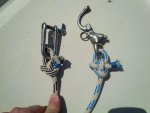
Halyard Knots.jpg
Here is the knot I use on the halyards. The one on the left was put in two years ago. You can see no slipping of the knot. The one on the right was put in this afternoon. I use this same process on my Dyneema main and jib halyards, as well as on my poly spinnaker halyards. Cut them all today.
 
Last edited:
I sail an average 100% cruising center cockpit of 36 feet. The genoa and mainsail halyard need to be replaced. The choice is between a regular pre stretched polyester line and a dyneema one. I know all about the difference of stretch between the two different materials in theory. But what difference can I expect between 12 mm polyester or 10 mm dyneema halyard in real life. Is the difference notable in the shape of the sails? Have anybody practical experience with this?

Yes. I prefer the dynema because I am an inveterate sail tweeker. But if you are the typical cruiser sailing in a relaxed fashion with Dacron sails at 10 years old and long out of shape, its not worth bothering. In fact thats really the issue - no point at all in dynema halyards and old Dacron sails.
 
To the OP,
get Dyneema - even for cruising .....unless your sailboat is really a motorboat with a mast.
ie if you enjoy sailing at all, don't settle for anything less than Dyneema. The cost is worth it. Stretch is a curse.
 
>I've never had noticeable halyard stretch, ever.... If I were so concerned about sail shape, I'd rather spend the money on better sailcloth.

I agree we had Polyester halyards for the genoa/Twistle rig, main and mizzen in 2,935nms over the Atlantic we never had to tighten any of the halyards. On the latter point I also agree that's why we had Hood sails no stretch after 10,000nms.
 
>I've never had noticeable halyard stretch, ever.... If I were so concerned about sail shape, I'd rather spend the money on better sailcloth.

I agree we had Polyester halyards for the genoa/Twistle rig, main and mizzen in 2,935nms over the Atlantic we never had to tighten any of the halyards. On the latter point I also agree that's why we had Hood sails no stretch after 10,000nms.

With the greatest of respect, I would suggest that if you have sailed 10000 miles & not adjusted your halyard ( apart from reefs, drops & hoists I assume) you really do not understand the effect of tension on the sails. So that would suggest that your comments are without informed basis so should not really be taken as expert advice just because it suits you.
But with 10000 miles under the belt it does suggest that you are a sailor of some ability -just one who has other priorities
 
OK, I've got a slightly different question: How long will uncovered Dyneema last? I've just replaced my halyards (previously wire) with dyneema, with the covers stripped off. I could run the halyards up (with a retrieving line, of course) when we are not sailing much, such as in the off season, and this would put the dyneema inside the mast and protected from the sunlight, but it is a hassle. Will these halyards last 5, 10, 15 years when exposed to nearly constant sunlight? What are other people's experience with this. I live and sail in Mexico.
 
>I've never had noticeable halyard stretch, ever.... If I were so concerned about sail shape, I'd rather spend the money on better sailcloth.

I agree we had Polyester halyards for the genoa/Twistle rig, main and mizzen in 2,935nms over the Atlantic we never had to tighten any of the halyards. On the latter point I also agree that's why we had Hood sails no stretch after 10,000nms.

If you had any understanding of sail shape you would realise that stretchy halyards do spoil the set of the sail.
8 years ago I changed from a Doyle to a much better Hyde main & until I changed to dynema halyards I could see the effect of the old ones stretching & spoiling the shape of the better sail.
The stretchy old Doyle sail hid the effect & i suspect the same was happening with your Hood sail. I bought Hood many years ago & felt it was very poor. I quickly changed it to a locally made Cranfield & Carter which was infinitely better
 
Last edited:
I find the most important halyard is the mainsail. Tensioning the halyard when raising the main only to have it go slack as the wind picks up a little is far more likely with non dyneema. I have run dyneema for 15 years on my main halyard to minimise this effect. The original 10mm dyneema I purchased 15 years ago is still going strong on my next boat as a mizzen halyard. It seems to stay softer on the hands than any other line on the boat. I am not a racer but wouldnt dream of using anything other than dyneema on the mainsail. Trim is so much easier and predictable.
 
Why is it more important to use dyneema ln the main halyard?
On my 30 year old sails I haven't noticed a problem with polyester halyards but I have a new genoa as yet unused and a new FB main on order both in premium dacron so plan to get dyneema main. Is it worth replacing 2 year old pre-stretched polyester genoa halyard I wonder?
 
Top