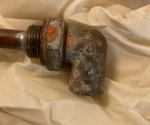
diesel tap - thread identification

Crazy-Diamond

Well-Known Member
Joined
27 Mar 2019
Messages
175
Location
Essex. UK
Visit site
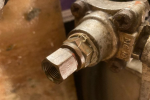
Hello everyone. I am trying to identify this thread, as I intend to replace the fitting with a brass hose tail, and clamp new rubber diesel hose to it, rather than using this old copper pipe, the other end of which is the wrong fitting for my new Racor filter.
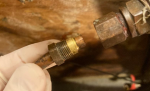
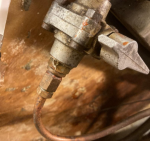
1609412417758.png 1609412456849.png

The outside of the threads measures 12.5mm. I wish I had been trying to identify this when I was able to get on the boat, as I would have measured the diameter of each end of the threads. I think that the fitting is tapered, and my measurement was taken in the middle of the threads. 1/4 BSP dimensions are max 13.5mm and min 11.45 - so I think that is what it is.

Could anyone offer an thoughts on this? Also, this existing fitting has a copper pipe with brass (I think) o-ring, would a fitting like this work OK? Or do I need some kind of brass o-ring too?
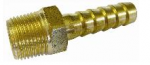
1609412756109.png

Many thanks.
 
Most likely BSP at 19 tpi, although 1/4" NPT at 18 tpi is a possibility. The "brass O-ring" is usually called an olive. The type of joint is called a compression fitting. I'm surprised that the male thread is tapered though. The seal should be created by squashing the olive, the taper will inhibit that.
Could you remove the brass fitting that screws directly into the valve and fit a suitably threaded hose-tail in there with one less joint?
 
I was wondering about removing the first fitting and having one less joint, always a good thing.

1609416568765.png

There are actually two fittings before the metal body of the tap itself.

I agree that a tapered fitting would have no need for the compression olive, I'll have to double check and see. If a fitting is sold as "BSP" but not specifically identified as parallel or tapered, what is the default? I've placed an order for some fittings I need for other maintenance, so I added a couple of brass fittings which are cheap enough to try out and see. The Racor uses NPT 1/4, so I will be able to try one of those hose tails on it as a test too.

How lovely it would be if fittings were marked in some way!
 
Yes, the Racor is NPT, it is the fitting going into the tap in the pictures I am trying to identify............

It is a 1978 Moody 30, I don't know if this tap is the original, but it certainly isn't a recent addition.
 
Most likely BSP at 19 tpi, although 1/4" NPT at 18 tpi is a possibility. The "brass O-ring" is usually called an olive. The type of joint is called a compression fitting. I'm surprised that the male thread is tapered though. The seal should be created by squashing the olive, the taper will inhibit that.
Could you remove the brass fitting that screws directly into the valve and fit a suitably threaded hose-tail in there with one less joint?
I agree. If it is a compression fitting with an olive and is tapered then it has been bodged and needs sorting out. I suspect that such a combination has never been used in an original fitting as it would be the worst of both cases.

Richard
 
What EB said . messing around with a hose tail into what is a compression fitting is not a good move.
Remove the fitting directly from the tap , find out what that thread is and fit the correct size hose tail direct into the valve body with a suitable sealant.

regards Clive
 
Most likely BSP at 19 tpi, although 1/4" NPT at 18 tpi is a possibility. The "brass O-ring" is usually called an olive. The type of joint is called a compression fitting. I'm surprised that the male thread is tapered though. The seal should be created by squashing the olive, the taper will inhibit that.
Could you remove the brass fitting that screws directly into the valve and fit a suitably threaded hose-tail in there with one less joint?

I think the OP has confused you. The original fitting (top left pic) has a parallel thread, the brass hosetail with the tapered thread is something the OP is possibly proposing, which, as you say, wouldn't work.

I'd go with your suggestion of fitting a suitable hosetail straight into the tap.
 
Ah! The missing R was the key. Norgren Enots looks interesting.

Air Cat Ltd - Product List - ITM Metric & Imperial Compression

1609504478757.png
Perhaps it is one of these, maybe? Anyway, it can go!

Thank you for the identification, how amazing a forum like this can be when you get this kind of knowledge, perfect.

I will remove the fitting into which this compression fitting goes, and hopefully get a hosetail to fit directly into this.

The engine is a Yanmar 3GM.
 
Did you know that Enots is Stone backwards? Originally in Aston, Birmingham (near my old school).
Although it wasn't a school fo dyslexics :)
Just thought you'd be interested!.
 
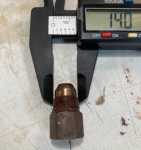
I have removed the reducing fitting from the tap, and the bafflement continues. This measures 14mm OD (the micrometer is resting on the worktop, so it does not look like it lines up, but it does).

1609671845633.png

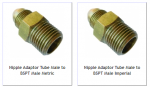
It looks similar to these fittings from here

1609671970797.png

but there is nothing anywhere near an OD of 14mm - which is nearly 9/16. I've been searching for BSP and other thread sizes, all over the web, but nothing appears close.

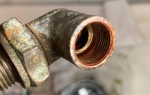
I'm thinking of replacing the entire diesel cut-off tap now. This is the view into the pipe at the top of the fuel tank. This is the exact same fitting, so I still need to identify what this is.

1609672204953.png 1609672174775.png

I have not found any compression washers in these connections, just ancient PTFE tape that was falling apart, and even some lumps of PTFE in the pipes themselves. I will be using Locktite 577.

There is this logo on this fitting, does anyone recognise it?

1609672532168.png
 
I was having trouble finding a fitting for a new fuel filter. Eventually I asked the yard engineer, a very experienced guy. His reply was that he kept a box of assorted fittings and just kept trying until he found a match. So it seems like it's a common problem.
 
Metric pipe threads are used, but they don't seem very widespread in "our" applications. M14 x 1.5 mm pitch is not impossible. Is the valve marked with any identification? A new valve might be the simplest solution.
 
Top