[70521]
Well-Known Member
Gravity is only one of the forces at work in a tank of fuel in a vessel on water.Why?

Gravity is only one of the forces at work in a tank of fuel in a vessel on water.Why?
So?Gravity is only one of the forces at work in a tank of fuel in a vessel on water.

Your understanding of the Laws of Gravity are not the same as mine. However, if the dirt or water gets into the sump, whether the boat is moving or not, the sump has achieved its purpose, and the dirt/water can be drained out.

The fuel tanks on my boat have dirt/water sumps. I check them regularly, and occasionally get some grains of dirt or signs of water.
I sometimes sail in quite rough conditions (West Coast of Scotland) but the movement of the tanks and their contents is never going to be similar to shaking a bottle.
If you have found something which "negates gravity", you should quickly patent it, and make a fortune. Next, perpetual motion.
Anyway, the sumps on my tanks work for me, and I'm not going to get into an unnecessary argument about it.
You have your beliefs. I have mine. That's OK with me.Because you of course drain / check when boat is sitting nicely on its mooring / in a marina ...
I doubt very much you ever do it in a seaway !!
Nothing to do with your "If you have found something which "negates gravity", you should quickly patent it, and make a fortune. Next, perpetual motion" and the smiley at end doesn't alter the fact of your being wrong !!

That's not quite right. Sediment will be picked up off the bottom of the tank by the agitation of the tank in rough weather. Have you ever noticed how many boat gets engine failure due to blocked filters when the weather turns a little bumpy?The fuel tanks on my boat have dirt/water sumps. I check them regularly, and occasionally get some grains of dirt or signs of water.
I sometimes sail in quite rough conditions (West Coast of Scotland) but the movement of the tanks and their contents is never going to be similar to shaking a bottle.
If you have found something which "negates gravity", you should quickly patent it, and make a fortune. Next, perpetual motion.
Anyway, the sumps on my tanks work for me, and I'm not going to get into an unnecessary argument about it.
The OP is talking about the diesel bug not 'some grains of dirt'.The fuel tanks on my boat have dirt/water sumps. I check them regularly, and occasionally get some grains of dirt or signs of water.
I sometimes sail in quite rough conditions (West Coast of Scotland) but the movement of the tanks and their contents is never going to be similar to shaking a bottle.
If you have found something which "negates gravity", you should quickly patent it, and make a fortune. Next, perpetual motion.
Anyway, the sumps on my tanks work for me, and I'm not going to get into an unnecessary argument about it.
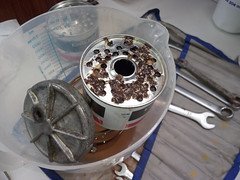
That's not quite right. Sediment will be picked up off the bottom of the tank by the agitation of the tank in rough weather. Have you ever noticed how many boat gets engine failure due to blocked filters when the weather turns a little bumpy?
I did some design work on large diesel storage tanks a while ago and we looked at many different ways to clear up sediment from the bottom of tanks where we were storing large quantities of fuel for diesel standby generators. Polishing doesn't work because in stationary tanks you need a scouring velocity on the bottom of the tank to help disturb the sediment so the polishing pumps can actually pick it up. Otherwise, the polishing system just circulates the clean fuel above the sediment layer. A bouncing boat is a great way to ensure you engine filters pick up the sediment.
A have a 6 month routine of vacuuming the bottom of my tank. I insert a copper pipe through the inspection port and suck the dirt out of the sump, through a filter and back in to the tank. It works well
How did they test?Going back to the original question.. Every sample of fuel taken (often..) showed no sign of bug.
But they could drain the tanks and leave them empty and connect a small portable tank (like an outboard) and run from that. Main tanks you still be there if ever needed in the future without the uncertainty of what might have grown in their hidden depths.The idea of 'getting rid of the tanks' is a non starter. They are part of the structure of the boat. It is 80x 20ft and kept in A1 condition.

StartRon (Starbrite) and Soltron have products quite clearly labelled as enzyme based. I haven’t studied the whole range of products but the enzyme ones are usually quite clearly labelled as such. Refuelers advice is consistent with a my first mate who spent years treating and tests tanks in the refineries and distribution depots. They will add small amounts of biocide (not enzyme based) preventative measures but sometimes it doesn’t work and then they will add enzyme. The enzyme costs more so isn’t routinely added to tanks with no contamination. Your incoming diesel probably still has trace biocide levels from its life in the distribution network unless it has been sitting for a while or in a contaminated tank. If you put biocide in already significantly contaminated fuel you are too late. For small tanks (<1000L) it is cheaper to just dose with enzyme than pay for microbiological testing. They decide which to use based on routine testing, but they are aiming to adjust doses or switch treatments long before “symptoms” or visible contamination. Enzyme alone may not completely solve a problem and stop it coming back. A fuel polisher on its own definitely won’t - you will always leave some organisms in the tank waiting for the perfect conditions to bloom. The aviation industry are particularly sensitive to contamination (for obvious reasons) but the biggest problems come from tanks that sit doing nothing like backup generators.Without asking for your endorsement does Startron qualify as an enzyme treatment? And do you think there is anything better that a normal yachty could buy in the chandlers?


Great mail, thanks. How much Enzyme for say a 100 ltr tank?I have been saying this for years and few seem to get the point of my posts ... they carry on using Bug treatment XX and then wonder why their filters are blocked solid ...
Most treatments out there are designed to kill just a the few bugs that get into your system when refilling. What they do - is to kill the bugs .. which then drop to bottom tank. Repeat enough times and you end up with sludge in tank bottom + the naturally dieing bugs ... this can then get sucked into fuel system and bingo - fliters clogged up.
I have recc'd many times that for real effective treatment - you need Enzyme based that not only KILLS but then also BREAKS up the dead bugs and sludge to allow it to pass through filters and get burnt in the engine.
Fuel Polishing is only a 'band-aid' as it is only filtering out crud ... its not curing or solving any other part of of this problem. Syphoning off and standing fuel will do just the same as some fancy pump and pipe affair ..
The problem for such as Post #1 ... the problem has been allowed to accumulate .. to then be a major undertaking to solve. Emptying of tanks ... removal of sludge in bottom ... treatment and if you have it - filtering of the removed fuel into clean containers. Let stand with an Enzyme treatment .. syphon off clean fuel - leaving crud in containers .. heavily dose this fuel again with Enzyme treatment and put back into tanks .... let the Enzymes do their work ...
Have at hand a couple of filters - as you most likely will clog a filter ... DO NOT KEEP engine plugging away if filter is clogged ... you may open a bypass and then it will clog the injection pump intake ... CHANGE filter at reasonable interval ...
Once the tanks are reasonably clear - then you can use your usual treatment ... but I would suggest that Enzyme treatment is used once or twice a year .. or each time preferably .. this should then help keep your tanks clear and engine running well.
Because I am in the Fuel Business - I will not endorse a brand name ... all I suggest is that you check details and specs of the treatment before buying.
...How much Enzyme for say a 100 ltr tank?
It's not surprising that diesel bug is so widespread these daysYes Startron is Enzyme based ....
If I cannot get my usual - I will buy Startron.
Years ago - when Soltron was being marketed out of Ch Isles ... I was asked to test and support Soltron ... I declined as it would be unprofessional and could lead to conflicts for my Labs.
I will pass on something - but please do not ask me to expand on it ...
It is not unusual to 'sound' storage tanks in transit terminals - (not the small terminals you guys see ... I'm talking about the large terminals that are filled ready to load out to ships) - and find a layer of dead bugs covering the tank bottom .... in some cases I have seen 30 .. 40cms deep.
Some tanks are dosed - but many are not. The onus on dosing lies in the Sales Clause of the shipment ... which is where I come in and may have to test and recc'd the dosing.
Generally in Europe / industrialised developed countries - the throughput of the terminals is sufficient to keep the problem to a minimum.
How long is fuel in transit / storage ? If the refinerys still have space to transfer into - then it can be months or longer ... while traders wait to see market pricing trend.
I shall now leave y'all to contemplate !!